
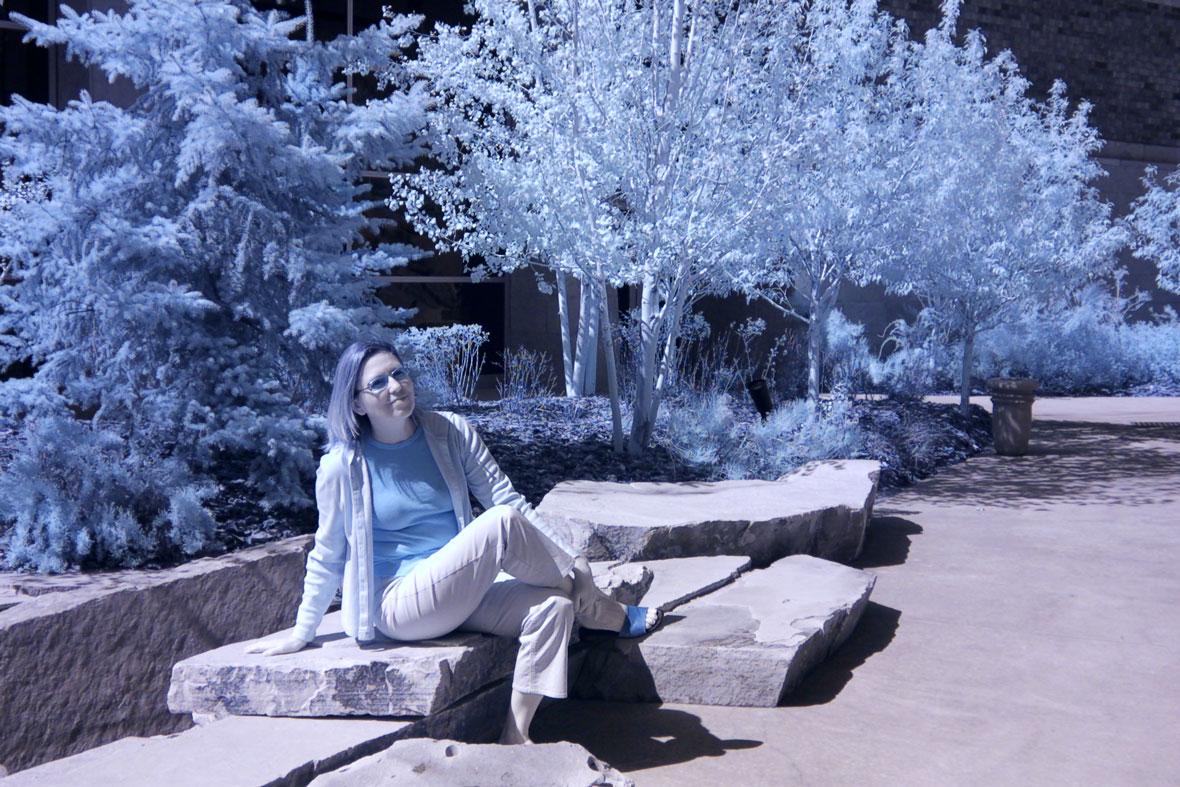
In a past #monochromemonday post, I’ve featured portraits, well today’s features an infrared environmental portrait of my wife Mary that was made at an outdoor Colorado shopping mall.
Today’s Post by Joe Farace
If your digital camera is not IR sensitive there are options other than filters for shooting infrared, including converting your camera into an IR-only DSLR or mirrorless camera. A few years ago, I did a video on IR Camera Conversions for my YouTube channel, Joe Farace’s Videos. You might want to check it out when you have time.
As Captured, Then as Monochrome
 After conversion your camera becomes a dedicated infrared camera; You won’t be able to shoot conventional images with it. That;s why I suggest you convert one of your older digital cameras that may just be sitting around collecting dust. Converting a camera is not inexpensive and, after conversion, it will then only capture IR images. It won’t become a thermal camera, in case you want to see how well your home’s windows are sealed.
There are many advantages to using an IR-converted camera: First, there’s no need to place an IR filter on the lens, so you won’t need tp pay for what seem to be en ever increasing price tag for those filters. Second, because there’s no on-lens filter, the viewfinder is just a s visible as it was before conversion, making composition a snap. Finally and most importantly, the camera can be hand held, no tripod is necessary and you treaty image capture the same as any other camera. This is something IR film photographers can only dream about.
Once converted the camera will capture infrared images that will look similar to photographs that might have been shot with Kodak’s HIE film when its used with a #89B filter. (There’s more about IR filters here.) To get an exact match. you’ll need to converts that captured IR file to monochrome using software as explained below. One upside is that the image typically wont have the grain/noise you traditionally get with infrared film but it will display some kind of color as you can see in the above right image that’s straight-out-of-the-camera. Who knows, you may like that better than converting to monochrome as some IR photographers do.
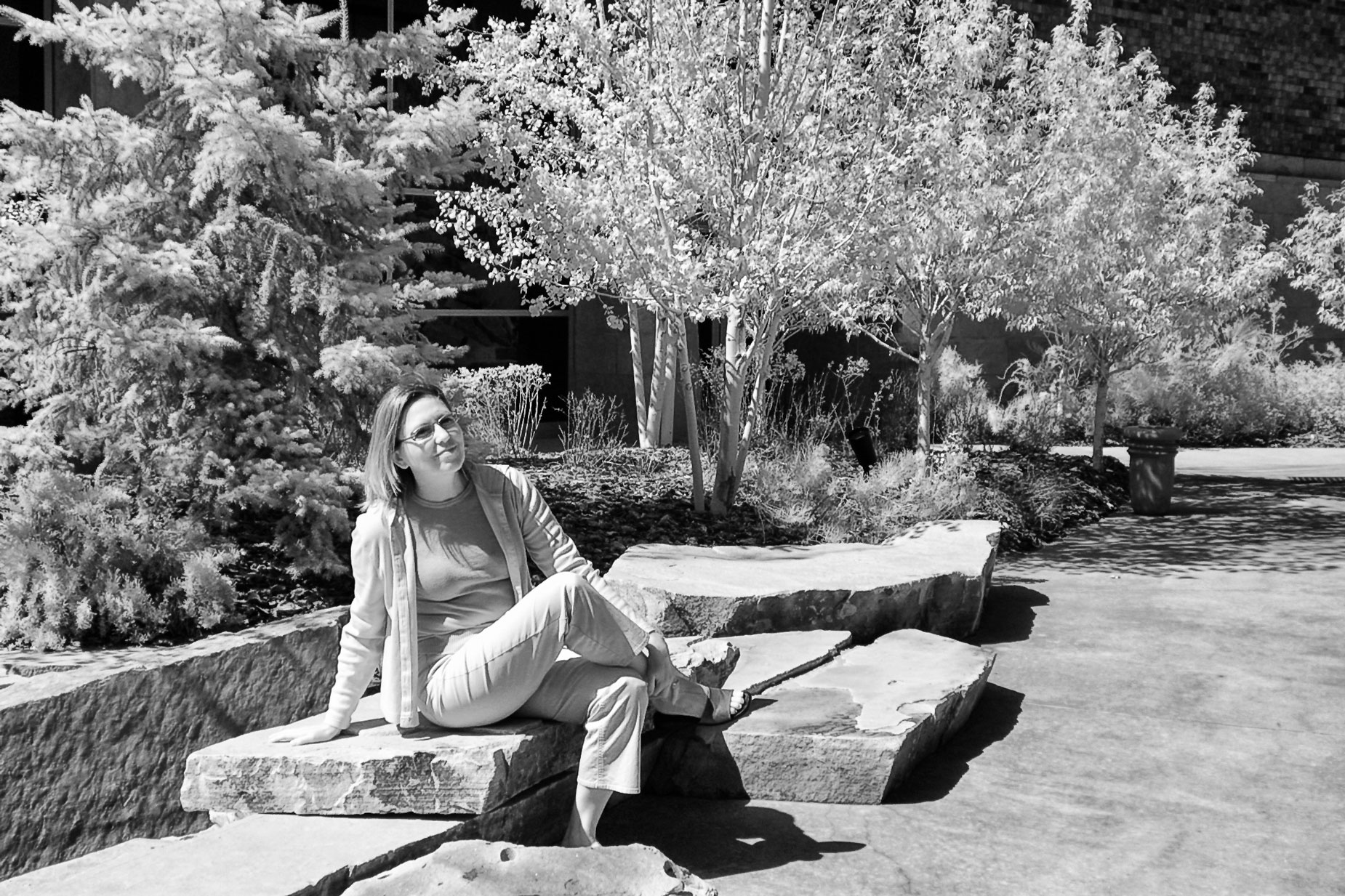
How I made these photograph: Above right is a typical daylight unprocessed (SOOC) image file that was shot with a Canon EOS 50D that was converted for IR capture by Life Pixel using their Standard IR (720nm) conversion.
To photograph Mary at an outdoors mall, I used a EF 22-55mm f/4-5/6 zoom lens with an exposure of 1/125 sec at f/8 and ISO 200. The second image was creating by processing that same JPEG file using Silver Efex with their.High Structure (harsh) preset with just a little tweaking of the Contrast and Structure sliders. Which one do you like better? Let me know. You can have it either way or both ways.
 I’ve found that Life Pixel does a great job with IR conversions and they’ve done conversions for some of my Canon DSLRs and all of my Panasonic Lumix G-series mirrorless cameras. This is not a paid or sponsored endorsement, just my experience.
New copies of my book, The Complete Guide to Digital Infrared Photography are available from Amazon for $43.66, with used copies selling for around eight bucks, as I write this. Copes of my book Creative Digital Monochrome Effects that has a chapter on IR photography are $27.43 with used copies selling for around seven bucks, as I write this.