
It’s not just #anythingcanhappenday, today’s post features one of the nicest, sweetest models I ever photographed—Colleen Brianne. It’s also National Oatmeal Cookie Day and as I’ve often said to Barry Staver in our Pixels, Grain and Cookies podcast, “there’s no such thing as a bad cookie.” Oatmeal cookies are super healthy and are packed with iron and fiber so you don’t even have to feel guilty about the calories!
Today’s Post by Joe Farace
“In a portrait, I’m looking for the silence in somebody.”– Henri Cartier-Bresson
 Whenever I’m with a group of photographers, like during a photowalk or at one of my Coffee & Camera events some photographers tell me they would like to try shooting portrait or glamour images but don’t have the right equipment, making it an unattainable goal. Nothing could farther from the truth. All you really needed to produce professional quality portraits is a camera that takes interchangeable lenses, a few simple accessories and a model that’s willing to pose for you. Bam!
In Studio or Indoors
My basic lens kit for portrait or glamour photography is simple and the specific lens I use is usually determined by whether I’m shooting indoors or outside. There are two facts-of-life about shooting glamour indoors: First, there’s never enough space, which is why I often find myself pressed up against the opposite wall. Second, the corollary to this challenge is there’s usually never enough light to shoot an available light portrait. That’s why I prefer a relatively fast 85mm prime lens for indoor portraits but don’t overlook the possibilities offered by a 50mm or 25mm focal lengths (equivalent) when shooting with Micro Four-thirds cameras.
That doesn’t mean you can’t use a zoom tens (more later) alternatively and depending on your DSLRs or mirrorless camera’s multiplication factor, a 135mm lens might be a tight fit for some indoor locations but if you have the space, you will love the perspective this focal length produces with either full frame or APS-C DSLRs.
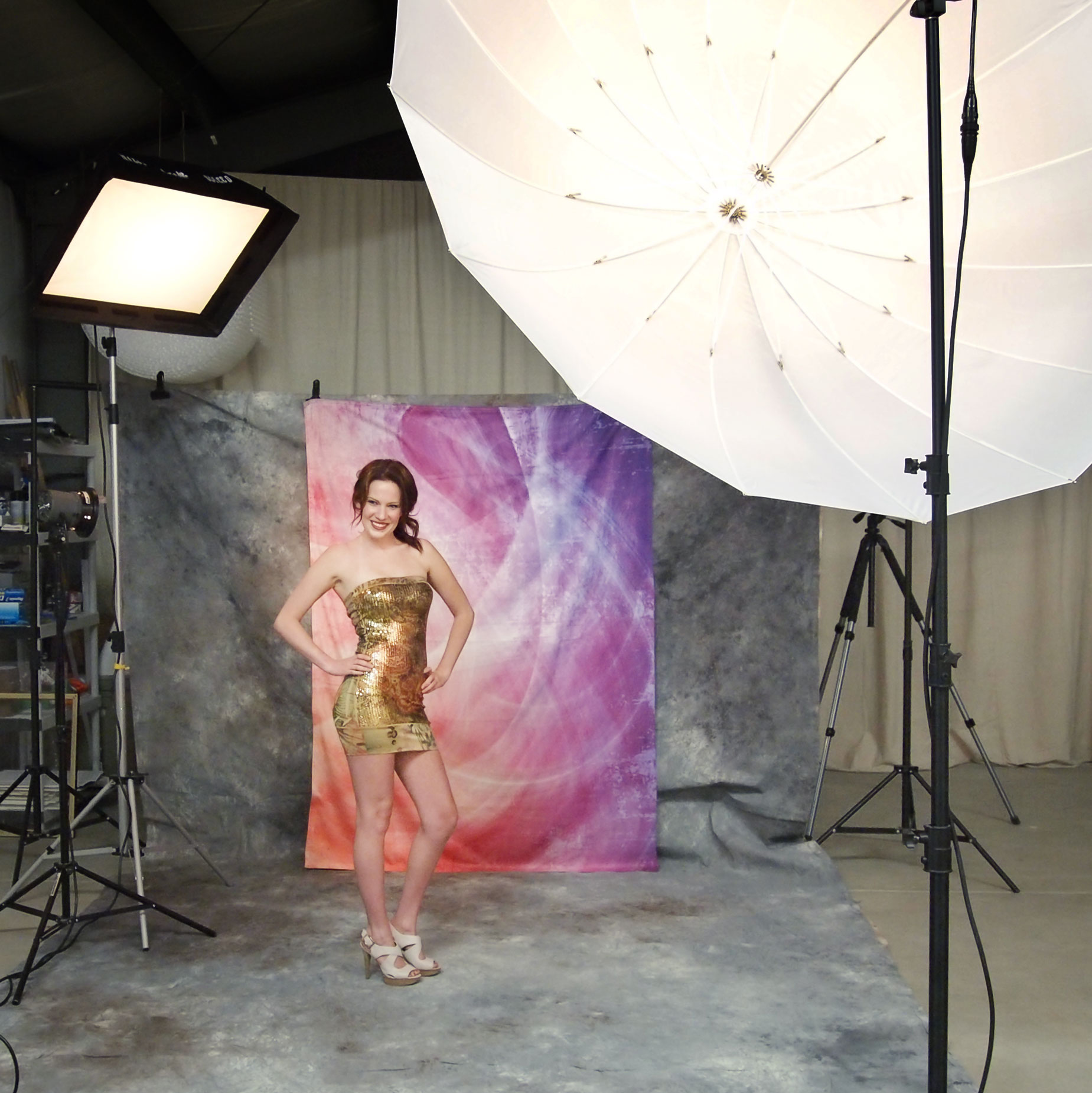
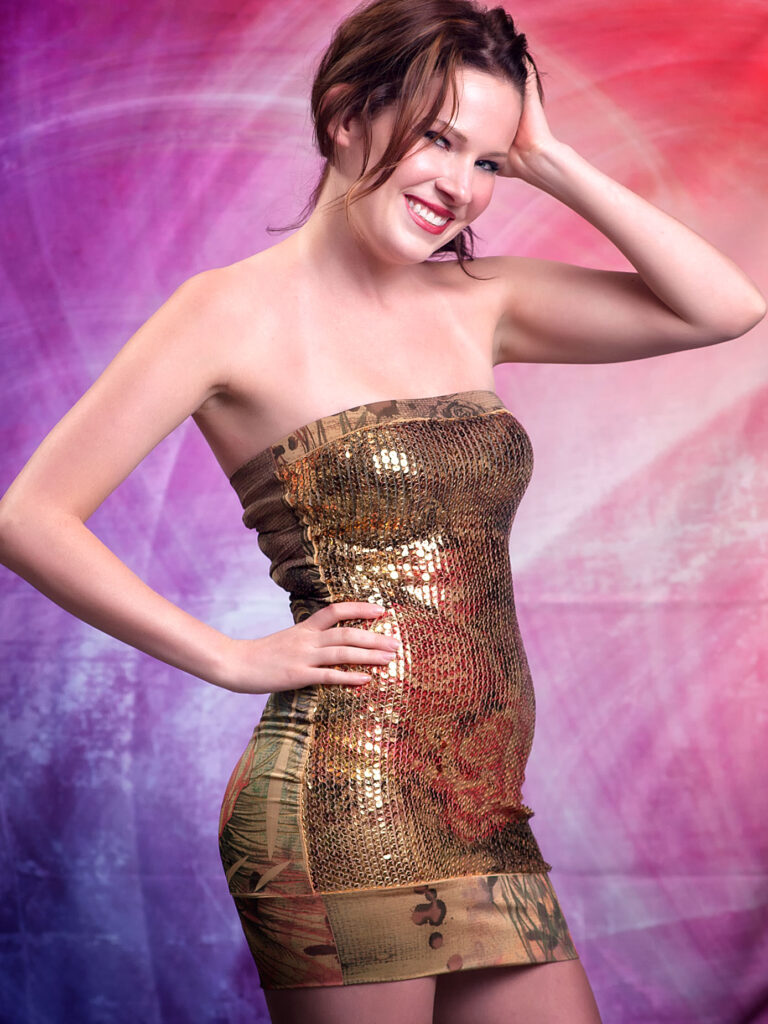 How I made this portrait: I made this portrait of Colleen Breanne in my friend Jack Dean’s large studio. The main light used a 64-inch umbrella at camera right, while the fill light had a 86-inch white parabolic umbrella at camera left and outside the setup shot photo. Both are used in bounce mode. A small softbox at camera left and behind the model was used as a hair light with a raw light head (from Jack’s power pack and head system) aimed at an Aqua Colorsmack backdrop from Silverlake Photo Accessories. The portrait was made with a Canon EOS 1D Mark II N and an EF 135mm f/2.8 SF lens with the soft focus set at zero (no soft focus) with an exposure of 1/100 sec at f/7.1 and ISO 100.
These days, I fin myself shooting In the studio with a Panasonic Lumix GH4 Micro Four-thirds mirrorless camera and more often than not I’ll use the image stabilized Lumix G Vario 14-45mm f/3.5-5.6 lens, which lets me shoot full length shots at the 14mm to 25mm focal lengths (28-50mm equivalent) or more traditionally framed portraits at the 45mm (90mm equivalent) focal length. But for a prime lens, I really like the image stabilized a Leica DG Macro-Elmarit 45mm f/2.8 lens that produces a 90mm equivalent angle-of-view.
In the Outdoors
Outdoors, you usually have more light and more room to work with than when shooting indoors–even if it’s in your studio. Outside. there’s typicality also enough room to do full length poses, which can be a challenge when shooting in my compact 11×15-foot home studio. That wasn’t true for the photograph above left that was made when shooing in my friend Jack Deans HUGE studio.
For full length shots, I like to use zoom lenses in the wide angle to mild telephoto range. A lens like the classic (but discontinued) Canon EF 28-135mm provides flexibility for choosing high or low camera positions. For APS-C cameras, I like the EF-S 15-85mm f/3.5-5.6 IS USM that is readily available on the used marketplace. Although thrifty shoppers might prefer the no longer available EF-S 17-85mm f/4-5.6 IS USM lens. I bought these lenses when they were still available new and tend to hang onto any lens I continue to use on a regular basis. And instead of chasing the newer, more expensive offerings, you should too. But that’s just my opinion and I may be wrong.
Another option is using something from the mild-telephoto to the longer telephoto range such as the classic 80-200mm or 75-300mm lenses. These kinds of longer focal lengths can produce a nice looking perspective along with shallow depth-of-field allowing a subject even in a full-length pose to pop out of the background placing the focus squarely on them.
 If you enjoyed today’s post and would like to support this blog, you can help by joining my Patreon, where memberships start at just $1.25 a month, with additional levels of support at $2.50 and $5 that include special benefits. If you do, I would like to thank you for your support.
If you’re interested in learning how I use cameras, lenses and lighting in my in-home studio and on location, please pick up a copy of Studio Lighting Anywhere which is available used from Amazon.com for less than ten bucks, as I write this. The Kindle version is $19.99 for those preferring a digital format.