
It’s “Tricky Tuesday,” a way for me to share some of the tricks, tips and techniques I’ve used over the years when shooting portraits in the studio, in this case, with the always wonderful Pam Simpson.
Today’s Post by Joe Farace
Incomprehensible jargon is the hallmark of a profession.–Kingman Brewster, Jr.
 The use of LED lighting gear originated in the world of television and many lighting equipment manufacturers have adapted the technology for use with still photography. When you think about it, it makes sense because the origins of the sensor technology in today’s DSLRs and mirrorless cameras all began with video cameras too.
The Color of LED
All of which brings me to one of the first questions people ask me about my use of LED lighting for portraits: “Isn’t the color bad?” The short answer is no.
While the color response curves of video and still photography sensors are different than our eyes, there are ways to tell if a light source is “color correct.” If you have time, read what I’ve written before about Color Rendering Index (CRI) and color temperature. To summarize, CRI is a quantitative measure of a light source’s ability to faithfully reveal an object’s colors when compared to an ideal light source. Color temperature, on the other hand, the warmth or coolness of a light source–its color–uses the Kelvin (K) scale. Lower Kelvin values (2000K–4000K) appear warm, while higher values appear cooler/bluish such as shade or cloudy sky. The short take: It determines the color cast of an image,
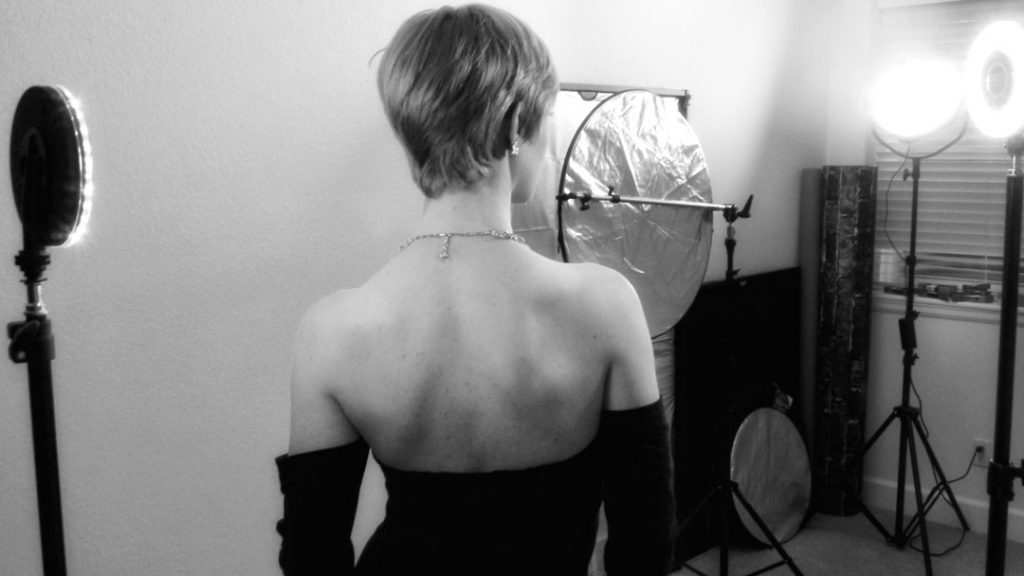
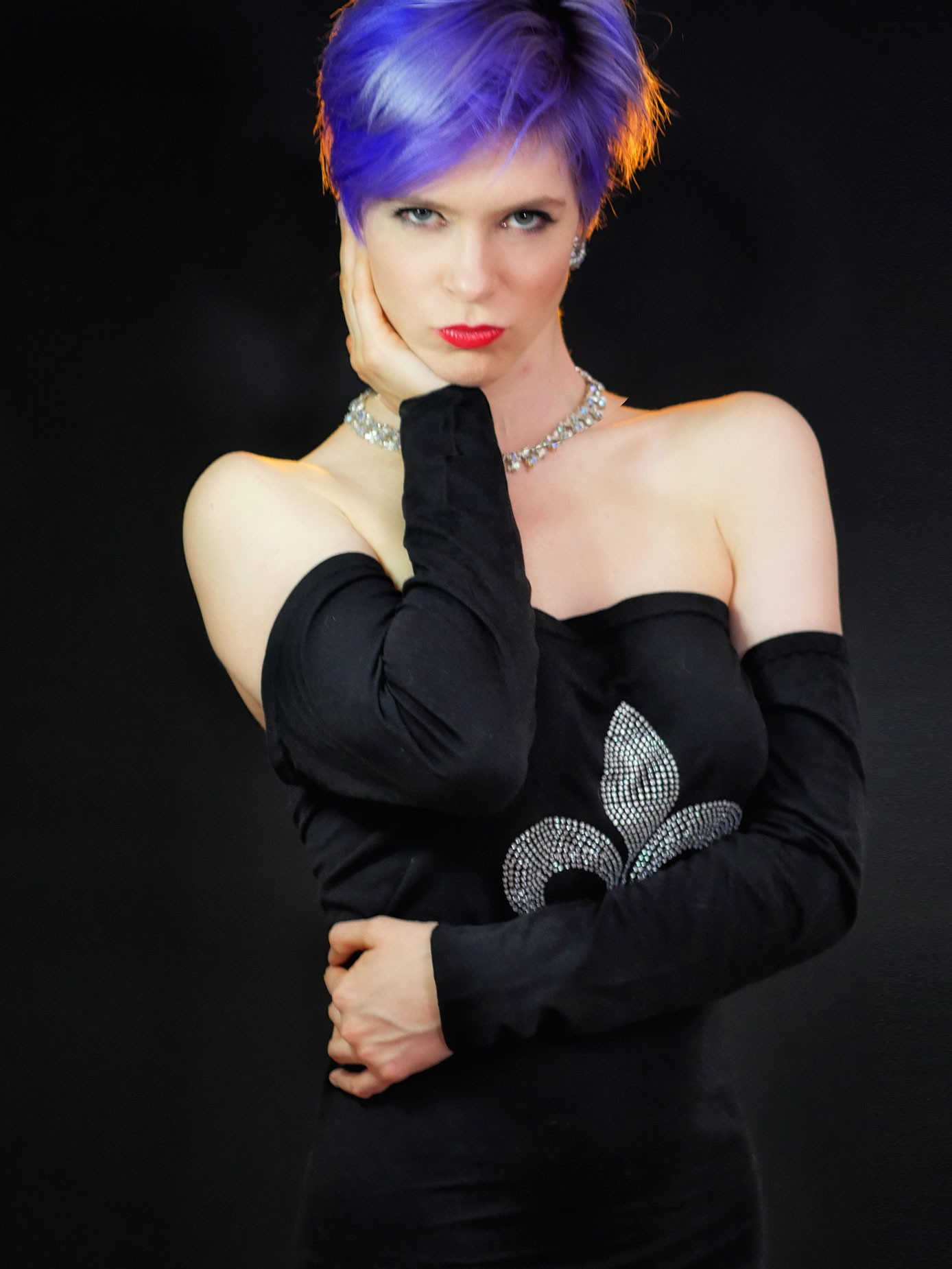 How I made this portrait: Pam Simpson, at left, was photographed using an original Rotolight NEO LED light that was placed at camera left (see setup image above) with a Rotolight RL-48 covered with a gold gel from the included Color FX Filter Pack used as a backlight. A Rotolight Anova was placed near the back of my home studio and was bounced off the ceiling and used as fill. The camera was a Panasonic Lumix GH4 with Olympus 45mm f/1.8 lens with an exposure of 1/80 sec and f/1.8 at ISO 800. The image was more drastically cropped than I normally do with portraits and enhanced with the Vivenza and Color Efex plug-ins.
Nowadays there is also Television Lighting Consistency Index to be considered. The European Broadcasting Union’s Technical Committee approved a recommendation that was designed to help broadcasters assess new lighting equipment or evaluate-the quality of their existing lighting. TLCI uses a method that’s similar to CRI and compares a standard set of colors under a test light with that from a black body light source or daylight. The colors are mathematically modeled so a test can be run using software containing an average of many (video) camera’s responses.
Unlike CRI that does not indicate the apparent color of the light source, TLCI uses multiple color temperature sources producing an index rating that ranges from 0 – 100, with a perfect light source having a TLCI of 100. Out here in the real world, any light source having a TLCI of 85 or higher will be practical for still photography with little or no color correction required. I expect that more and more manufacturers will integrate this measurement into their specifications.
Take Rotolight’s NEO LED lighting system for example: Right now, the original NEO has been discontinued but the newer NEO 3 has a TLCI of 99, which amounts to color errors so small that no matter whatever Photoshop, Lightroom or software color correction tool you prefer, the image files won’t need any correcting.
 If you enjoyed today’s post and would like to support this blog, you can help by joining my Patreon, where memberships start at just $1.25 a month, with additional levels of support at $2.50 and $5 that include special benefits. If you do, I would like to thank you for your support.
If you’re interested in learning how I use cameras, lenses and lighting in my in-home studio and on location, please pick up a copy of Studio Lighting Anywhere which is available used from Amazon.com for around eleven bucks, as I write this. The Kindle version is $19.99 for those preferring a digital format.