
Today’s Post by Joe Farace
In photography there is a reality so subtle that it becomes more real than reality.
–Alfred Stieglitz
Let me repeat myself: Cropping can be one of the most creative tools that a photographer has.
I’ve always thought that a poorly cropped photograph has TMI: Too Much Information. In all the years I spent shooting film, especially slides, my philosophy about cropping was influenced by the late Leon Kennamer, who once told me during a week-long class at the PPA’s old Winona school to “get it on the negative.” By that he meant the image on the film should represent the final photograph that you deliver to the client for them to hang on the wall.
Cropping: Two Approaches
Two of my friends, who are outstanding portrait photographers, crop their subjects loosely in-camera often capturing edges of the background, lightstands and sometimes even a studio light within the frame, before cropping the final image into a shape that may or may not have any relationship to that original file.
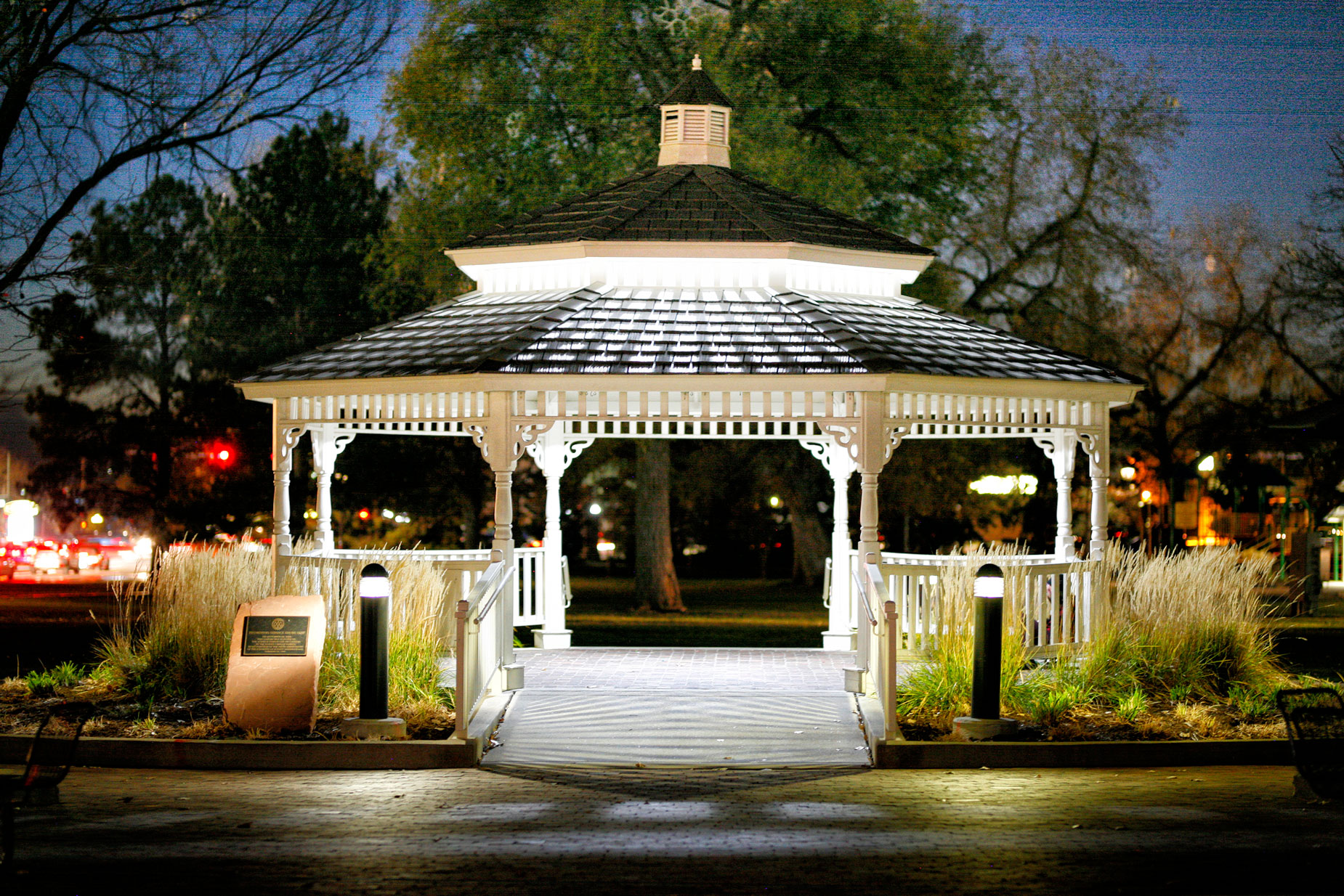
How I made this photograph: I haven’t posted a photograph of Parker Colorado’s O’Brien Park gazebo in some time, so let me do that today and include a lightly cropped image that was made at night. I photographed the gazebo at 8:00 PM using a Canon EOS 5D Mark I with a Sigma 85mm f/1.4 DG HSM Art Lens, The handheld exposure was 1/15 sec at f/1.4 and ISO 1600 with a plus one-third stop exposure compensation. The RAW file had some light burning and dodging via layers from PhotoKit before applying the Tonal Contrast filter from Color Efex.
My personal aversion to cropping goes back to the time I spent shooting film but according to my horoscope,I’m a Gemini, I may be doing more in the future. For far too long I considered the 2:3 rectangle to be sacrosanct and that was, my default shooting crop with my DSLRs and my mirrorless cameras too, not the 4:3 that is the default for cameras in the Micro Four-thirds system. I finally realized by cropping images shot with my Panasonic and Olympus cameras in-camera to 3:2, that I was throwing away resolution from an already small (17.3-13mm) sensor. I don’t do that any more.
 If you shoot with a zoom lens why not use it to frame the image exactly the way you want before tripping the shutter? If you prefer using prime focal length lenses, use your feet as a zoom and move around to get the subject framed exactly the way you want. Often taking a single step closer to a subject will improve the composition more than you might think. Don’t forget what Ernst Haas once said, “The most important lens you have is your legs.”
Changes in Attitude
As you get older, a person can change one’s mind and these days I tend to crop my images, especially portraits, more than I did in the past. If you look at some recent posts where I show both before and after images of portrait, there is always some cropping involved. I’m gradually getting over my previous way of thinking partially because of Instagram’s 1080 pixel limit, which brings the image format closer to a 4:3 ratio but mostly because I seem to like cropping my portraits tighter to make the subject fill the frame more than I did in the past. As they say, “you live, you learn.”
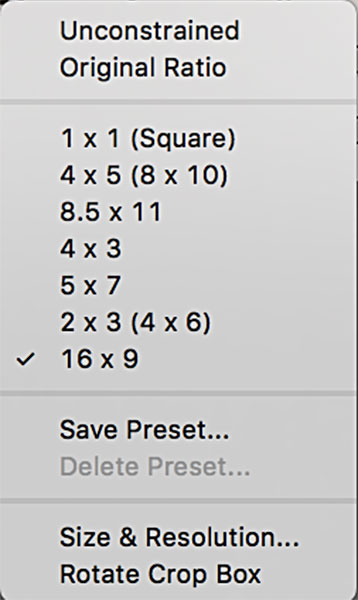
Let me tell you a secret: While I seem to have a bias toward cropping using the “standard” cropping ratios, like 5×7 or 4×5, sometimes I cheat by first cropping using one of these ratios then use Photoshop “unconstrained” cropping option to (slightly) crop from the top, bottom or sides to make up my own ratio, much like what my two pals are doing and coming to it without their influence. My original thoughts of not cropping can be carried to extremes, as evidenced by the SOOC movement or as Seinfeld once said, “not that there’s anything wrong with it.”
 If you enjoyed today’s blog post and would like to treat me to a cup of Earl Grey tea ($3.50), please click here. And if you do, thanks so much.
Along with photographer Barry Staver, I’m co-author of Better Available Light Digital Photography that’s available from Amazon for $24.50 prices with used copies starting around seventeen bucks, as I write this.