
I often hear from readers who are interested in giving infrared a photography. While there are many posts about IR photography on this blog—many on #monochromemonday—I suggest you start with two posts written by my friend Barry Staver: Some Newbie Thoughts About Infrared Photography and Part II of that same series.
Today’s Post by Joe Farace
“You can’t make the good old days come back just by painting pictures of them. That kind of stuff is dead now and I think it’s about time.” ― Norman Rockwell
I recently received a few emails from readers that I’d like to address today: The first question concerns the influence of technology in today’s digital cameras and the other is about the resurgence of film photography, especially among younger shooters, runs headlong into one of the most important Farace’s Laws of photography: Every change in image making has been one of convenience, not always improved quality.”
Until the dot-com bust of the early 2000’s, in addition for writing for photography publications (back when they existed,) I also wrote articles and product reviews for computer magazines/ I’ve always been somewhat of a geek; my degree is in Electrical Engineering and I’ve worked with all kinds of computers since 1964. After the Apple II was introduced in 1977, I got my first computer—an Apple II Plus—in 1978. Tech stuff fascinates me, especially in the many ways it intersects digital photography.
Digital vs Analog
 Back in the heyday of film, after making a photograph —we didn’t say “capture” back then— most of the process were done by others. Commercial photo labs processed our film, producing mounted slides, proofs or proof sheets from our negatives or transparency film. Then we’d make image selections from proofs and the lab would make prints from the negatives. If we didn’t like how the prints looked, the lab would (usually) re-make them for us at no charge. Now we have to do all that work ourselves. That means photographers also have to have to learn concepts such as color space, printers, paper profiles and image stability. We are the lab now.
Outside of your own desktop, there are digital photo labs and even places—there used to be more of them—like Walgreens and (maybe) Costco that will make prints for you. If any readers know a digital lab they can recommend, please let me know and I’ll be sure to mention them in a future post. The one thing that I’ve noticed in with any of the on-line digital labs I’ve used, the process of uploading image files is not all that simple.
film cameras vs DSLRs and mirrorless cameras
For a long time, there seemed to be endless debates on-line about DSLRs vs. mirrorless cameras, although ] it seems as if the mirrorless camera has won this battle and appears to be converting even the most die-hard DSLR users to the mirrorless fold. Some of these cameras are not all that easy to use for someone moving up from using a smartphone. By comparison, controls for film cameras seem simpler: You set the shutter speed and aperture and maybe the film itself sets the ISO for you via DX film cassette barcode. The Nikon Zf and previously launched Zfc are bucking that trend but seem to appeal to a small minority of digital shooters. On the other hand, gear like my Olympus and Panasonic mirrorless camera have deep—maybe too deep—menus with what seems like hundreds of settings; I tend to ignore most of them and just take pictures. But I’ll admit that I may be missing something.
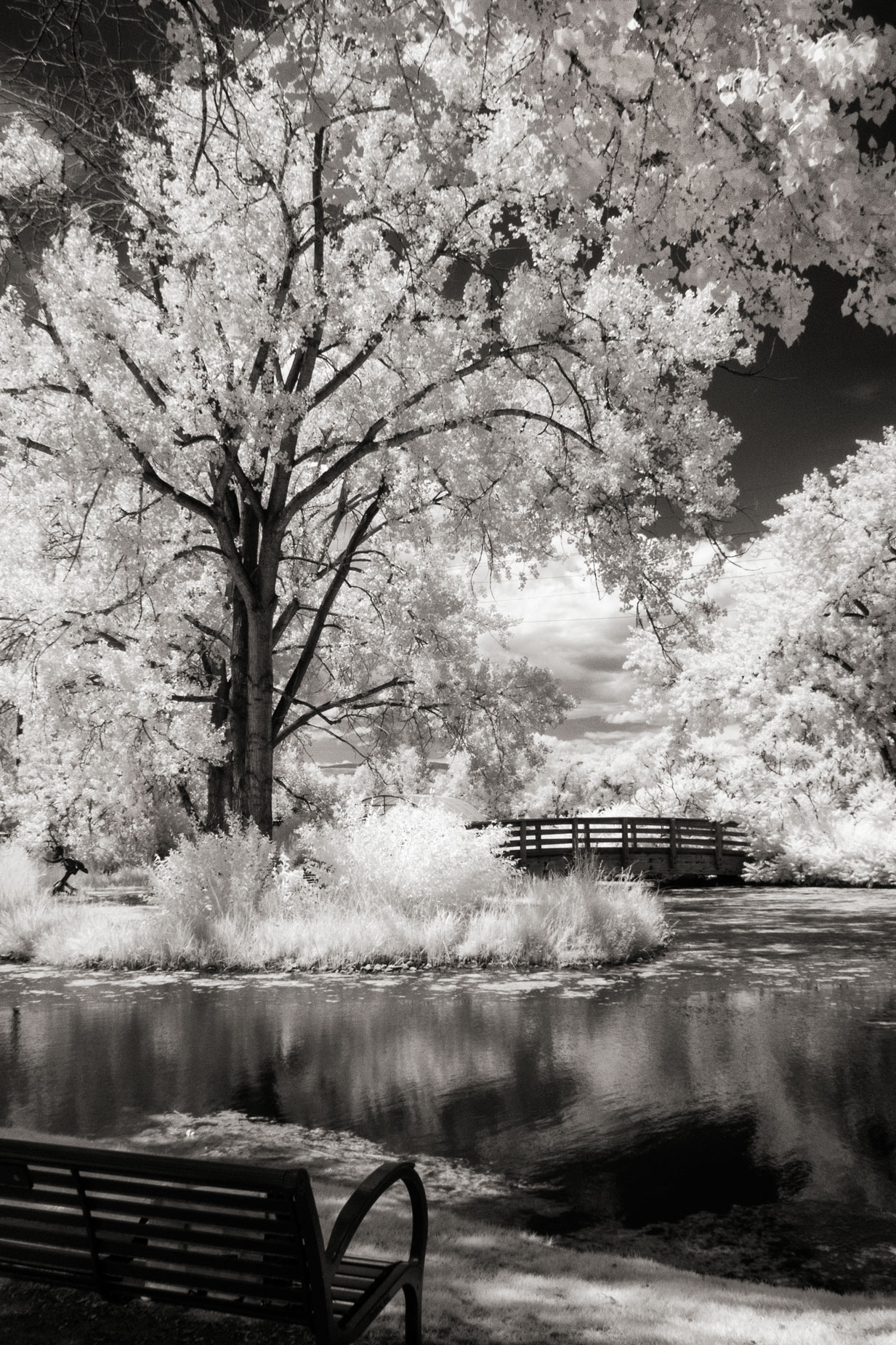
How I made this shot: The featured photograph was made during a PhotoWalk at Littleton, Colorado’s Hudson Gardens when my friend Barry Staver when we had an infrared PhotoWalk.The property is composed of thirty acres of garden exhibits, trails, natural terrain and event venues and was opened to the public in June 1996. The camera I used was a Panasonic Lumix G6 with Olympus M.Zuiko 17mm f/2.8 lens with an exposure of 1/250 sec at f/16 and ISO 400. To convert it to monochrome, the image file was processed using Silver Efex with some Platinum toning added via PhotoKit.
I written before about how the Ninety-Ninety Rule applies to photography, especially to pundits who claim to know everything about digital photography. Or as Mario Andretti once told me, “if you think you’ve got everything under control, you’re not going fast enough.” In the meantime, I’m inspired by my friends and try to learn something new each week. That’s because there is no rest for the committed digital photographer because as soon as you feel you’ve got it under control along comes newer technology. It’s no wonder that some people find the digital photography experience complicated and this may be the real and unsaid reason why so many people make snapshots using their cell phones.
And to answer the question in the title of today’s post, “Maybe they are.”
 I’ve found that Life Pixel does a great job with IR conversions and they’ve done most of the conversions for some of my Canon DSLRs and all of my Panasonic Lumix G-series cameras. This is not a paid or sponsored endorsement, just my experience.
New copies of my book, The Complete Guide to Digital Infrared Photography are available from Amazon for $43 and used copies are available starting around thirteen bucks as I write this. My book Creative Digital Monochrome Effects has a chapter on IR photography and is available new from Amazon for $11.46 with used copies starting around three bucks as I write this.