
Today’s Post by Joe Farace
We must make the choices that enable us to fulfill the deepest capacities of our real selves. —Thomas Merton
 Whether you’re shooting portraits with speedlights, power pack and head systems or monolights, one of the best ways I know of to improve the quality of their output is by using a light modifier.
The inevitable question is: What kind of light modifier? Should it be an umbrella or a softbox? Each of these devices has advantages and disadvantages and choosing which one is best for you is governed by several considerations. The first is what kind of mood are you trying to create with the portrait. Second is an important rule that governs all forms of portrait lighting: The closer a light is to the subject, the softer it will be; conversely, the further away a light source is from them the harder it becomes.
Let’s Look at Umbrellas
Umbrellas are mostly round—I have 48-inch Dynalite Quad Square umbrella— and provide a broad and soft source of lighting that could, for simplicity’s sake, appear to emulate natural outdoor lighting. Softboxes come in rectangular, square or even octagonal shapes and mimic the kind of soft, directional lighting produced by window light. And yes, I have an octagonal-shaped window in my home’s master bedroom.
 Because umbrellas create a broad lighting source, they’re easy to use for portraiture. All you have to do is point an umbrella at a subject and bang, zoom nice you’ve got soft lighting! If you use two umbrellas, you’ll think you’re a lighting genius. Because rain and sun versions have been around for 4,000 years, umbrellas are simple to construct and less expensive to purchase making them perfect for a photographer who’s new to portrait lighting equipment. You can buy an umbrella, like the 33-inch Godox Reflector Umbrella for less than 16 bucks. So they’re cheap, easy to use and produce nice-looking light.
Soft boxes are available in large and small sizes that when placed close to a subject produce diffuse, yet directional light. There are also lots of accessories available for soft boxes, including grids or louvers, that make the lighting even across the plane of light and even a bit more dramatic. What’s the downside? Typically softboxes are not as inexpensive as umbrellas but I found a 32×32-inch -inch Godox softbox on Amazon for $23.25, as I write this.
 Unlike umbrellas which are forgiving on how you use them, softboxes require a little more effort to balance the main versus fill light (that could even come from an umbrella) that’s often expressed as lighting ratio.
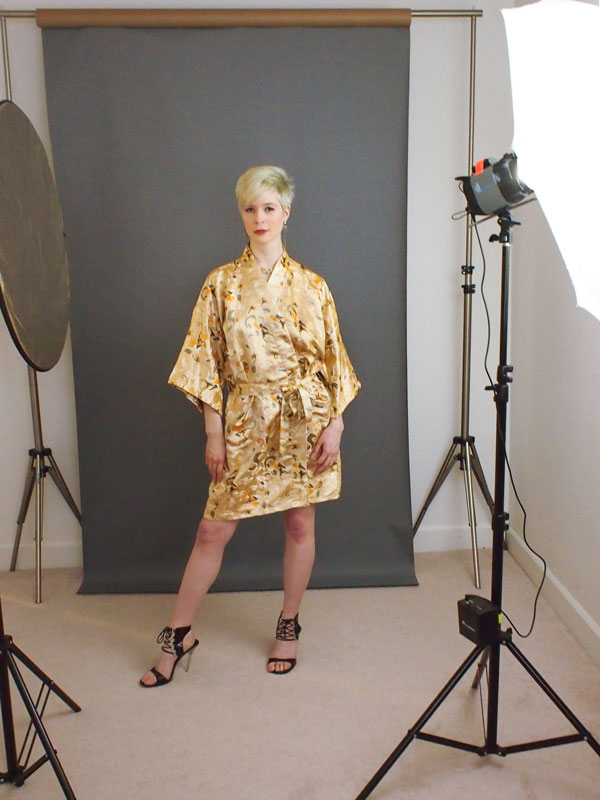
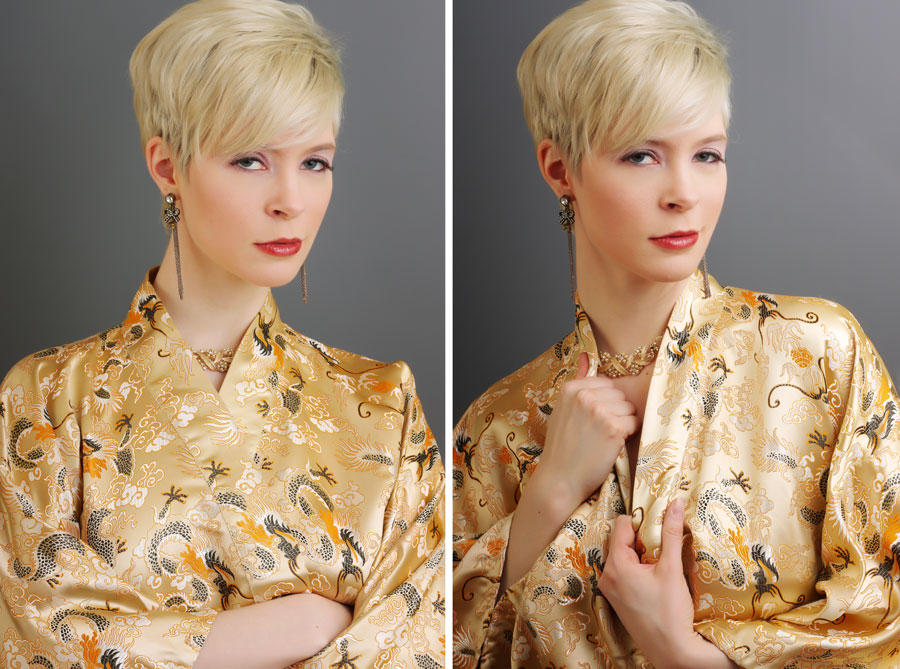
How I Made These Photographs: For both test shots above a Flashpoint monolight was placed at camera right with a 32-inch round reflector located at camera left.
For the first set-up (left) the umbrella is in traditional bounce mode, while in the second (right) a translucent umbrella is used in shoot-through mode. The difference between the two setups is subtle but there is a directionality to shoot-though mode that hopefully is visible, depending on how large the images area is displayed on your device.
Exposures for the above images were 1/125 sec at f/8 (left) and ISO 200 and 1/125 sec at f/9 and ISO 200 right.) The differences in exposure between the two umbrella setups could have been made dramatically different if I moved the lights between sessions but this way you can see what happens without moving the light.
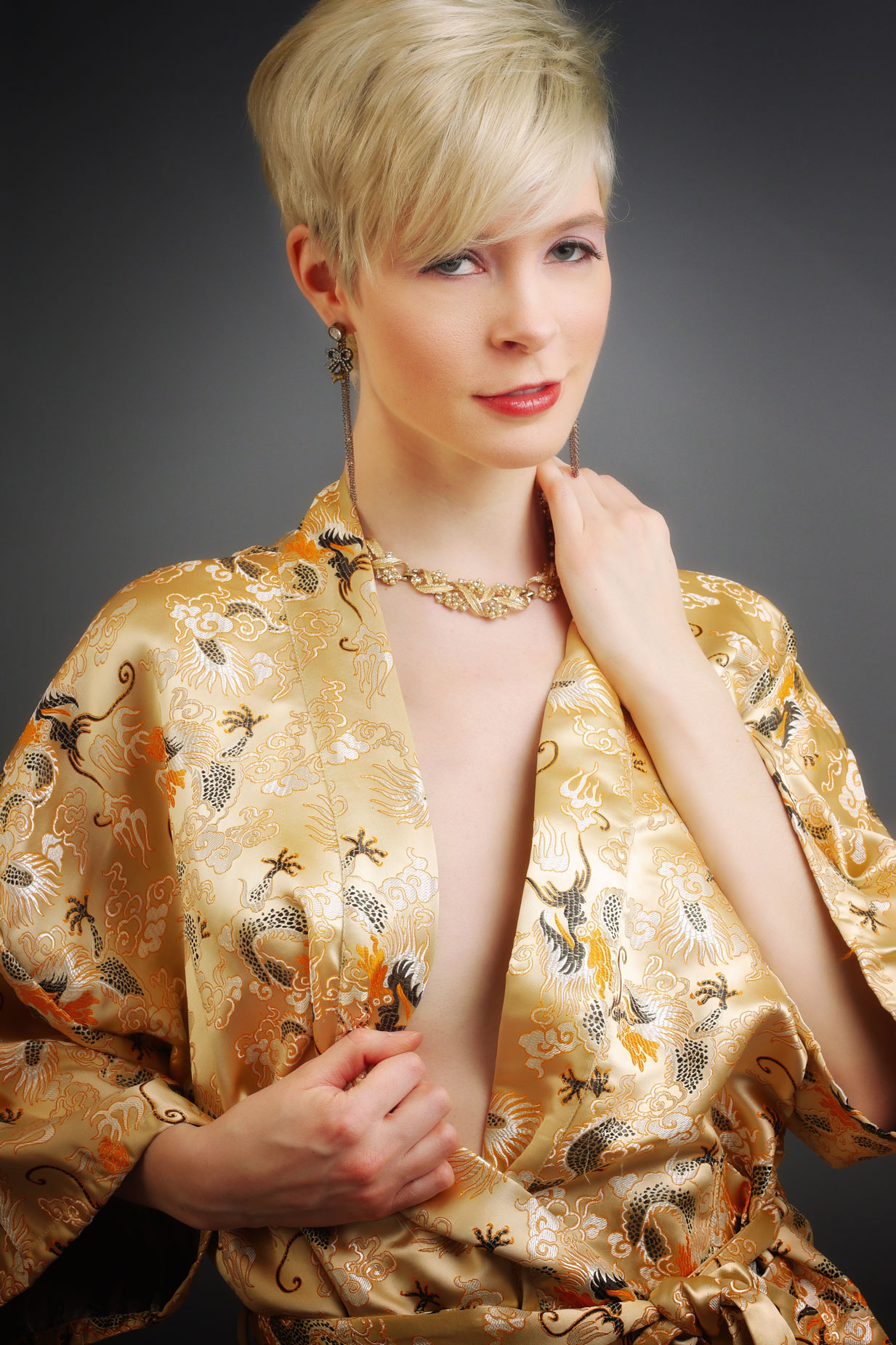
For my final portrait of Pam (at right,) she was photographed with a translucent umbrella in Shoot-through mode. The camera used was a Panasonic Lumix G5 with the M. Zuiko 45mm f/1.8 lens and an exposure of 1/125 sec at f/9 and ISO 200. The backdrop is a Savage 5 x 7-foot Infinity grey vinyl hung on JTL background stands.
Ultimately there is no “one size fits all” solution for portrait lighting modifiers. Just as you will have to select the right lens and ISO setting for a natural light photograph, when it comes to working with artificial light you need to choose the right tool for the concept of the project at hand.
Postscript: If you would like to see uncensored portraits of Pam or any of the other models who have appeared on this blog, please consider subscribing to my Patreon that gives you access to all of the past and upcoming uncensored posts about model photography. You can find details in this post. You should know that 100% of the money from Patreon goes to keeping this blog on-line. It goes to pay for hosting, domain name renewal and the software that runs this site,