
We celebrate Nature Photography Day on June 15 to learn more about nature and enjoy capturing it at its best over the coming summer months. Nature is all around us and you can take part wherever you are, with whatever camera equipment you might have. It doesn’t matter whether you’re a professional photographer, or you’ve never captured nature before, give it a try to celebrate Nature Photography Day, You might even want to try infrared photography!
Today’s Post by Joe Farace
Every single national park had some component of private philanthropy. –Douglas Tompkins
I’ve said it before but I’ll say it again: I have captured infrared images all over this country and even in Mexico but by far the best place I’ve found to make infrared images in the United States is Zion National Park. My friend Juan Pablo tells me that Columbia is the best country to make infrared images and I hope to join him there someday and find out. I’ll have to add it to my bucket list.
It’s all about the landscape
Zion National Park is located near Springdale, Utah and is about 700 miles southwest of Denver. Zion Canyon, which is a prominent feature of the 229-square-mile park, is 15 miles long and up to half a mile deep, cut through the reddish and tan-colored Navajo Sandstone by the North Fork of the Virgin River. The park’s lowest elevation is 3,666 ft at Coalpits Wash and the highest elevation is 8,726 ft at Horse Ranch Mountain.
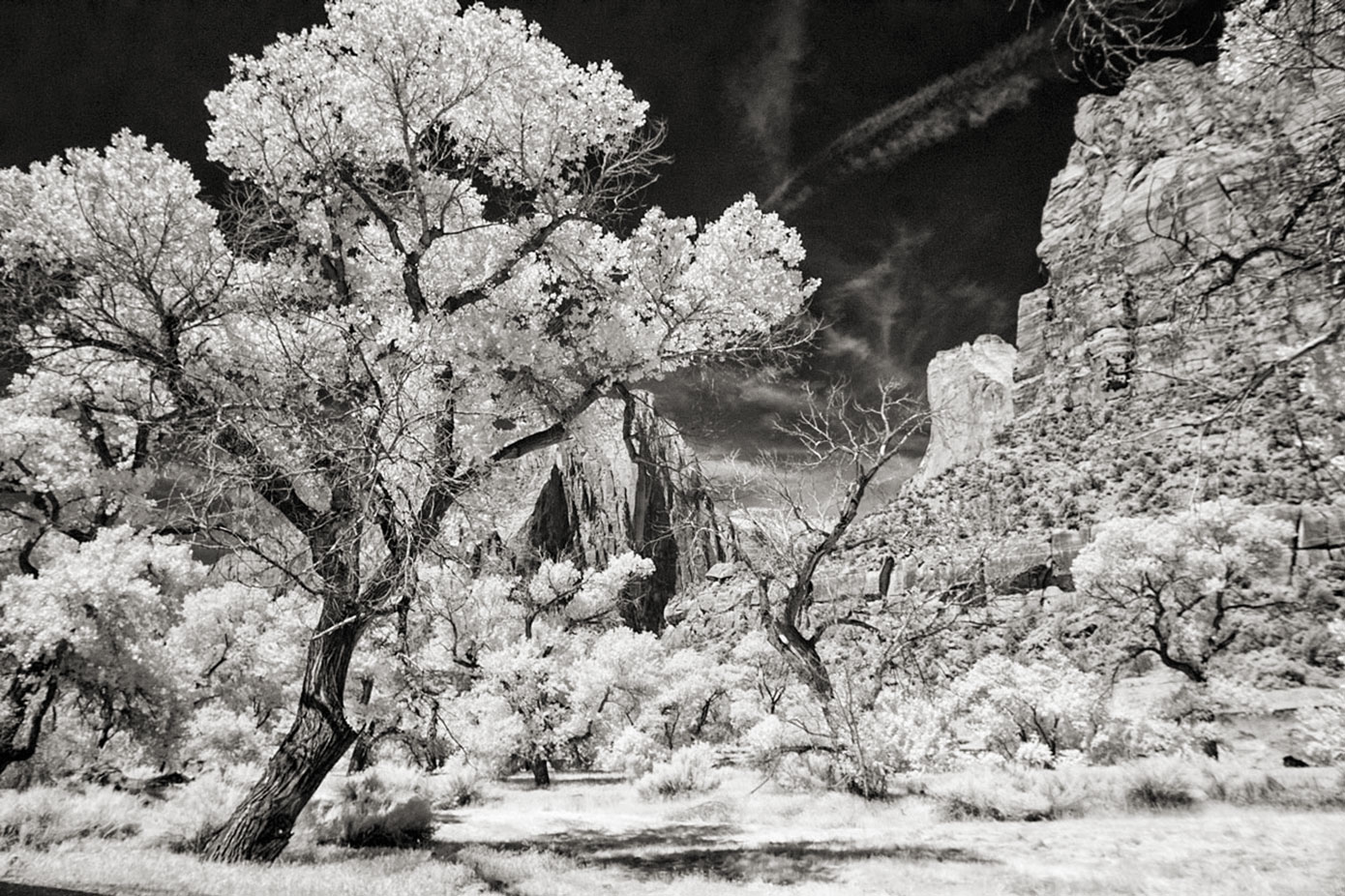
The park’s unique geography and variety of life zones allow for unusual plant and animal diversity. Numerous plant species as well as 289 species of birds, 75 mammals (including 19 species of bat), and 32 reptiles inhabit the park’s four life zones: desert, riparian, woodland, and coniferous forest.
How I made this photograph: The above image was made using a Canon EOS D30 that had been converted to infrared capture by a company no longer in business. The resolution of the D30 was three-megapixels with a maximum resolution of just 2160 x 1440, which is the resolution of the featured image. Depending on what kind of device or screen you may be viewing this on it may not be crisp but that was the IR camera I had when shooting this image several years ago before I started building my stable of Panasonic Lumix IR-converted cameras.
The lens used was the Tamron SP AF 11-18mm F/4.5-5.6 Di-II LD Aspherical (at 15mm) that has been discontinued. The exposure was 1/125 sec at f/9 and ISO 200 with a plus two stops exposure compensation, all of which points up the big advantage of shooting infrared with an infrared converted camera as opposed to using an on-camera filter; You can easily handhold the camera instead of have to place it on a tripod. The RAW file was converted to monochrome with Silver Efex and tones using the Platinum filter that’s part of PhotoKit 2.
Sometime in the future I would like to hold an infrared photography workshop in Zion National Park. A few years ago one of the big photography websites approached me asking about sponsoring such a workshop but with a change in their ownership the offer evaporated. If your organization is interested in sponsoring such a workshop, please click the Contact button and let’s talk.
 I’ve found that Life Pixel does a great job with IR conversions and they’ve done some of the conversions for my Canon DSLRs and all of my Panasonic Lumix G-series cameras. This is not a paid or sponsored endorsement, just my experience.
New copies of my book, The Complete Guide to Digital Infrared Photography are available from Amazon for $44.34, with used copies selling for around nine bucks, as I write this. Used copes of my book Creative Digital Monochrome Effects that has a chapter on IR photography are available from Amazon for around eight bucks, as I write this.