
Today’s Post by Joe Farace
Photography is a way of feeling, of touching, of loving. What you have caught on film is captured forever.—Aaron Siskind
I’m looking forward to the New Year...For a long time, almost every image I’ve made was captured using mirrorless cameras or DSLRs, In the past few years I’ve been occasionally shooting film for everything but infrared and in-studio glamour photography, but I want to change that in 2026.
In a previous post, I mentioned plans to shoot some film during a model session with Scarlet Ana but because of unforeseen circumstances, the shoot was canceled. If and when that is rescheduled—she is preparing to move out-of-state— I would like to shoot at least part my next in-studio session with a Canon A-series camera and Ilford HP5 PLUS.
Black & White or Color Film
Most regular readers know I have a renewed interest in shooting film and own several film cameras* from back in the film days, including a Leica M6 TTL, Zeiss Ikon SW, Minolta Prod20, along with a medium format, Seagull TLR that Mary gave me as a birthday gift. With this focus on film photography, I’ve managed to collect all six of the SLRs in Canon’s A-series cameras and have enjoyed shooting each of them. Check out other Film Friday posts for a look at what I shot with some of them.
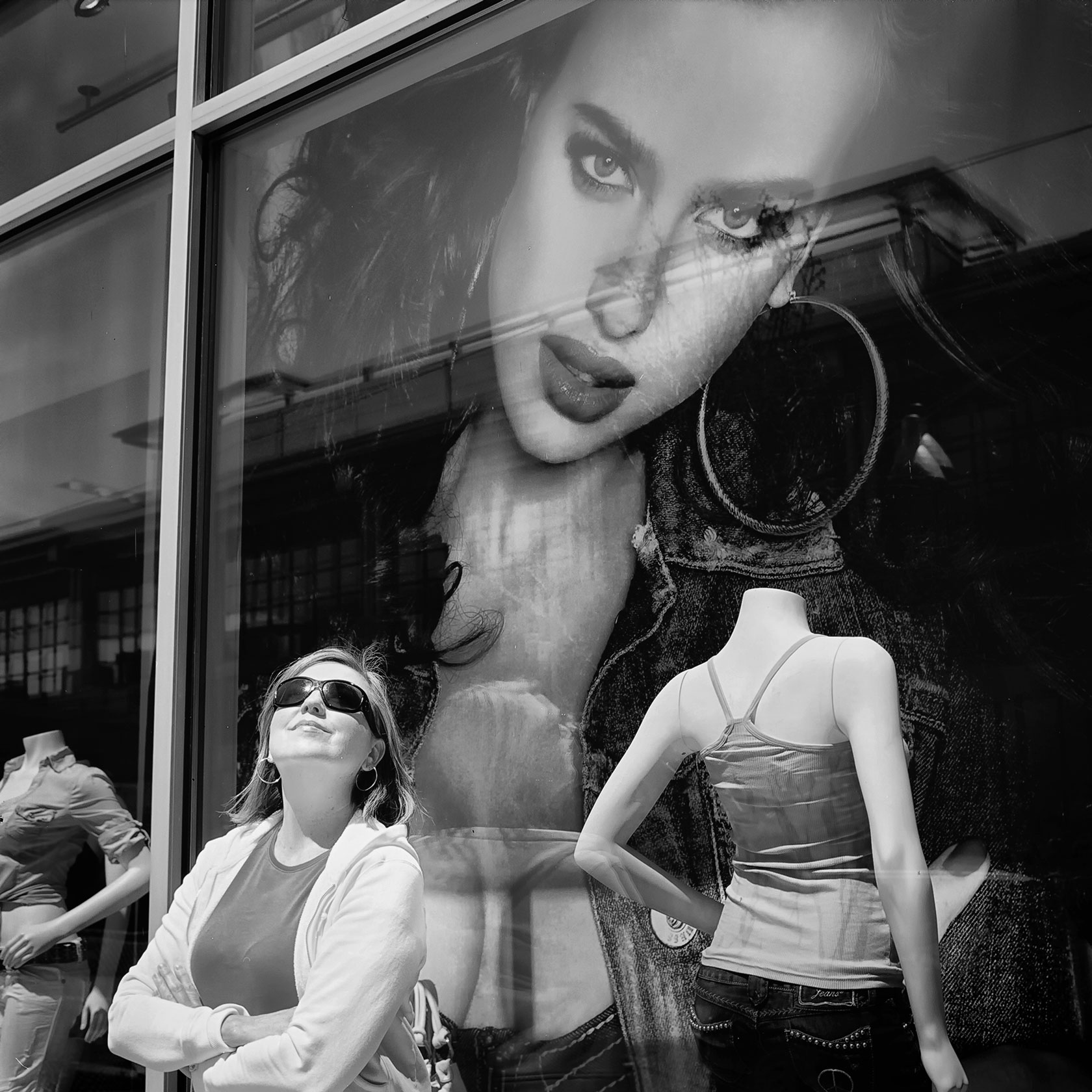
How I made this shot: I really like the square format. I photographed Mary with the gold-trimmed Seagull TLR she gave me as a gift. This portrait of her is one of my favorites and was originally made using Kodak Ektar 100 color negative film with an exposure of 1/125 sec at f/11. It’s color negative film but I thought, what the heck, let’s make the image black and white and used Exposure Software’s Exposure to remove all that saturated color putting the emphasis on Mary and the looming photograph in the background.
For me, shooting film these days is as much about having fun as it is about making photographs. And isn’t that why we got into photography in the first place? Some people even think that shooting film can be therapeutic. While I enjoy making images with digital cameras, there’s are several things I like about shooting film
- Surprise. In my post A Photographer’s Life in Three Phases I talked abut how after a person purchases their first “good” camera, they discover photography’s creative potentials. During this time, novice shooters are fearless and enthusiastically explore the world around them creating images that, after examining the results, look so much better than they could have imagined. You get that same excitement when shooting film.
- Travel. When I’m on the road, in addition to cameras and lenses, I bring along a laptop and an external drive to store all of the images I shoot each day. I have spent far too many nights in hotel rooms sorting and backing up images when I should have been out soaking up the local culture and making photographs.
- Space. In my film days everything I needed for my travel photography fit into a single Domke F-2 camera bag, which I finally have (again) for my Canon AE-1 and A-1 plus accessories and lenses. The bag was a gift from my loving wife, Mary.
- Time. Digital imaging takes time. During the film days, I’d drop off rolls of film at the lab and come back in a day or so to pick up the slides, negatives or proof sheets. If the contact sheets or prints didn’t look good, I would make the lab do it over. Nowadays we’re the lab and if it doesn’t look good, all I can do is yell at myself.
If you’re wondering how much of my photography, going forward, will be shot on film, I’m wondering the same thing myself but I can tell you that may—key word— be my emphasis for the near future—when the weather here in Colorado warms up. It’s snowing as I write this, which might be great for black and white photography. Some readers have asked if I’m going to process and scan the film I shoot? Process? Probably not. Scan maybe. Right mow, I just shoot film and have it scanned by the lab, staying firmly in the digital realm as far as post-production goes.
*I also own a Jaguar automobile-themed Leica Z2X 35mm film camera that’s crafted in British Racing Green and was purchased via a friend in the UK. But I sometimes forget I own it, so it’s added here as a postscript. Maybe I’ll shoot a car show with it—I did!

My book Creative Digital Monochrome Effects is available from Amazon for $11.46 with used copies, as I write this, starting at around seven bucks, for what is one of my personally favorite books. That’s cheaper than a Starbucks latte, so you should get one while you can.