
It’s National Chocolate Chip Cookie Day and there’s no better way to celebrate the day than to watch one of Barry Staver and my “Noise, Grain and Cookies” Podcasts on my YouTube channel—while munching on a chocolate chip cookie.
Today’s Post by Joe Farace
A photograph can be an instant of life captured for eternity that will never cease looking back at you.—Brigitte Bardot
Most of the sensors that are used in DSLRs and mirrorless camera are sensitive to more than just visible light and can also be sensitive to other forms of electromagnetic radiation such as infrared and ultraviolet light. To prevent problems with color balance in your day-to-day photography, manufacturers typically place a low pass filter in front of the camera’s imaging chip to block any excess infrared light and eliminate moiré effects*. A low pass aka anti-aliasing filter rejects strong infrared light while protecting your images from color errors and desaturation, all without any loss of ISO speed.
*Moiré is created when a fine pattern in the subject matches the pattern of the imaging chip. When the two patterns collide, a third, new pattern, called moiré, can be created.
This is related to infrared because…
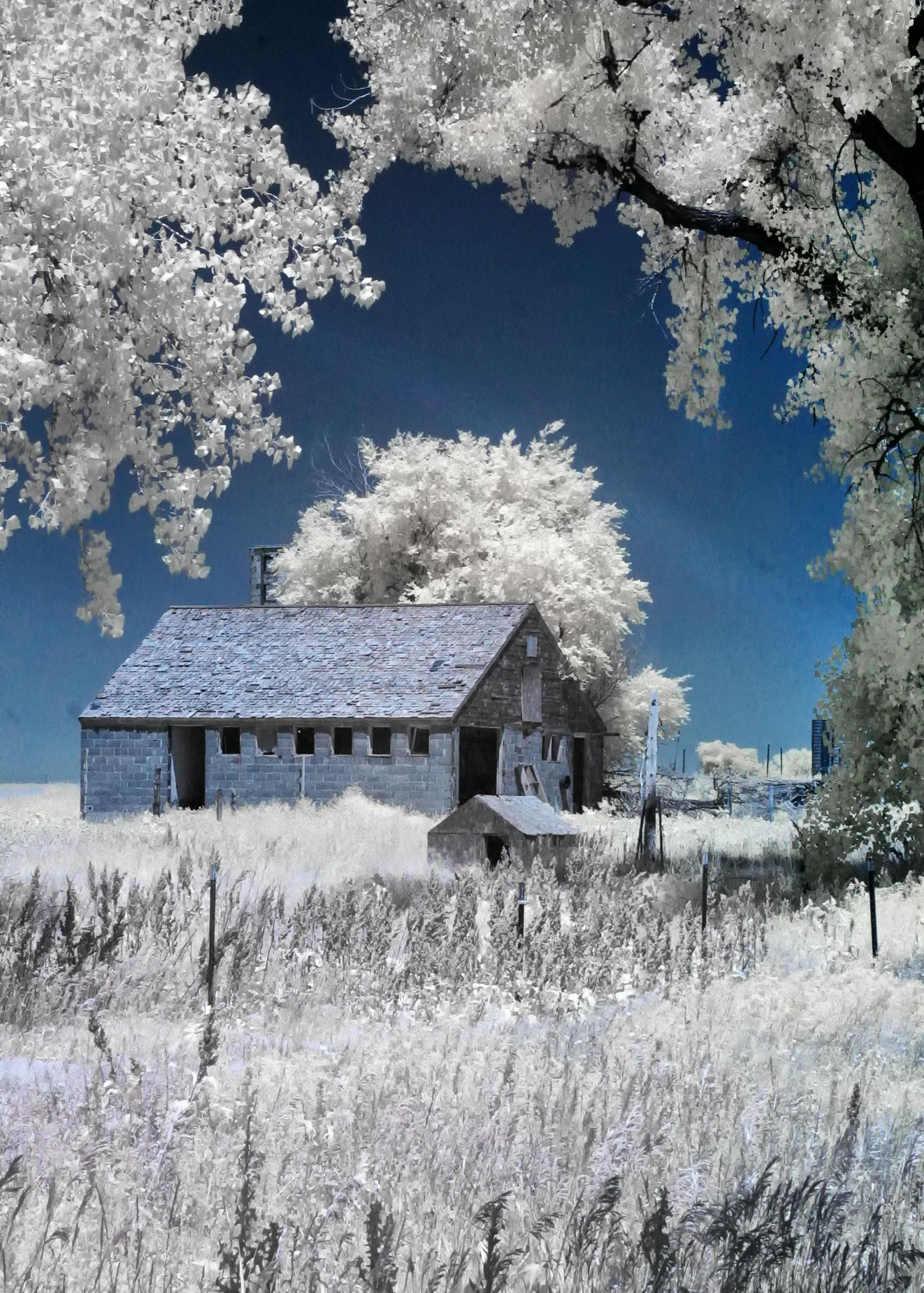 A camera’s infrared capabilities is a feature often overlooked when cameras are reviewed in photographic blogs and YouTube videos. (When I was reviewing cameras for the former print edition of Shutterbug, I always tested the cameras for IR sensitivity,)
The imaging chips in most digital cameras are fitted with an internal infrared cut-off filer that’s designed to reduce IR contamination. Some cameras let enough IR through to allow some of what techies call near infrared photography.
One of Farace’s Laws is that most contemporary Canon, Nikon, Leica, Olympus and Panasonic cameras can be used, with the appropriate filters, to capture infrared images. I can’t speak for the current generation of Fuji and Sony digital cameras because they haven’t loaned me any of their recent cameras so that I could test their infrared capabilities.
How I made this photograph: The image at right was captured near Brighton, Colorado using a Canon EOS D30 that was converted to infrared capture by a company no longer in business using their 720nm conversion. The lens used was the EF 28-135mm f/3.5-5.6 IS USM at 65mm. You can produce an image in black & white and blue like the above image by applying the image processing technique that is shown in this tutorial
Test, test and test some more
Like everything in digital photography, everything you read about almost any subject can change. So you’ll need to test your own camera to find out how IR sensitive it is. How do you do it? Whenever I get a new digital camera to review, I run down to the family room and give it a “remote control test.” What’s that? One of the easiest ways to check if your DSLR or mirrorless camera is infrared capable is to point a TV remote control at the lens and take a picture or look at the image on the LCD panel. If you see a point of light, you’re —with the appropriate filters—ready to make IR digital images. I have been told this test is not infallible but it’s always worked for me.
What happens if your camera fails the test and you just gotta make some IR images? The best course is converting your camera for IR-only capture. I’ve mentioned conversions in previous posts and even produced a video on the subject, and maybe I’ll jump into all of the positive attributes of camera conversion again in an upcoming post. If you have have a questions, just click CONTACT and ask.
 I’ve found that Life Pixel does a great job with IR conversions and they’ve done most of the conversions for my Canon DSLRs and all of my Panasonic Lumix G-series cameras. This is not a paid or sponsored endorsement, just my experience.
Used copies of my book, The Complete Guide to Digital Infrared Photography are available from Amazon starting around nine bucks as I write this. My book Creative Digital Monochrome Effects has a chapter on IR photography and is available new from Amazon for $11.46 with used copies starting around six bucks as I write this.