
Flashback: Recently, my wife and I were having lunch and I told her I was having trouble coming up with a new theme for Tuesday blog posts and she suggested “Tricky Tuesday” as a way to share some of the different tricks, tips and techniques I’ve used over the years in the studio when shooting portrait and glamour images. Here’s another try at this new theme…
Today’s Post by Joe Farace
 A few days ago I took a look at this blog’s statistics, evaluating the number of page views of different kinds of posts and noticed that posts about portrait, glamour and boudoir photography were the most popular. My continuing series of infrared images, featuring photographs made at McCabe Meadows, like yesterday’s, had fallen to number two. On the other hand, my series of uncensored Password Protected posts remain popular with some readers. (You can learn more about these posts here.) Let me know what your favorite kinds of posts may be, even if they are not well represented here, and I will do my best to feature these kinds of postss that as well/.
Shooting with Micro Four-thirds
You might be interested in trying glamour photography but think it’s difficult requiring lots of expensive equipment but the truth is that all you really need is a camera, some lighting gear—even windowlight or speedlights— and a subject. In various posts that I’ve written in the past, I’ve covered the topic of “Where to Find Glamour Models.” Just use the Search function and type “finding models” to find these posts. I’ve thought about writing an eBook on this subject and if anyone is interested, click CONTACT and let me know.
My friend Mark Toal introduced me to the Panasonic Lumix system several years ago and for a long time now, I’ve been using Micro Four-thirds cameras for most, but not all, of my studio portraits. I’ve since embraced Olympus cameras and lenses and use a mix-and-match approach for my mirrorless portrait and glamour photography both in the studio and outdoors.
For me, the main advantage of using a Micro Four-thirds camera, or any mirrorless camera for that matter, is that with their electronic viewfinder it becomes immediately useful during a portrait session. When you click the shutter, the image you just made is immediately visible in the viewfinder! You don’t have to remove the camera from your eye and chimp. You see the captured image right away, which means you can make refinements in the subject’s pose, lightning or exposure faster, all of which makes the shoot go smoother. And blinks? Forget about it! You just re-shoot before the subject cna chage their pose or expression.
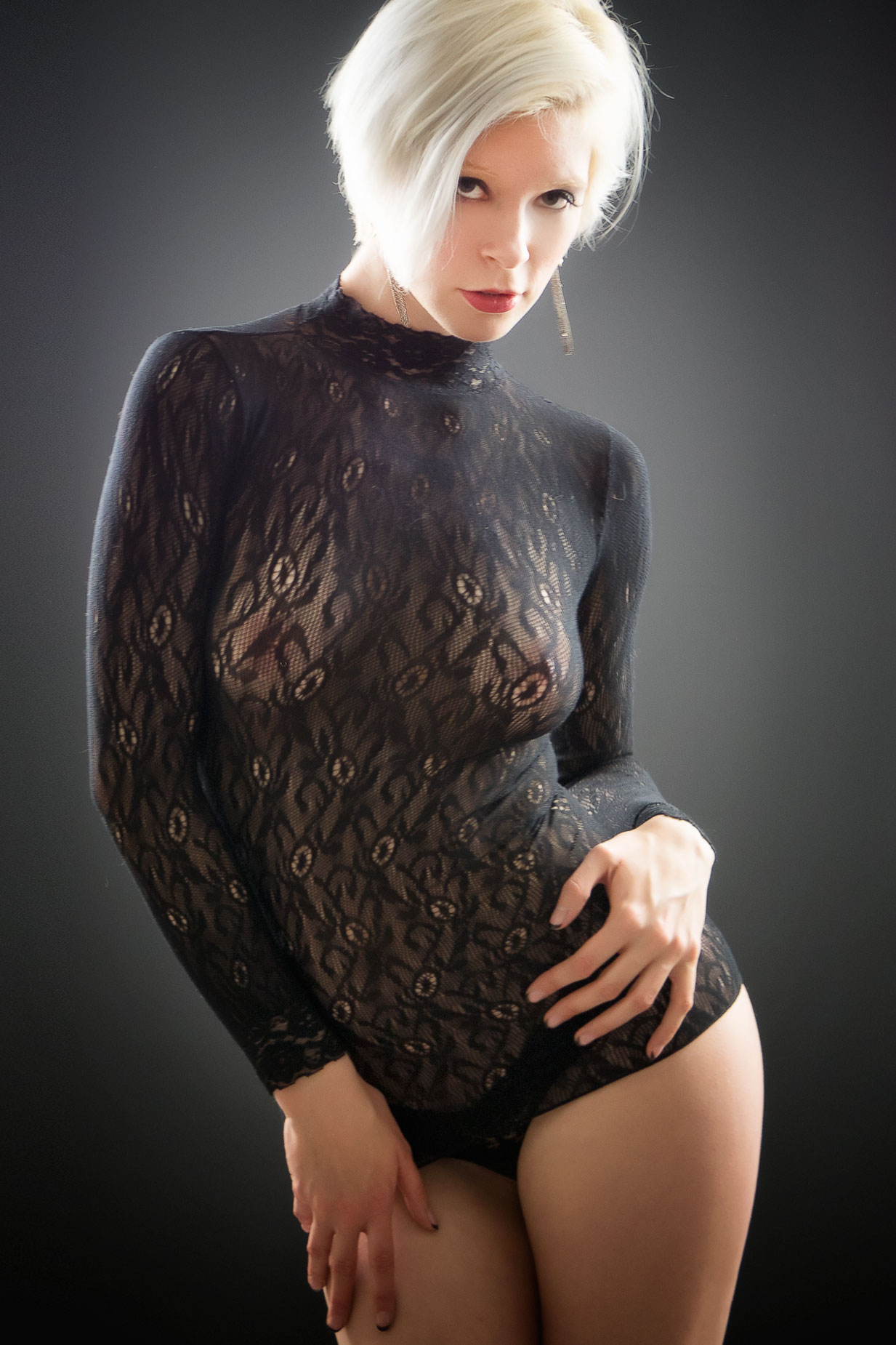
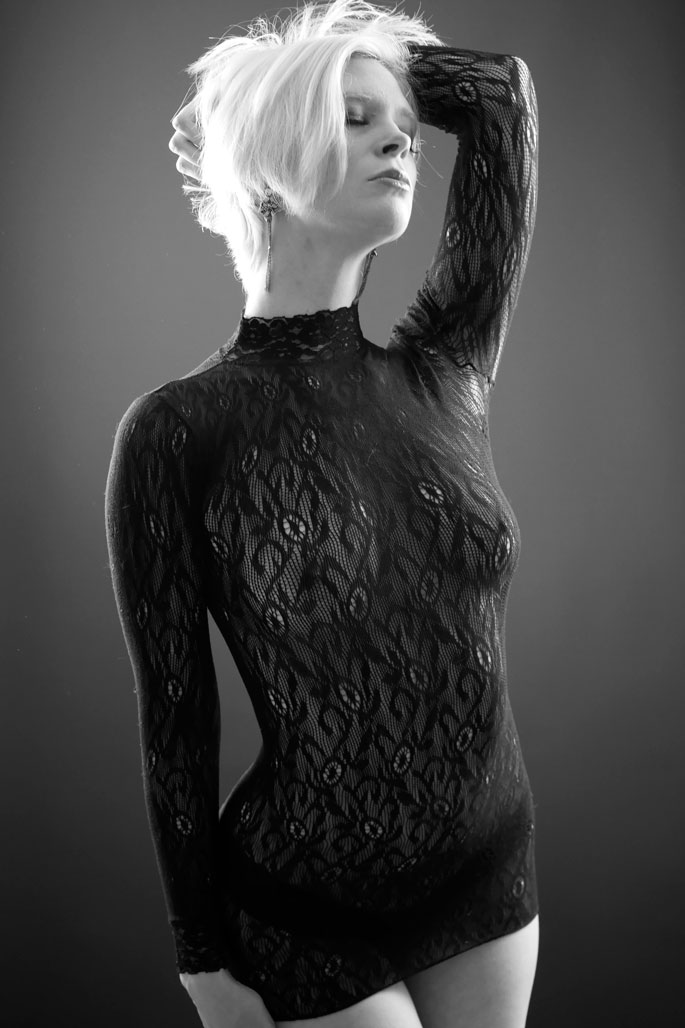 How I made this Portrait: Many boudoir photographs are shot as environmental portraiture but I get many requests from models who prefer to shoot this genre in the studio, if only for privacy reasons. When shooting boudoir or intimate portraits I sometimes like to work in monochrome to produce a more quietly, pensive look. At left is an unretouched JPEG that was shot in direct monochrome mode—all images from this session were shot as RAW+JPEG—from the same session as the featured image. Lately I prefer making these images in color like our featured image above right. As always this decision is between the subject and photographer.
At a risk of sending our younger readers rushing off to IMDB, Pam Simpson’s chameleon-like performance in front of my camera in this instance gave off a distinct Jean Harlow-vibe. The portrait was made with a Panasonic Lumix GH4 and Leica DG Macro-Elmarit 45mm f/2.8 lens that I purchased used from KEH. Lighting for the portrait was provided by Westcott’s (now discontinued) Two-Light Daylight D5 Softbox Kit. For both images of Ms Simpson, I placed the main light at camera right with the second light behind the subject at camera left. The background is a Savage Infinity vinyl Black backdrop. The exposure was 1/30 sec at f/4 and ISO 640.
The original (color) RAW file was retouched in Imagenomics’ Portraiture before being lightly enhanced with Color Efex where it was layered with the Glamour Glow filter to mimic the soft focus often used in movie glamour images of that 1940’s.
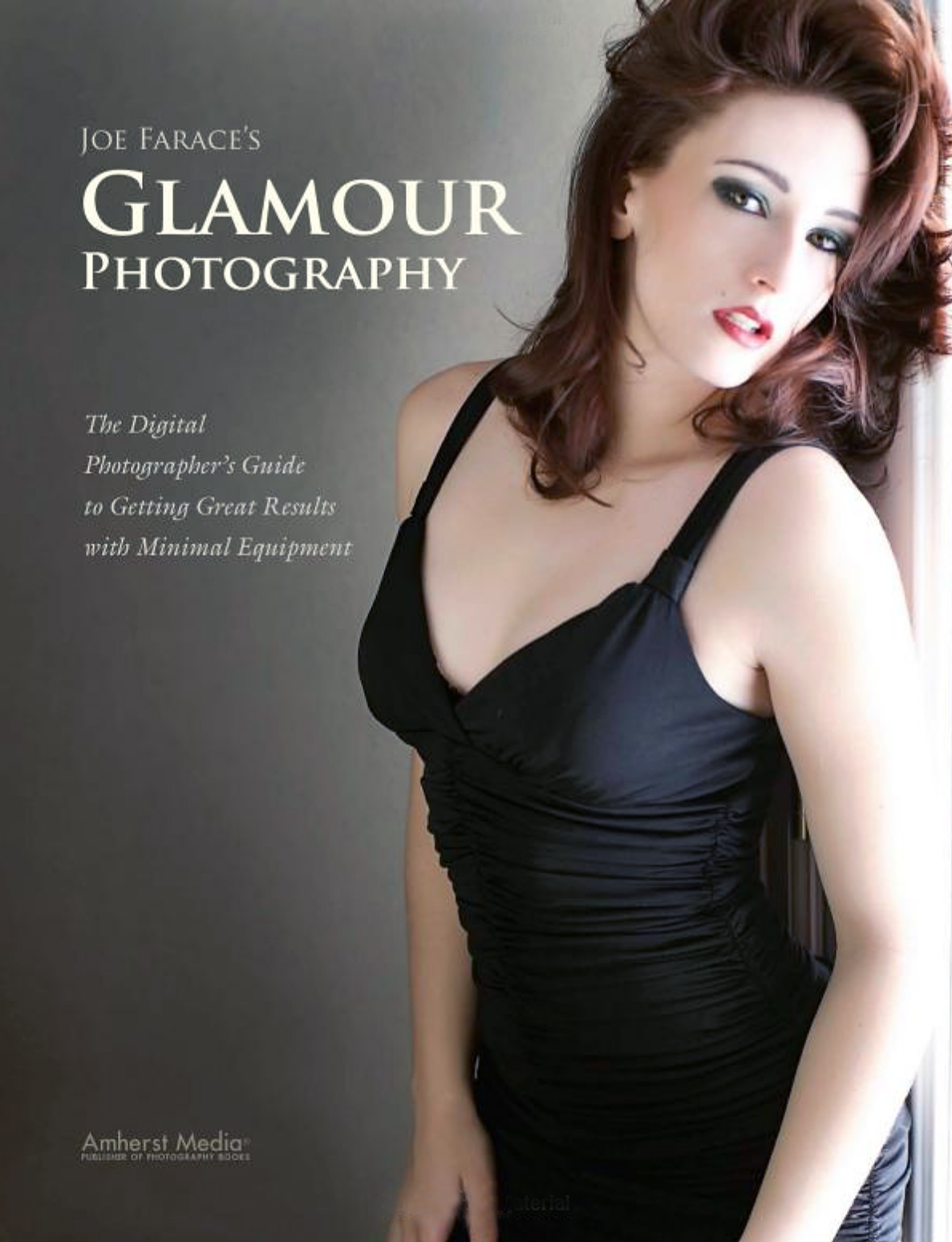
My book Joe Farace’s Glamour Photography is full of tips, tools and techniques for glamour and boudoir photography and includes information on the cameras and lenses used as well as the complete exposure data for each image. New copies are available from Amazon for $30.54 with used copies starting around ten bucks as I write this. The Kindle version is $19.99 for those preferring a digital format.