
Today’s post might be considered Part 3 of my series on image sharpness You can see the other parts here and here. It’s also National Zoo Lovers Day that encourages us to get out and explore our local zoos.
Today’s Post by Joe Farace
“Sharpness is a bourgeois concept”—Henri Cartier-Bresson
 When I replaced my old computer with a new 5K iMac it changed the way I view and work with many of my older digital images. In the past, some of my photographs were made using older, lower resolution digital cameras and when viewed on softer CRT monitors they don’t compare with how they look today on higher resolution, crisp and contrasty LCD monitors. All of which brings up the question…
How Sharp is Sharp Enough?
The basic laws of imaging state that only one part of a three-dimensional object can be in focus at the image plane. This means the areas that are in front of and behind the focus plane appear more or less in focus or as I like to call it “acceptable focus.” This is, of course, what depth-of-field is all about.
At the point of critical focus, there is a range of acceptable focus that lays one-third in front of that point and two-thirds behind it that is covered by the term depth-of-field. This includes an area that your eyes perceive as being in focus and is affected by several things: Depth-of-field increases as the lens’ aperture is stopped down and decreases as the aperture gets larger, It increases as the the camera-to-subject distance increases and decreases when the reverse is true.
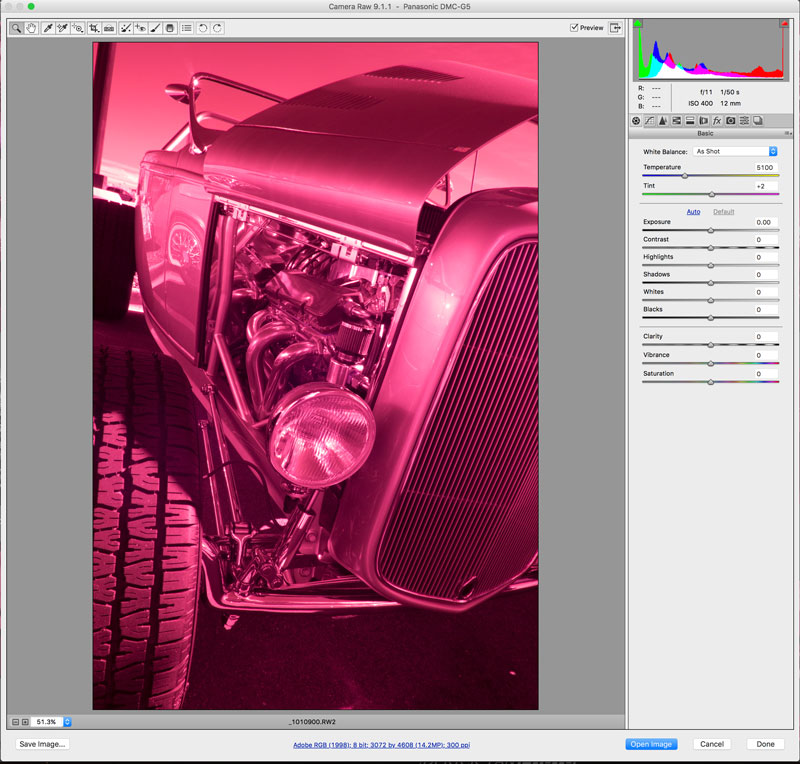
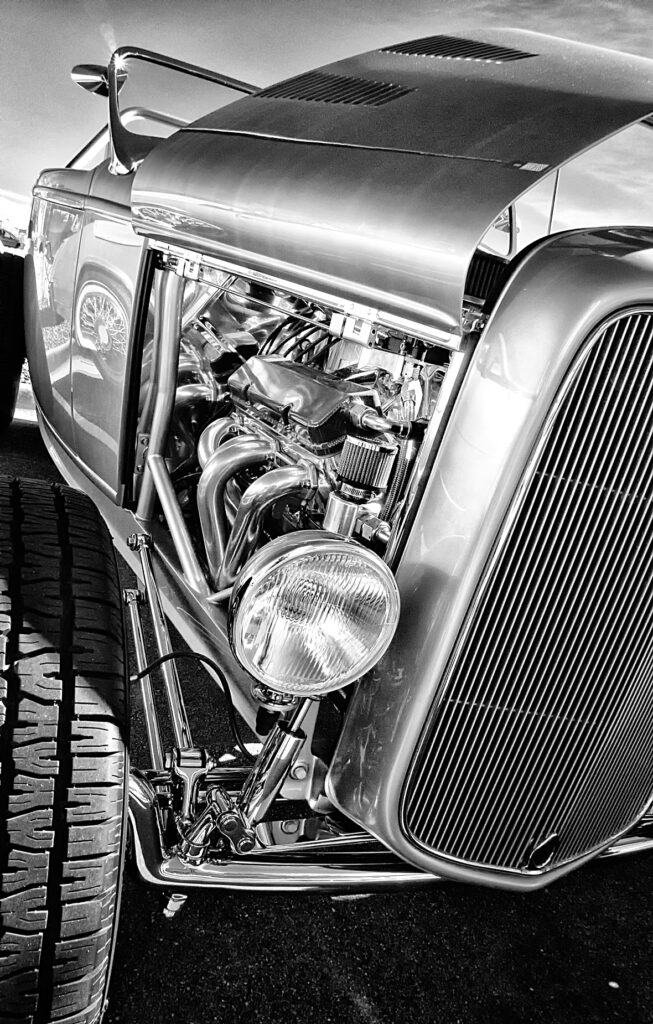 How I Made this Image: I photographed this hot rod with a Panasonic Lumix G5 that had been converted to infrared capture by Life Pixel with their Standard IR (720nm) filter. The lens used was the Lumix G Vario 12-32mm f/3.5-5.6 kit lens (at 12mm) that is not without its own sharpness concerns. The exposure was 1/50 sec at f/11 and ISO 400. The RAW file was opened in Adobe Camera RAW (above right) then converted to monochrome using Silver Efex.
Focusing infrared images: When shooting infrared images with AF lens, like the 12-32mm f/3.5-5.6 kit lens, I try to shoot small f/11-16 apertures to cover any depth-of-field challenges tat are created by infrared focus shift. You can read about it in my post Focusing for Infrared Capture. For the most part this method works, depending on the lens used.
With manual focus lenses, I focus them using hyperfocal focusing. What’s that? The Hyperfocal Distance is the specific point of focus where any object that lays between that distance and infinity is in focus. Some lenses have an aperture ring but this feature is gradually disappearing from modern optics. Most vintage lenses not only have an aperture ring but have a depth-of-field scale, which can be helpful when using hyperfocal focusing.
Here’s how I do it: You select an aperture on the lens, then rotate the focusing ring setting so the aperture appears opposite the infinity mark on the lens’s depth-of-field scale. Bingo, you’re all set and it’s how all of my images made with the Zenitar manual focus lens were made.
 I’ve found that Life Pixel does a great job with IR conversions and they’ve done some of the conversions for my Canon DSLRs and all my Panasonic Lumix G-series cameras. This is not a paid or sponsored endorsement, just my experience.
New copies of my book, The Complete Guide to Digital Infrared Photography are available from Amazon for $41.98, with used copies selling for around $18, as I write this. New copes of my book Creative Digital Monochrome Effects that has a chapter on IR photography are available from Amazon for $16.15, with used copies selling for around eight bucks, as I write this.