
In response to several suggestions from new readers of this blog, I wanted to get back to the basics with some recent posts and take a look at some subjects that may challenge new photographers, especially those people switching from cell phones to using a DSLR or mirrorless camera.
Today’s Post by Joe Farace
“Dearer to me than the evening star A Packard car A Hershey bar Or a bride in her rich adorning Dearer than any of these by far Is to lie in bed in the morning.”–Jean Kerr
At photowalks and workshops, the number one question I get from students and one that usually permeates the entire event is their quest for obtaining “the perfect exposure.” I used to tell my Basic Photography students at Columbia Maryland’s Howard Community College that the perfect exposure was the one they liked.
Ask The Man Who Owns One
The above statement wasn’t the first car motto, but it certainly was among the most memorable: “Ask the Man Who Owns One” went beyond a seasonal sales campaign. It eased into slogan status, then became the official motto of the Packard Motor Car Co. Its longevity is still upheld by Packard collectors who proudly flash the “all Packard” phrase in signage and bounce it around in conversations with friends. And as a former Packard owner, that phrase resonate with me today, long after the car that I owned that now sits in an Arizona museum.
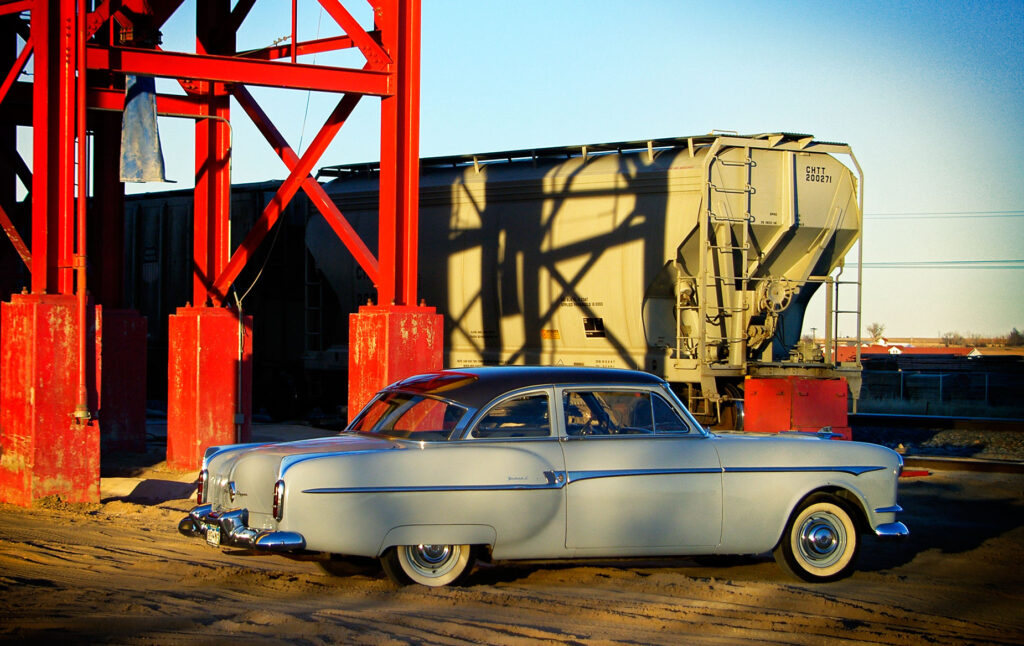
How I made this photograph: My 1953 Packard Clipper Club Sedan was photographed alongside a railroad siding in Brighton, Colorado using a Samsung Pro 815 with it’s built-in Schneider-Kreuznach 28-420mm (equivalent) f/2.2-4.5 lens. The exposure was 1/600 sec at f/3.2 and ISO 50. I did some slight perspective correction to get the red structural elements on the left to appear straight. The image was, for some reason, was shot in 16:9 aspect ratio but I cropped it into an elongated 3:2 image for display here. The full 16:9 image can be seen in the thumbnail for this post. Trivia: This setting was used as a location in the funny (to me anyway) Bill Murray film Larger than Life.
The Basics: As is true for all aspects of photography there are no one right way to accomplish anything. While some influencers, bloggers and program presenters may disagree and argue that only their methods are the one, true perfect way to obtain correct exposure, I disagree. There is no “my way or the highway” for photography; you get to choose the method that works best for you. Even a road less traveled is OK if it produces the results you want. If it doesn’t produce the kind of results you like then it’s time to look at alternatives or fine-tune them using your favored subject matter and preferred way of working.
For example… if you have a light meter reading–either from a hand held meter of the camera itself–for a subject that’s 1/500 sec and f/11 at ISP 200 and want to use a slower shutter speed to allow for subject blur and choose 1/125 sec you will have to adjust the aperture (make it smaller) so the equivalent amount of light will fall on the sensor or film frame. When selecting either aperture (Av) or shutter priority (Sv) automatic modes, your camera should give an equivalent exposure, eliminating most but not all of the guesswork. For 90% of the photographs that you’ll make, these automatic exposure modes do a fantastic job in producing correct exposure but its those last 10% that’ll kill you. That;’s why sometimes you have to shift into Manual Mode.
So what’s the perfect exposure? It’s the one that you like. Go make a few tests, shooting brackets either manually or automatically to find out for yourself. One of the advantages of using digital capture is that it won’t even cost you any money to find out.

Along with Pulitzer Prize-winning photographer Barry Staver, I’m co-author of Better Available Light Digital Photography that’s available from Amazon for $24.50 prices with used copies selling for around fourteen bucks, as I write this.