
Would you believe National Toast Day honoring the humble slice is on the Last Thursday in February? I love a slice of toast and toasted sandwiches too. Toast is so very versatile. It carries a multitude of jams, jellies, and don’t forget peanut butter!
Today’s Post by Joe Farace
“Black and white is the salt and pepper of colors, for life tastes bland without them.”— Vikrmn
Tip #1: Next to your camera, the most important thing you should bring with you to the next car show is lots of memory cards and by that I mean, fast cards with high capacity.
A Few Tips for You
Tip #2: Whether you’re photographing cars indoors or outside, sometimes getting the correct exposure can be tricky, so you should always follow one of Farace’s most important Laws abour photographing cars: You should slightly overexpose white and light colored cars and slightly underexpose black or dark colored ones. Otherwise they’ll all end up looking like 18% grey to your camera’s metering system.
Tip #3: While I shoot cars in color I sometimes will use the camera’s black and white mode to produce images that produce a vintage look. Can’t make up your mind about whether to shoot color or monochrome? Shoot it in RAW+JPEG and you can make that decision later and convert to black and white using monochrome conversion software like Silver Efex. This is something I often do, especially with portraits, but also applied to the below photograph of a real Hummer .
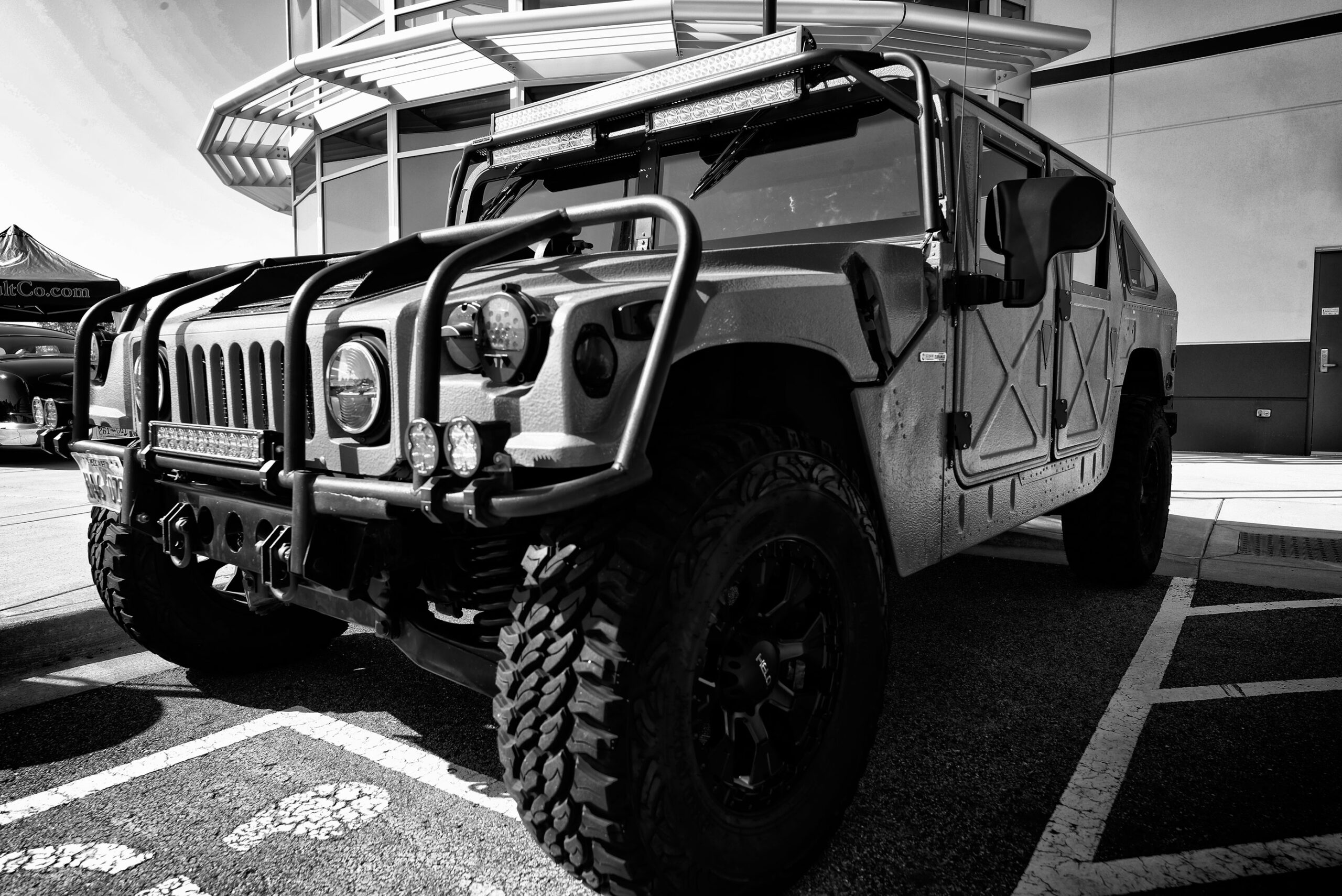
How I made this photograph: This is a real big photograph (18.38MB JPEG) of a real hummer, not some Chevy pickup dressed up like a Hummer or an overweight—the battery weighs as much as a Honda Civic—EV Hummer but the real thing! The camera used was a Panasonic Lumix S1R full-frame mirrorless camera with a Sigma 14-24mm f/2.8 DG DN Art lens (at 14mm.) The Program mode exposure was 1/1000 sec at f/6.3 and ISO 320. The image file was converted to monochrome using Silver Efex’s Underexposed (-1 EV) preset..
Tip #4: To maintain consistent depth-of-field, I’ll shoot in Aperture Priority mode and typically like to bracket exposures in one-third stops and usually one or more of the three shot bracket is perfect.
Tip #5: Don’t be frustrated by the lack of space and crowded conditions you’ll encounter at some shows. That’s the time to shoot images of parts of a car or some its finer details, like hood ornaments. My wife loves shooting close-ups at shows and is constantly shooting hubcaps and wheel details. You should use this lack of space to your advantage by finding small things, such as details in a car’s grille or the sensuous lines of a street rod’s fender and capture them in sharp focus.
Lens Choice: That’s one of the reasons I like to use wide-angle zooms for car shows, especially ones that let me get close and fill up the frame with part or even the entire car while eliminating distractions. The Sigma 14-24mm f/2.8 DG DN Art lens I used for the featured image focuses as close as 11-inches. Tip 6: When shooting close ups, start by working in close and gradually back off the zoom ring until some extraneous details appear in the frame, then re-zoom to crop them out—in camera. Tip 7: A low angle also helps to simplify the background.
If you enjoyed today’s blog post and would like to treat me to a cup of Earl Grey tea ($2.50), please click here. And if you do, thanks so much.