
Recently, my wife and I were having lunch and I told her I was having trouble coming up with a new theme for my Tuesday blog posts and she suggested “Tricky Tuesday” as a way to share some of the different tricks, tips and techniques I’ve used over the years in the studio—and outside it too. Here’s another try at this new theme…
Today’s Post by Joe Farace
There are two ways of spreading light: to be the candle or the mirror that reflects it. —Edith Wharton
 DEFINITION: A softbox is an enclosure built around a light source that typically has reflective side and back walls with diffusion material in the front to soften the light. A softbox can be used with either electronic flash or continuous light sources and can be said to emulate natural window light. One way that you can think about a soft box is that it’s a more directional umbrella.
Another Way of Looking at it
You will occasionally hear a soft boxe called “light box” and even “lightbanks.” I prefer the more generic term “soft box” because it can refer to the many different shapes and sizes in which they’re they’re available.
 Any light source that’s placed inside a softbox (or outside as in some models produced by Westcott) can be aimed to shoot through the diffusion material on its front toward the subject or it can be bounced into the back of the soft box before exiting the front creating even more diffuse light. Some soft boxes let you use them either way so you can have more powerfully direct, yet softened light or the maximum possible soft light experience.
There are lots of reasons to use a softbox: One is the clean unobstructed highlight that’s reflected in the subject whether it’s a reflective subject like a product or a portrait subject’s eyes. The other is the ability to use a shorter distance between the light and the subject maximizing the soft box’s broad light. One of the downsides of using softboxes is as they get bigger they also get deeper. Remember one of the rules of portrait lightning is that as a light source gets bigger, it also gets softer. Conversely, the smaller a light source is, the harder it becomes.
You also obtain improved control of the light because a soft box’s flat two dimensional diffuser is direct (or can be feathered) while its opaque shell keeps light from spilling onto surrounding objects or creating flare into the camera lens.
Lighting equipment innovator Gary Regester created a soft box with a thinner-than-normal profile he called the Plume Wafer. Its narrow profile results from using a combination of aluminum tubes and flexible fiberglass rods. Pole pockets inside the softbox reinforce the corners. The Wafer has a narrow profile and its silver-with-white interior and graduated inner baffles create efficiencies allowing a choice of contrast across its front diffuser panel. For all of these reasons it’s the go-to softbox I use with my Paul C. Buff monolights in my home studio for my portrait, glamour and boudoir photography.
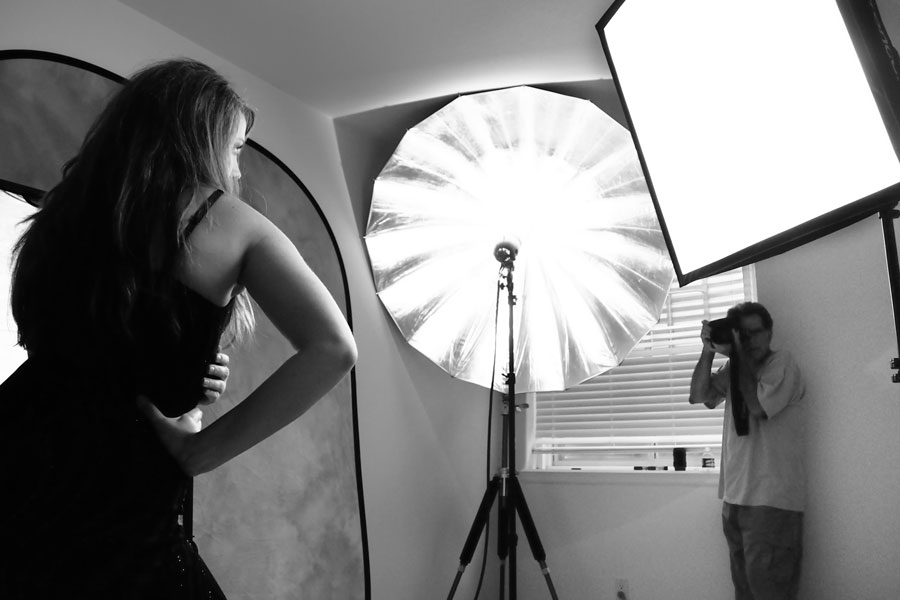
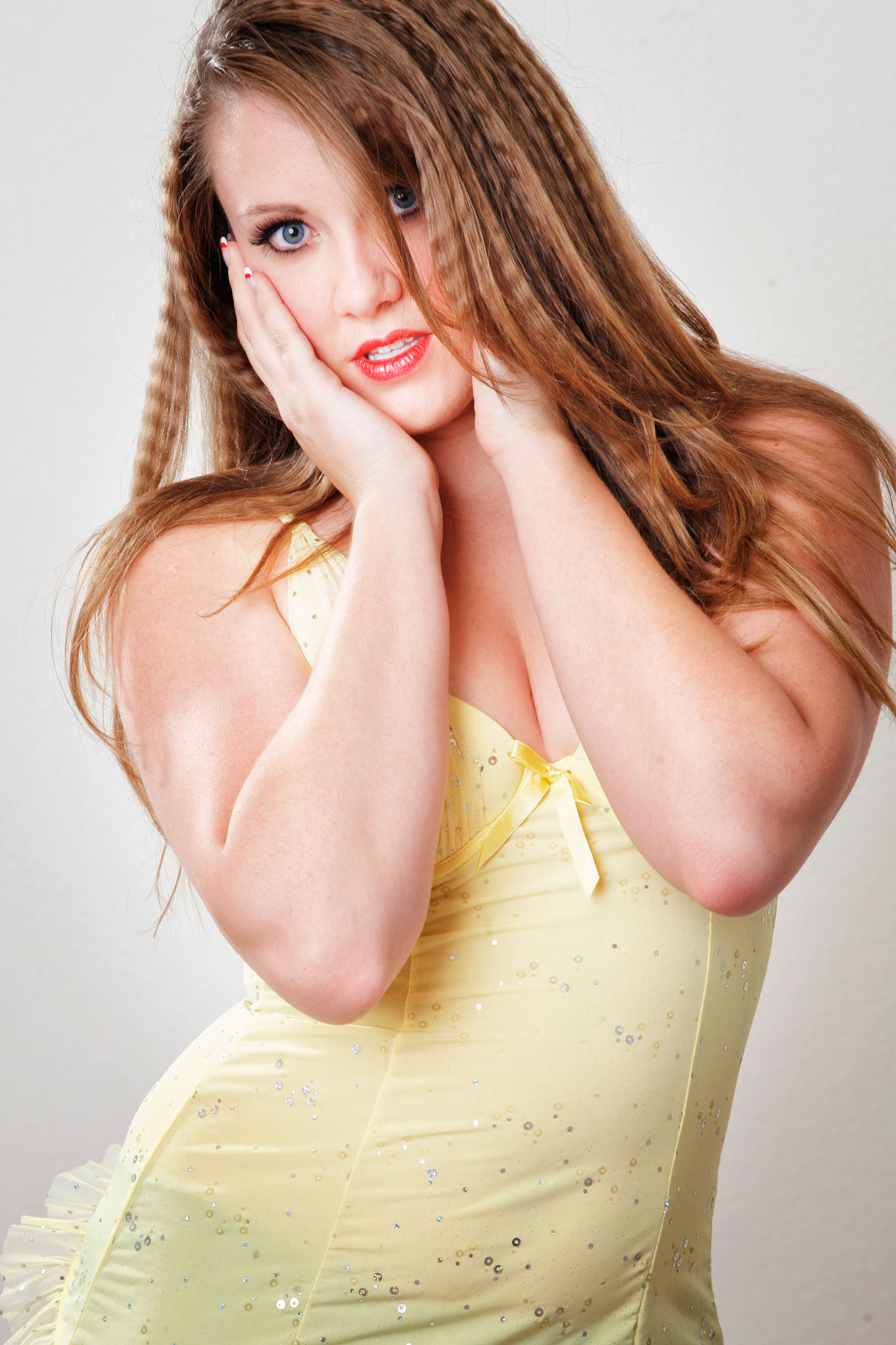
How I Made this Portrait: Today’s featured portrait of Amber was made while working in my home studio. The main light had a 28-inch (71 x 71cm) square Broncolor soft box attached and was placed at camera left. Fill is provided by a second Broncolor light head with a 60-inch (152cm) parabolic umbrella mounted. See setup photo at above right. I cranked up the power in the second head, lowering the lighting ratio to 2.5:1 but (I think) the combination of the Broncolor softbox and the big umbrella produced excellent light quality.
The camera used was a Canon EOS 5D Mark I with an EF 135mm f/2.8 SF lens (at “zero” soft focus. The exposure was 1/60 sec at f/9 and ISO 200.
 If you enjoyed today’s blog post and would like to buy me a cup of Earl Grey tea ($2.50), click here. And if you do, thank you very much.
My book Joe Farace’s Glamour Photography is full of tips, tools and techniques for glamour and boudoir photography with new copies available from Amazon for $30.54. Used copies are starting at the hard-to-beat price price of around ten bucks and the Kindle version is $19.99 for those who prefer a digital format.