
Today is National Hug a Bear Day and it encourages everyone to share the warmth of an embrace on November 7. While it’s certainly not about real bears, this day reminds us of the profound benefits of physical affection. Give a big hug to your loved ones, your cherished teddy bears, and spread comfort and love.
Today’s Post by Joe Farace
“Never confuse the improbable with the impossible: Burke’s Law.”—Burke’s Law, 1963
 I recently received an email asking, me to explain the concept behind the so-called “Farace’s Laws.” I’ll be sending that reader a link to this post so he will get some background and history on where it originated. It all began with,,,
Burke’s Law was a TV detective show that ran from 1963 to 1966. It starred Gene Barry as millionaire captain of Los Angeles Police Amos Burke, who was chauffeured around in a 1962 Rolls-Royce Silver Cloud II. The series was revived in 1994–1995 with Barry reprising the role. The title reflects Burke’s habit of dispensing wisdom to his underlings, for example, “Never ask a question unless you already know the answer. Burke’s Law.” To put it all in perspective, here are some other rules or “laws” that might help you as you pilot your way though life.
A Few Rules to Live By
Some of the most commonly quoted informal laws, principles, and adages describe human behavior, productivity, and life.
Murphy’s Law: “Anything that can go wrong will go wrong.” This is named after Captain Edward A. Murphy Jr., a U.S. Air Force aerospace engineer who worked on rocket-sled tests in 1949.
Parkinson’s Law: “Work expands so as to fill the time available for its completion.” People often quote this when talking about procrastination or why projects take longer than expected. Cyril Northcote Parkinson was a British naval historian and author of 60 books, the most famous of which being Parkinson’s Law.;
The Peter Principle: “In a hierarchy, every employee tends to rise to their level of incompetence. Laurence J. Peter, was a Canadian educator and psychologist.
Hanlon’s Razor: “Never attribute to malice that which is adequately explained by stupidity.” In 1980, Robert J. Hanlon of Scranton, Pennsylvania submitted this adage to a law compilation book. A “razor” in philosophy is a rule that’s used to “shave off” or eliminate unlikely explanations and unnecessary assumptions.

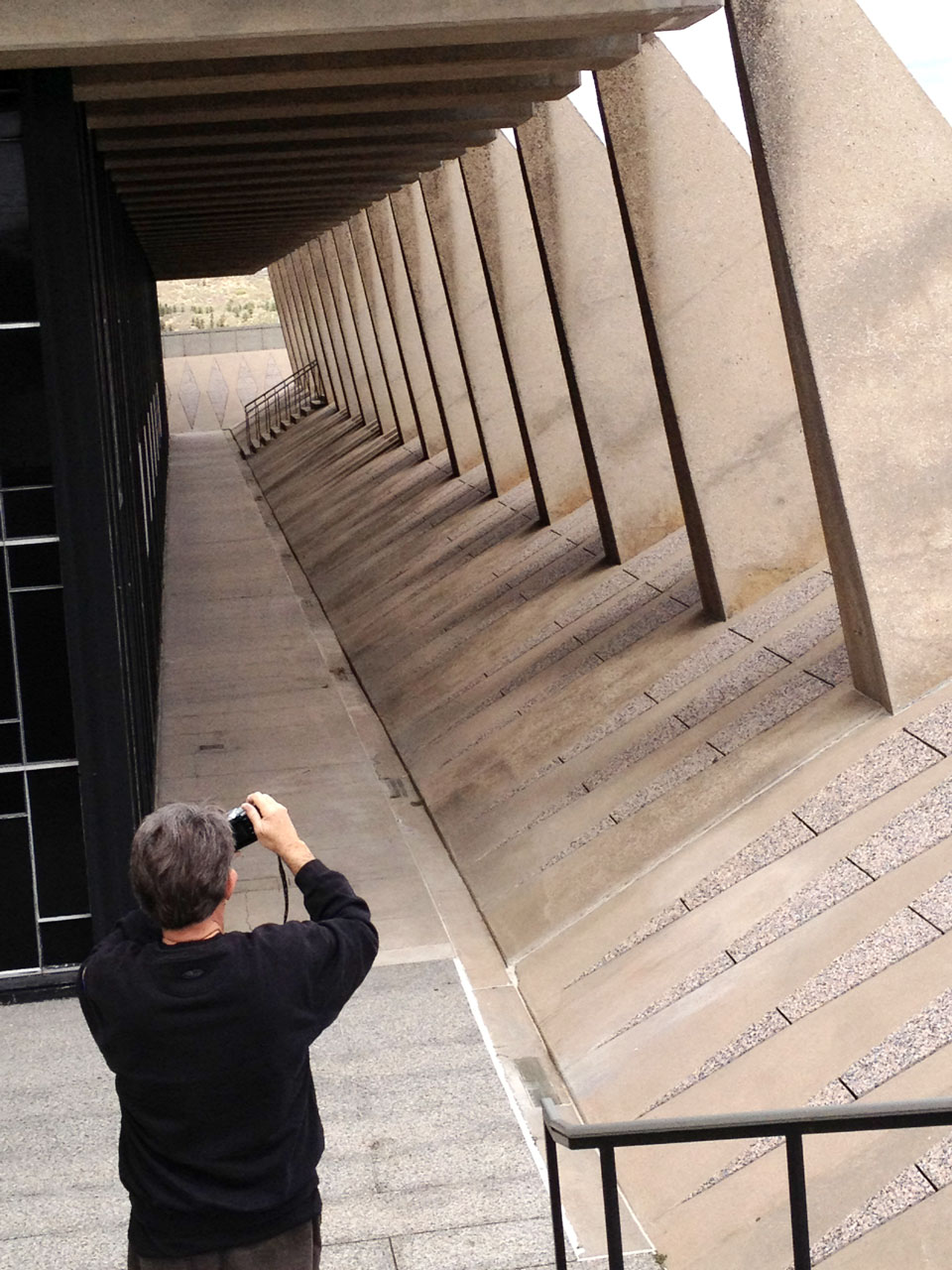
How I Made this Photograph: : Even the foundation of the Air Force Academy Chapel is beautiful and echoes the design of its superstructure. I got a kind of Stonehenge feeling from it and photographed this section of the chapel using a Pentax K-01’s using its Extract Color digital filter with an exposure of 1/640 sec at f/8 and ISO 400.
A Look at Farace’s Laws
During a boom in the magazines world, in addition for writing for several photography magazines, i also wrote articles and reviews for several computer publications but that was before the Dot Com bust decimated them too.
Back when I was writing for ComputerUser magazine I came up with a series of “Farace’s Laws of the Computing Universe.” I figured if Murphy could have a law and there was Burke’s Laws, my inspiration for the idea, there could also be Farace’s Laws. Here’s a funny story about the first time I used the term “Farace’s Laws” in an article for ComputerUSER: Shortly after the article appeared I received and email form a reader saying, “I’ve been hearing about these “Farace’s Laws” for years, what the big idea behind them?”
When I started writing exclusively about photography, I dragged those laws along with me and they surfaced from time-to-time in my magazine articles and books and, later on, in these blog posts. There’s an old computer adage that goes: “Garbage in, Garbage out” that’s been attributed, if not literally, to computer pioneer Charles Babbage. I think the same thing’s true for photography.
New Farace’s Laws pop up from time-to-time in these blog posts and in my YouTube videos. One of them is that “The best captured files make the best photographs.” Here’s some of my thoughts on this subject: I don’t always shoot in RAW but always do it when working under tricky lighting conditions, as with the available light portraits featured here from time-to-time, especially on Sundays. When shooting under these kinds of conditions, most DSLRs and mirrorless cameras have a Histogram feature that you can use to home in on the proper (or best) exposures. For critically important photographs, you can also put the camera in Manual mode and bracket exposures.
If you enjoyed today’s blog post and would like to treat Joe to a cup of Earl Grey tea ($3.50, Starbucks raised the price of Earl Grey), click here. And if you do, many thanks.