
Today’s Post by Joe Farace
“A photographic portrait is a picture of someone who knows [that] he is being photographed.”—Richard Avedon
The above quote shows that the late Richard Avedon was not only was a genius behind a camera but also unusually perceptive about his photographs and what they represented. The truth is that any portrait seldom represents reality. Instead it’s a snapshot of a point in time and though lighting and posing presents an idealized version of someone who knows they are being photographed.
Any portrait shoot is a collaborative effort so its important that you start by talking to your subject to discuss what you and they would like to accomplish during a shoot. Many times I’ve seen photographers shooting portraits and expecting the subject to do all the work.
 In a recent post I wrote about how each photographer sees the world in an entirely different way. Well, the same can be said of the different kinds of portrait subjects you might encounter especially when working in the genre of glamour or boudoir photography. Sometimes that approach works and sometime it doesn’t and that’s because there are basically two kinds of photo subjects:
Inner-directed people are the Energizer bunnies of photo subjects. You tell them to stand “over there,” point the camera at them and they will change poses as fast as you can click the shutter. This type of subject probably represents 20% of the subjects that you’ll ever get to photograph.
When photographing inner-directed people, you’ll get lots of good poses, some great ones and a few not so good because the subject isn’t getting any feedback, except from themselves. The other downside is that you will also shoot more photos, which in turn takes more editing time. But the BIG upside is that this kind of model will make you look like a better photographer than you really are.
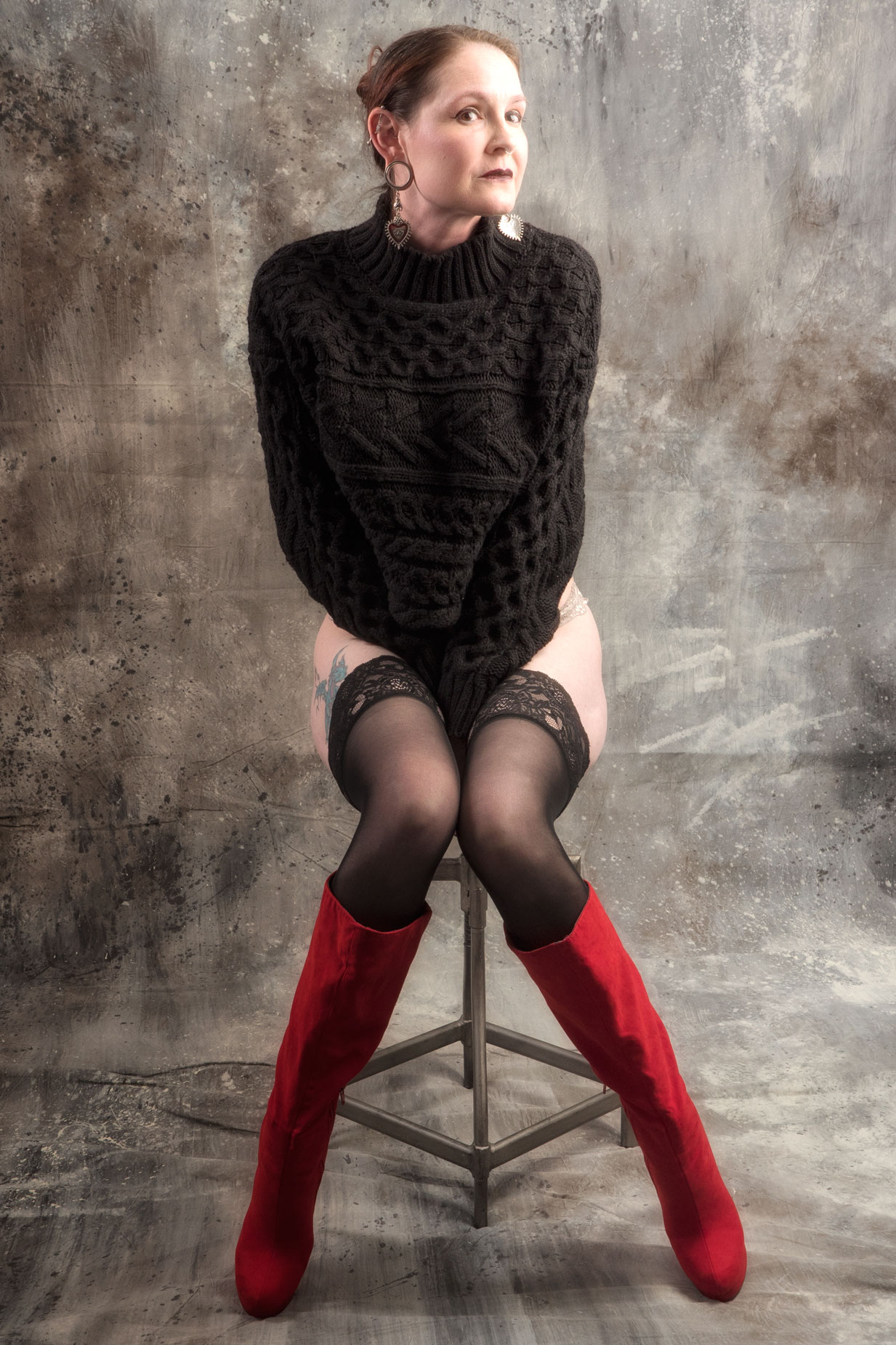
About this portrait: Scarlet Ana is the best kind of model; she an actress. I have found that that actresses along with figure model are the very best glamour models. Her personality and posing inspires me to make the best photographs during a shoot. And that’s what a talented inner-directed model can do for your photography.This image was made during a series of warm-up exercises that I re-introduced to the beginning of my current glamour model shoots. You can read about it in that linked post or see a visual sequence of the technique on pages 101-102 of my book, Part-time Glamour Photography – Full-time Income.
The camera used was a Panasonic Lumix GH4 with a Lumix G Vario 14-45mm f/3.5-5.6 lens (at 46mm) with an exposure of 1/125 sec at f/9 and ISO 200. The lighting setup consisted of a DigiBee DB800 with a 37x27x12inch Plume Ltd. Wafer soft box that was placed at camera right. An Alien Bee B800 with an 16 x 30-inch Westcott Apollo Strip soft box was located at camera left. Another DigiBee DB800 with a Paul C Buff 18-OMNI Reflector, with a triple-layer Diffusion Sock, was located at camera left and placed neat the back corner of my home studio.The color RAW file was opened in Adobe Camera RAW slightly tweaked with its sliders then converted to monochrome with Silver Efex with a layer of Glamour Glow filter from Color Efex.
Outer directed subjects represent the other 80% of photo subjects and they expect you to tell them what to do at every step of the way. If the inner-directed subject will make you look like a better photographer, the outer-directed model will challenge your posing sills. Photographing this type of subject takes longer (and you’ll shoot fewer images) and you’ll need the extra time to communicate exactly what you want them to do. They will respond better if you occasionally (key word) show them what the photograph looks like on the camera’s LCD screen.
The point of any pose is not just to look natural, although that may be one lofty objective but perhaps to tell a story and there are many ways you can pursue that goal. It’s up to you to tell outer directed subjects how to pose and in order to do that, you need to know what you want but you also need to be gentle and allow them to be who they really are. What I do is try to watch what they do and than use a pose that is an improved variation of what they do naturally.
While exploring any of these concepts, be sure to enjoy yourself because having fun is the single most important component of photography. It is for me and I hope will be for you as well.
 If you enjoyed today’s blog post and would like to treat Joe to a cup of Earl Grey tea ($2.50,) click here. And if you do, many thanks.
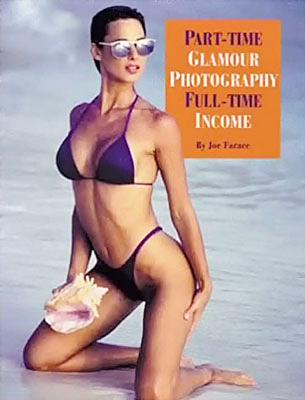
New copies of Part-time Glamour Photography – Full-time Income are available for $14.95 (some sellers are less) with used copies starting around five bucks. This book is film based but my book Joe Farace’s Glamour Photography is full of tips, tools and techniques for digital glamour and boudoir photography with new copies available from Amazon for $23.64. Used copies start around twenty-three bucks too, as I write this and the Kindle version is $18.49 for those who prefer a digital format.