
IR in the snow? In May? According to National Weather Service records, Denver’s winter was one of the warmest and driest in history. Usually, there’s no snow in Denver after April 28 but not this year, As of 6:00 AM, last Wednesday, 4.7 inches of snow was recorded at Denver International Airport. Another two inches of snow was expected to fall before the storm’s end. As I write this on May 6, there is about five inches of snow in my back yard where today’s featured image was made and more was expected by this afternoon
Today’s Post by Joe Farace
“If winter comes, can spring be far behind?” ―
OK, maybe was an optimist because I’m writing this post as I watch the snow falling today (see above) here on Daisy Hill for one of the rare May snowstorms that I’ve experienced since moving to Colorado in 1981.
Infrared in the Snow? Why Not.
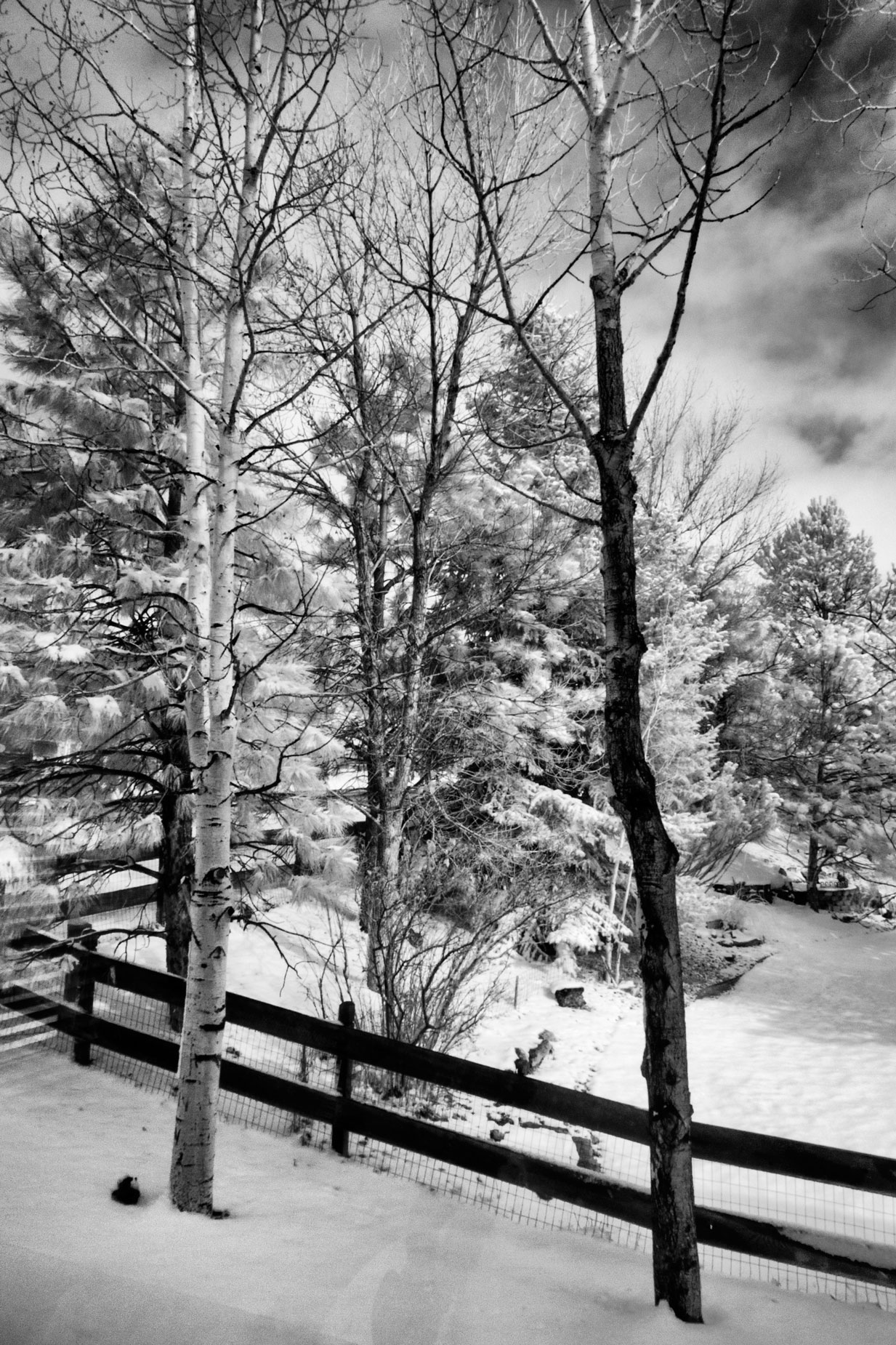 In traditional infrared photography, the Wood Effect in infrared photography produces the bright to white reproduction of the chlorophyll layer that’s found in deciduous plants. Even non-deciduous plants and trees can show some of this effect albeit slightly. To my mind, digital infrared capture can work perfectly well even with the snow on the ground.
How I made this photograph: Continuing a theme I began with an old post entitled “What Inspires Your Photography,” I’ve been making a few digital infrared images during this past winter when the only “leaves” on the trees are needles on evergreens, like those Ponderosa Pines in the background of these leafless aspens. Yes, evergreens do not respond to infrared photography as dramatically as deciduous trees but my experience has shown that there is always some kind of response depending on the time of day when you make the image and (maybe) even the time of year.
Today’s featured image was shot literally in my own backyard with a Panasonic Lumix G6 that had been converted to infrared-only capture by LifePixel using their Enhanced Color IR (665nm) filter with a Lumix G Vario 12-32mm f/3.5-5.6 ASPH kit lens. This lens was the subject of my post, It’s Not the Sharpest Knife in the Drawer, that also happens to include a longer than normal prologue about image sharpness when working in the infrared idiom. Give it a read when you have time. The exposure for this RAW file was 1/40 sec at f/16 and ISO 400. The RAW file was converted to monochrome using Silver Efex with the Full Spectrum preset with some tweaks of the Contrast slider. Since this lens is not known for it’s sharpness I used the Smart Sharpen (Filter>Sharpen>Smart Sharpen) plug-in to provide what proved to be minimal sharpening over what perhaps was an image that suffered somewhat from Diffraction.
If you would like to experience some of the same thrill of discovery that occurred during the first phase of your personal photographic education, my advice is never stop exploring. Try some new things. Maybe it’s infrared photography but whatever you do this year you might want to try something that’s outside your comfort zone.
PS: You might want to check out the related post about shooting infrared color in the snow. that was created using a Panasonic Lumix GX1 that had been converted by Life Pixel using their Hyper Color conversion.
 I’ve found that Life Pixel does a great job with IR conversions and they’ve done some of the conversions for my Canon DSLRs and all of my Panasonic Lumix G-series cameras. This is not a paid or sponsored endorsement, just my experience.
New copies of my book, The Complete Guide to Digital Infrared Photography are available from Amazon for $41.18, with used copies selling for around twelve bucks, as I write this. Used copes of my book Creative Digital Monochrome Effects that has a chapter on IR photography are available from Amazon for around nine buck, as I write this.