
My Sunday Series on Available Light Portraiture continues today with an image of a model whose appearance always generates questions from photographers who would like to work with her. After our last shoot together, Maria told me that she was thinking of retiring, and as far as I know, she has moved. I’m pretty sure, has retired from modeling and if that changes, I’ll update this post.
Today’s Post by Joe Farace
In dreams, anything can be anything, and everybody can do anything. We can fly, we can turn upside down, we can transform into anything. —Twyla Tharp
In the Netflix series Stranger Things, the “Upside Down” was a mysterious extra-dimensional realm that was an integral part of the plot (at least in Season 1 and 2) but I don’t necessarily understand its place in portraiture.
Recent Social Media Trends
By “upside down” what I’m referring to is a trend in portraiture I’ve seen on the Internet, especially on Instagram. (You can follow me on there at @joefarace.) That trend is the practice of photographing female models lying on a sofa, bed or another piece of furniture so that their head is at the bottom of the frame; in other words, she’s upside down.
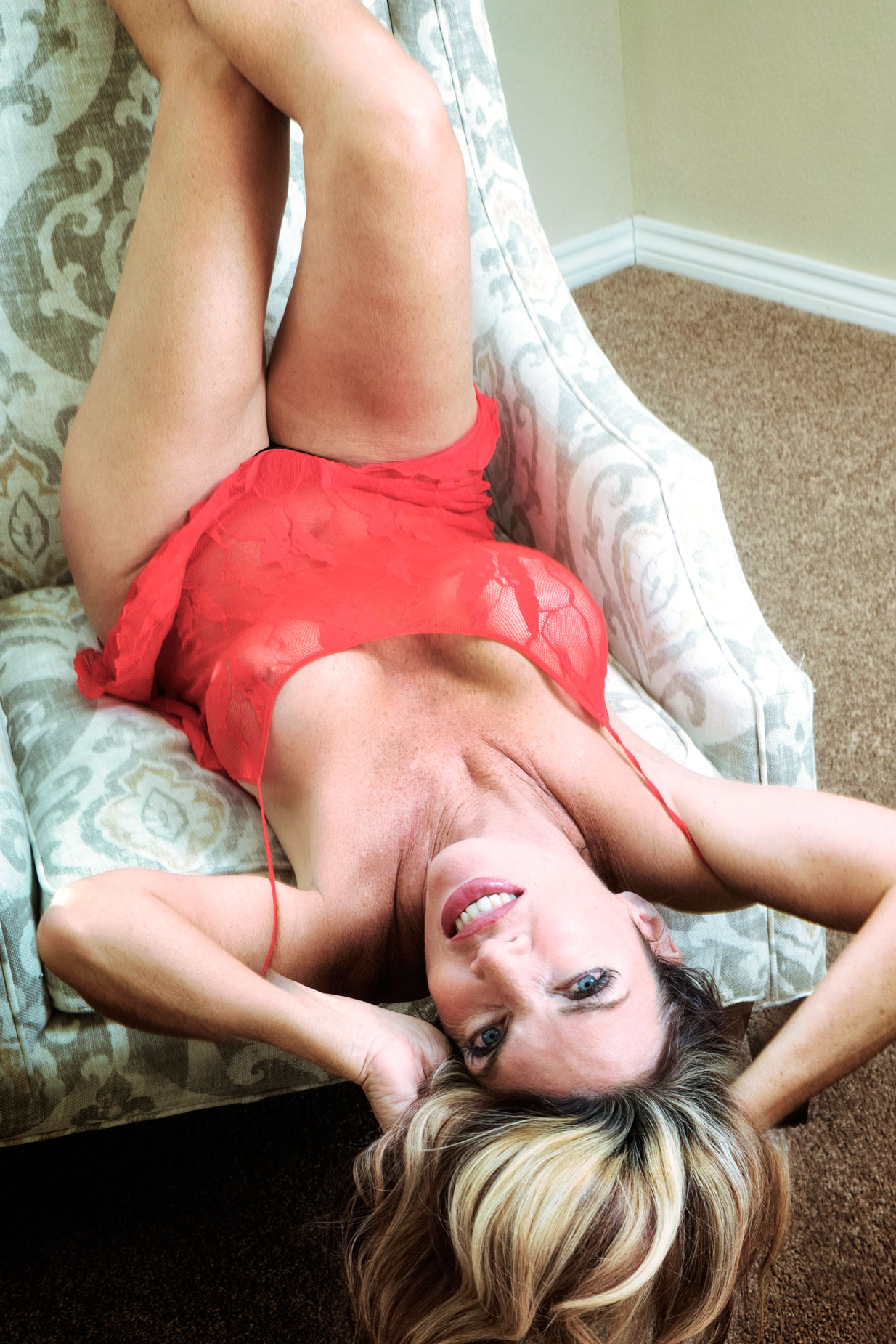 My first thoughts about this style is that it was an homage to pinup models from the forties or fifties but when looking at books written by the late Peter Gowland, one of the premier practitioners of glamour photography during that era, I didn’t see similar poses. I searched the Internet for some old Hollywood publicity shots and didn’t find any/many images like that but that doesn’t mean there isn’t any. Please let me know if you can tell me where I can see similar photographs.
To be doubly fair, some of these upside down portraits can be quite dramatic and, at least, were not photographed with wide-angle lenses used close to the subject, another unfortunate Internet trend. Maybe I’m a curmudgeon (and not embarrassed to admit it) but I find these upside down images somewhat disconcerting; Seeing a mouth where there should be eyes, which I think should be the focal point of any portrait. I have a theory that some subjects like this look is because they have a fear of photography* and because the portraits doesn’t look like them. Or maybe I’m all wet about these ideas and am not embarrassed to admit that either.
How I made this portrait: I looked though my files and found I had, indeed, once made an upside down portrait. It was a portrait of famous Internet model Maria Cedar. You can see her right side up here. I photographed her in the living room of my Daisy Hill home using a mixture of daylight from four large Southwest-facing windows at camera left and two smaller Northwest-facing windows at camera right. A Nissin i40 speedlight was used to porvide fill. The camera was a Panasonic Lumix GH4 with Lumix G Vario 14-45mm f/3.5-5.6 lens at 34mm with an exposure of 1/30 sec at f/8 and ISO 640. This was one of three similar shots, one of which I cannot show except in Patreon-only posts, that I made of her at that time and it’s the one I liked best to feature on this blog.
As I’ve said here many times before and it’s worth repeating, this is not a ”my way or the highway” blog. You may love your upside down portraits and so do your portrait subjects. And I’m cool with that.
Note for my Patreon Subscribers. After looking at the images I made with Maria Cedar during this session, I might be able to produce a Bonus post for one of my uncensored Password Protected posts using some of the other images that I made of her during this particular session. If you are interested in seeing some of the other photographs from this and other sessions with Maria, click CONTACT and let me know. If you are not currently a Patreon subscriber—it’s surprisingly inexpensive—details on how to sign up can be found here.