
My Sunday Series on Available Light Portraiture continues today with a post about using window light to make glamour portraits. Today’s featured photograph is of Ashley Rae, a model I worked with many times before moving to Daisy Hill. These days, the 200 mile round trip between our homes, at these gas prices, makes it a challenge for us to work together but I live in hope.
Today’s post by Joe Farace
“…amateurs worry about equipment, professionals worry about money, masters worry about light, I just take pictures..–Vernon Trent
“Light,” as a wise photographer once told me, “is light.” What he was trying to tell me, I think, was that it didn’t matter what kind of lighting equipment you used, it all produces the same variables of color, direction, intensity and quality. To get an accurate or correct-for-the-mood exposure, you’ll need to be able to measure the amount of light. If your chosen exposure doesn’t allow enough light to reach the sensor or film plane, the image or part of it will be underexposed. Conversely, too much light reaching the sensor will result in blown highlights and with an overexposed shot, you can’t get’em back.
Correct exposure is critical, maybe even more so for digital capture than with film, especially color negative film. That because latitude or the ability to handle over or under exposure is greatest with color negative film than for any other capture media. Slide film has the least amount of latitude, especially on the overexposure side. Digital camera imaging sensors respond more like a hybrid of the two different kinds of color film: Any overexposure wipes out image data but underexposed image files have more latitude, almost but not quite as much as film. The downside of digital underexposure is the creation of digital noise, especially in shadow areas that looks like“grain,” although that seems less of an issue with newer cameras.
Contrasty Light Can Be a Challenge
 Setting accurate exposure begins by choosing the correct combination of lens aperture and shutter speed and you can manually set that exposure yourself or let the camera do it. The manual method requires either a hand-held light meter or you can use the one built into the camera by selecting manual mode. For 90% of photographs you’ll make, the automatic metering systems inside digital SLRs and mirrorless cameras do a fantastic job in producing correct exposure but it’s that last 10% that will drive you crazy.
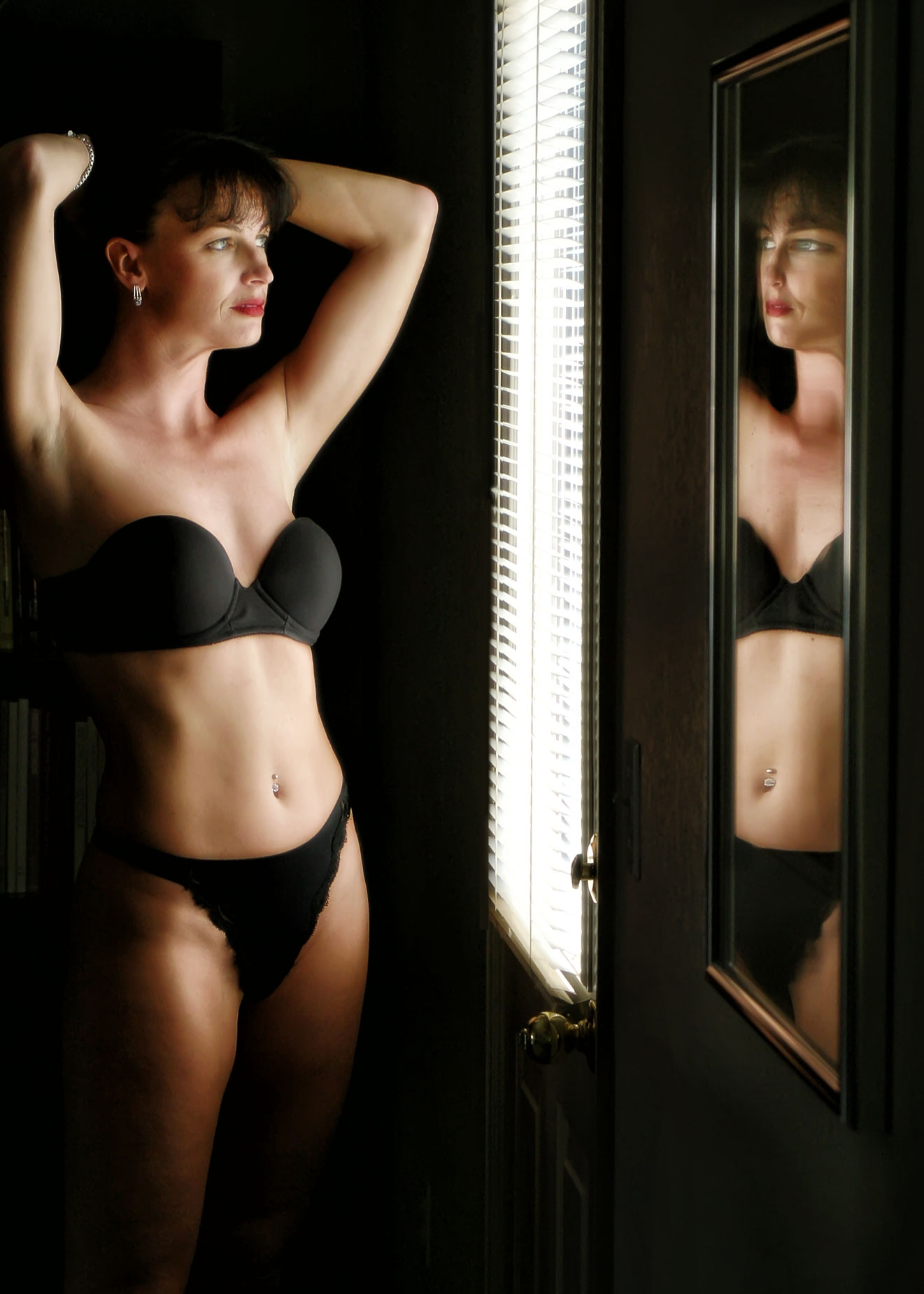
How I Made this Portrait: During the early part of my glamour photography journey, I shot almost all my images using window light. Since moving to Daisy Hill the majority of my glamour images are made in my home studio but I still make some photographs using window light and you will see them here from time to time. The main location for glamour portraits made in my former home was the kitchen that had a large North facing bay window, I occasionally made images in my dining room that had a door to the outside with a South-facing window. Iits here where I photographed Ashley Rae, That is not a mirror at camera right. It was a glass-framed poster that depending on the camera angle, lens focal length and the model’s placement, is reflected in the glass.
This one image encapsulates the problem of obtaining proper exposure from the blown out highlights in my back door’s window to the deep shadows at the bottom of the frame. In the middle is the subject and that’s where the emphasis on my manual mode exposure was placed. The camera used was a Canon EOS 10D with EF 28-105mm lens at 60mm and an exposure of 1/160 sec at f/6.3 and ISO 400. The original image was slightly underexposed and when combined with the higher than normal ISO produced some digital noise. I reduced the noise using Dfine then applied the Tonal Contrast filter that’s part of Color Efex.

My book Joe Farace’s Glamour Photography is full of tips, tools and techniques for glamour and boudoir photography and includes information on all of the cameras and lenses used as well as the complete exposure data for each image. New copies are available from Amazon for $45.08, with used copies selling for around forty-three bucks, as I write this. The Kindle version is $19.99 for those preferring a digital format.