
Today’s Post by Joe Farace
“There’s something strange and powerful about black and white imagery.”– Stefan Kanfer
I’m always surprised when learning that many new shooters don’t know about the creative potential of infrared photography. Once upon a time I was photographing a model who was also an avid photographer and mentioned photographing Erin Valkari using infrared techniques and she asked, “what’s infrared?” Well, that’s the topic of today’s post.
My wife, Mary, says shooting in infrared transforms mundane subject matter into something more “interesting and exotic.” I believe it can add drama to landscape photography while allowing you shoot during the middle of the day because the best time of day for infrared photography is the worst time for traditional photography.
Let’s Get Started
Getting started begins with a question: Is your camera infrared sensitive? Because if it is, you can use on-lens infrared filters. One way to check is to take the TV Remote test: Press a button on the remote, point it at your DSLR or mirrorless camera and take a picture or look at it in real time on the cameras LCD screen. If you can see a light from the remote you’re almost ready to make infrared images. Caveat: A few readers of my infrared book have told me this test isn’t infallible but it’s always worked for me.
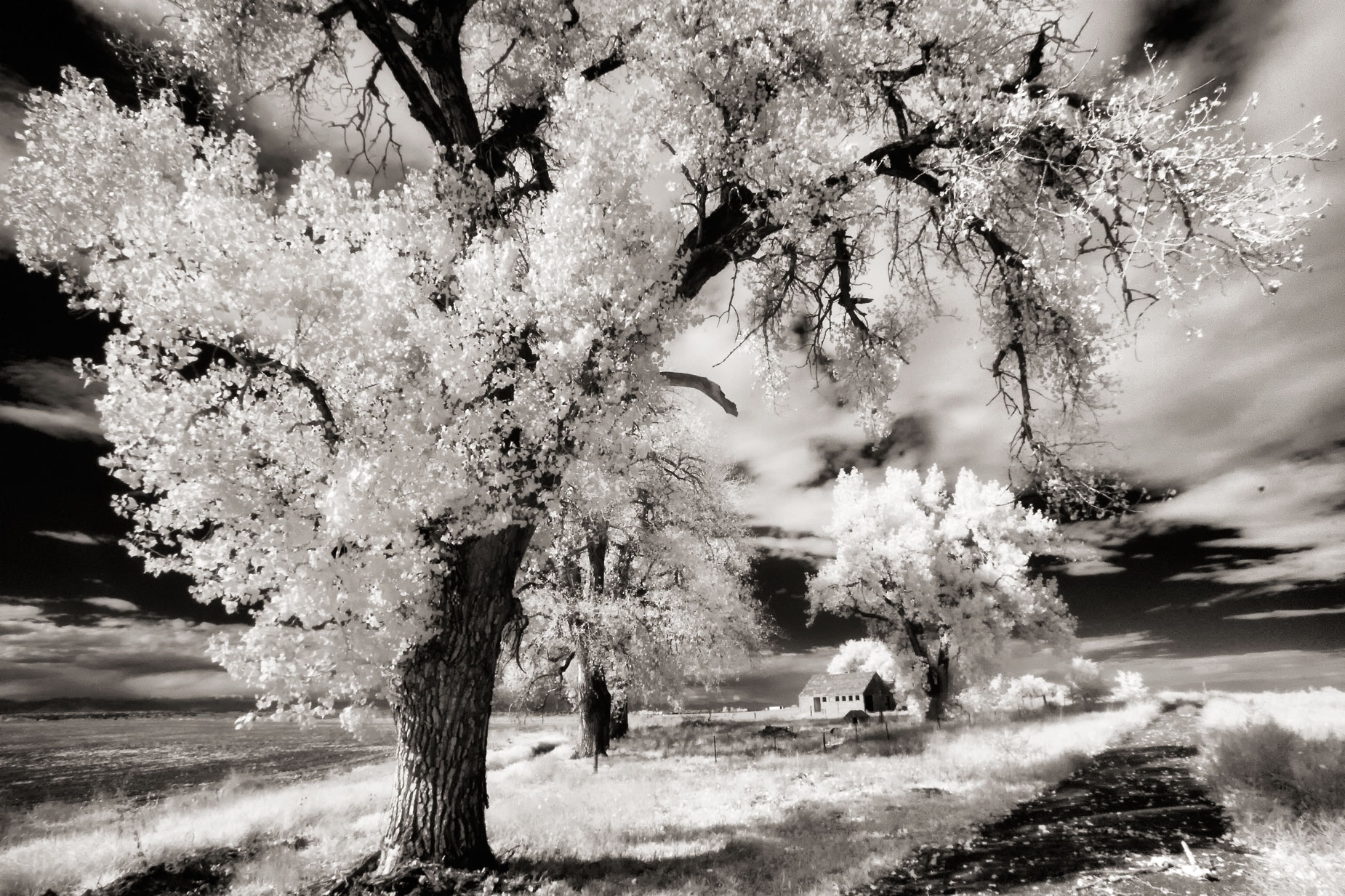
How I Made this Photograph: I made this image near Brighton, Colorado using a Canon EOS D6-—not a 60D— that was converted to infrared capture using a 720nm filter. The lens was a Tamron AF 11-18mm f/4.5-5.6 Di-II (at 11mm.) The Av exposure was 1/90 sec at f/16 and ISO 400 with a plus two-top exposure compensation. It was made at a time when I was more concerned about depth-of-field that I was about diffraction. My advice: Don’t make that same mistake, so take the time to test your lens. Platinum toning added via PhotoKit.
Depending on their thread size, using infrared filters is typically the least expensive to make infrared images but they are by no means a cheap solution. I even did a video about IR filters and you can watch it by clicking this link. The Hoya R72 filter is typically the least expensive way to try IR photography. A 52mm Hoya R72 Infrared filter, for example, usually costs around $55. The Cokin A007 filter, one of my other favorites, is no longer available but can be found by poking around the Internet or eBay,. More powerful infrared filters such as a Singh-Ray 690 I-Ray start around $160 (depending on size) but the difference in the images it produces are dramatic and noticeable.
All of these filters are so dark they require shutter speeds of one or more seconds on a sunny day, which just so happens to be great fir infrared photography. You’ll need a sturdy tripod and may have to focus with the filter off the lens, then put it back on to make the final exposure. Some mirrorless cameras I’ve tried will focus through the filter; yeah it surprised me too, Then there is the question of the wind, which, sadly, translates in blurry images
Another Option
Another option is having your camera converted for IR-only operation which costs a lot more than a filter and you won’t be able to use the camera for any other kind of photography. I also did a video on this subject and you can see it by clicking on this link. (Some conversions just remove the ant-aliasing filter and you will need to use different filters for both traditional or infrared photography.) Life Pixel, the company that has converted all my mirrorless cameras, charges $175 and up (depending on the specific camera brand and model) to convert cameras for infrared capture.
But, and this is the important bit, once your camera is converted you can shoot hand held using the same kind of exposure settings as it did before conversion. There’s no long exposures, which can be a problem in windy days. You can use the camera much as any of your other (non-converted) cameras,. other than maybe kicking up the ISO setting a bit higher than normal, Why do I shoot at higher ISO settings? The higher settings lets me shoot at smaller apertures to minimize focusing problems. Out here in the real world, I find that there’s no real difference between shooting an IR-converted camera than operating a “normal” DSLR or mirrorless camera.
If I put two IR photographs next to one another with one being made with a filter and the other with a converted camera, you probably would not be able to tell the difference—if they were not made on a windy day. The only difference is asking yourself which method suits your budget and how you prefer to shoot.
 I’ve found that Life Pixel does a great job with IR conversions and they’ve done some of the conversions for my Canon DSLRs and all of my Panasonic Lumix G-series cameras. This is not a paid or sponsored endorsement, just my experience.
New copies of my book, The Complete Guide to Digital Infrared Photography are available from Amazon for $44.59 with used copies starting around eight bucks as I write this. My book Creative Digital Monochrome Effects has a chapter on IR photography and is available new from Amazon for $11.46 with used copies starting around eight bucks as I write this.