
Today’s Post by Joe Farace
From time to time I get to test both new and old cameras but regular readers of this blog know that when it comes to my personal cameras I tend to be thrifty. I may get to shoot with some high-end expensive camera but contrary to what many think, after the review they must be returned to the manufacturer. (I suspect that this might not be true of all photo bloggers.)
All of my personal gear is funded out of my wallet. And because of that, I have over time evolved a simply philosophy and even wrote a blog post (“Why I am not an Equipment Snob“) that explains my attitude and personal feelings about buying and using photographic equipment. I get rid of (sell) gear I don’t use but also tend to recycle cameras, turning older model SLRs and mirrorless cameras into Infrared-only models, which explains why I have three IR-converted camera. Sometime I’ll sell off on my previous IR cameras, although I haven’t done that lately. My last IR body sale was my Canon EOS 50, which was a great IR camera but really but, maybe I’m wrong, I don’t think anybody needs four IR-converted cameras. My Panasonic Lumix G5 and G6 were recycled into IR-only bodies but I bought a used Lumix GX-1 from Roberts Camera specifically to have it converted into an IR camera using Life Pixel’s Hyper Color filter. I love that camera and the IR conversion. See below.

How I Made this Shot: I made this image while on an infrared photo walk with my friend Barry Staver along the bicycle paths behind McCabe Meadows near Parker, Colorado. The camera used was that aforementioned used Panasonic Lumix GX-1 that I bought for $125 plus a Lumix G Vario 12-32mm f/3.5-5.6 kit lens at 12mm. The camera was converted to infrared capture by Life Pixel using their Hyper Color conversion. Exposure was 1/500 sec at f16 and ISO 400. The JPEG file—I don’t know why I didn’t shoot RAW—was lightly tweaked in Photoshop before applying one of the Photoshop actions that are available from Life Pixel. That was topped off by some color correction, if those words are even apply to this example, with PictoColor’s iCorrect Portrait and finally added a dash of Glamour Glow from Color Efex.
Similarly,I have long been a fan of using grips and battery grips for cameras. Some like the inexpensive ECG-1 grip for the Olympus OM-D EM-10 Mark I that Mary gave me for for one of my birthdays a few years ago. She even gave me the grip! Others like Panasonic’s DMW-BGG9 Battery Grip are expensive ($347.99) and I bought one of these grips shortly after buying (for myself) a Panasonic Lumix 69 body.
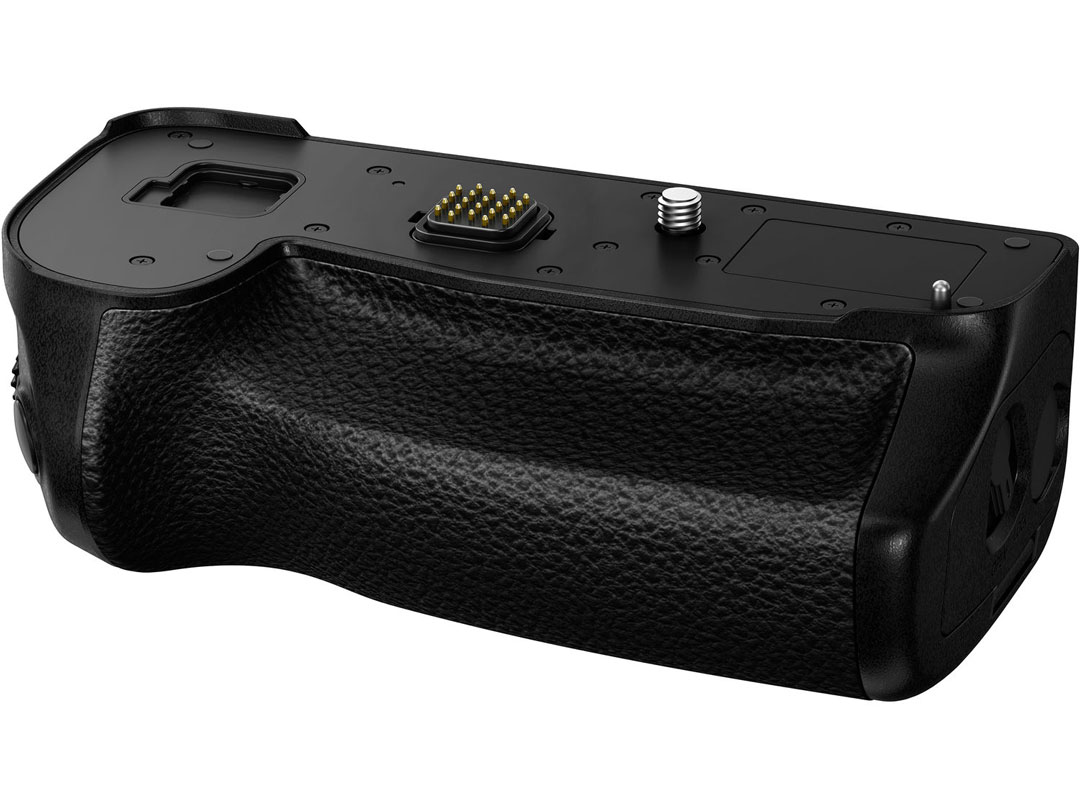 I tend to shoot lots of vertical images for model and glamour photography. When shooting verticals having a grip lets me hold the camera steady instead of my “elbow waving in the air” ” and gives me more control over cropping in camera. The other advantage is that in addition to the vertical shutter release there is usually a control wheel that lets you change camera functions fast and easy using data displayed in the viewfinder as a guide.Yet while I liked working with the DMW-BGG9 Battery Grip in the studio, the one time I took the G9 plus DMW-BGG to a car show the whole package felt too heavy at 32.21 oz. So when I’m out of the studio, I tend to leave the DMW-BGG9* at home.
There are lots of third-party grips available and based on my experience with these kinds of battery grips for Canon EOS cameras, they are inexpensive, have similar build quality as the Canon bodies they’re attached too and trouble free. I never had a single problem with any of them. But as always caveat emptor.