
It’s Arbor Day today. This celebration of nature began in Nebraska when Julius Sterling Morton, a journalist, suggested to his fellow Nebraskans that they plant trees to show an appreciation for nature and the environment. The first Arbor Day was celebrated in 1872 and the idea grew from there.
Today’s Post by Joe Farace
“I think the 50mm lens is an extremely good discipline lens; it requires you to see in a more refined way, not just tighter.—William Albert Allard
A story of lens mounts: The Canon FD lens mount was introduced in 1971 alongside the legendary Canon F-1, one of my personal dream cameras especially the Lake Placid Olympics model. The FD mount served as Canon’s SLR standard lens mount system until 1990 and the release of the company’s T60 camera, that was the last manual focus FD-mount 35mm SLR. The mount lasted until 1987 and the introduction of the Canon EOS series that used the EF lens mount. In 2018, the RF mount for Canon’s full frame mirrorless cameras was launched and was followed by the RF-S mount for APS-C format cameras in 2022, The RF and RF-S currently coexist with the EOS EF mount but I can only wonder for how long?
It’s The “Nifty Fifty”
 The FD mount replaced Canon’s earlier FL mount system. FD-mount cameras, like their A-series, can use FL lenses but only in stop-down metering mode. One definition of the FD name, according to Wikipedia, was that it stands for “Focal-plane shutter with Dual linkage for diaphragm control.” In reality, there were two linkages and two signals: the automatic aperture lever, aperture signal lever, full aperture signal pin, and automatic exposure lock pin. This is two more that the previous FL lens series aka “Focal-plane shutter, Linked mount” used.
Over the 21-plus years of its production, Canon introduced 134 different FD lenses in different focal lengths ranging from 7.5mm through 1200mm and nineteen different zoom ranges. The Canon FD system enjoyed popularity in the 1970s and 1980s and was used by more than a million users including my wife who owned an FTb when I first met her. If that sounds like a lot of lenses, keep in mind that Pentax and other companies manufactured more than 24 million K-mount lenses.
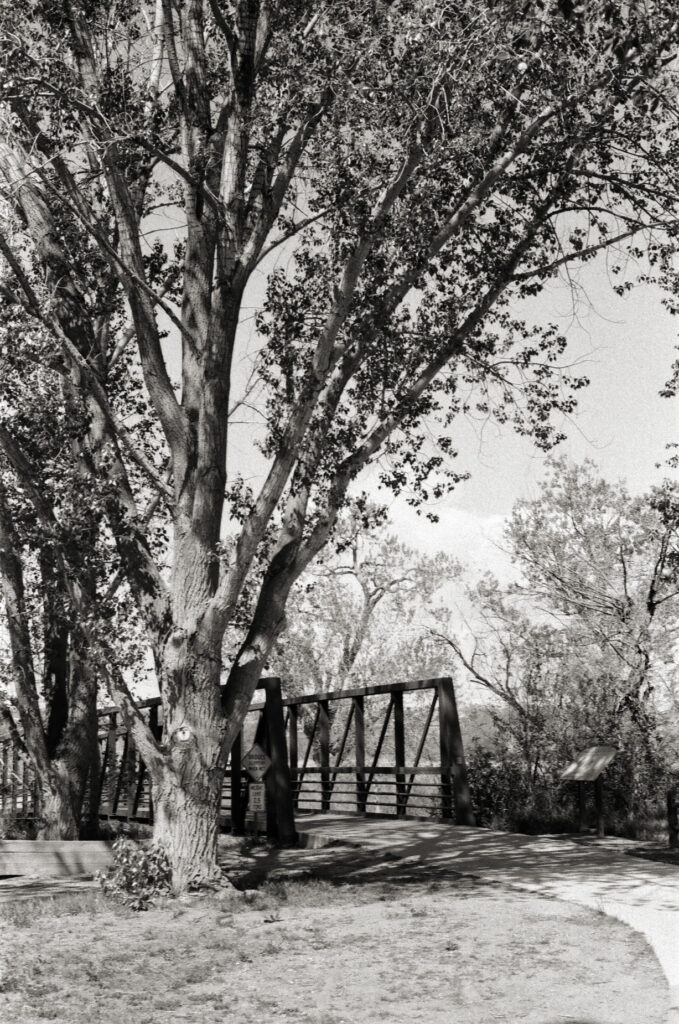
How I Made this Photograph: Since it’s Arbor Day, why not feature a photograph of a tree? This image was made during a PhotoWalk around McCabe Meadows, near Parker, Colorado. I mounted the FD 50mm f/1.8 lens on a Canon A-1 that I purchased from Japan via eBay. The Av mode exposure was unrecorded. The Fuji Neopan 400 Professional film that I used was processed and scanned by The Darkroom in San Clemente, California.
The myth of the 50mm lens and Henri Cartier-Bresson’s legendary usage was based on the fact that he preferred using that particular focal length with his Leica rangefinder camera because he said it “allowed the photograph to breathe.” In today’s digital vernacular, breathing refers to a lens shifting its angle-of-view when its changes focus but my guess is that Cartier-Bresson was thinking somewhat more existentially.
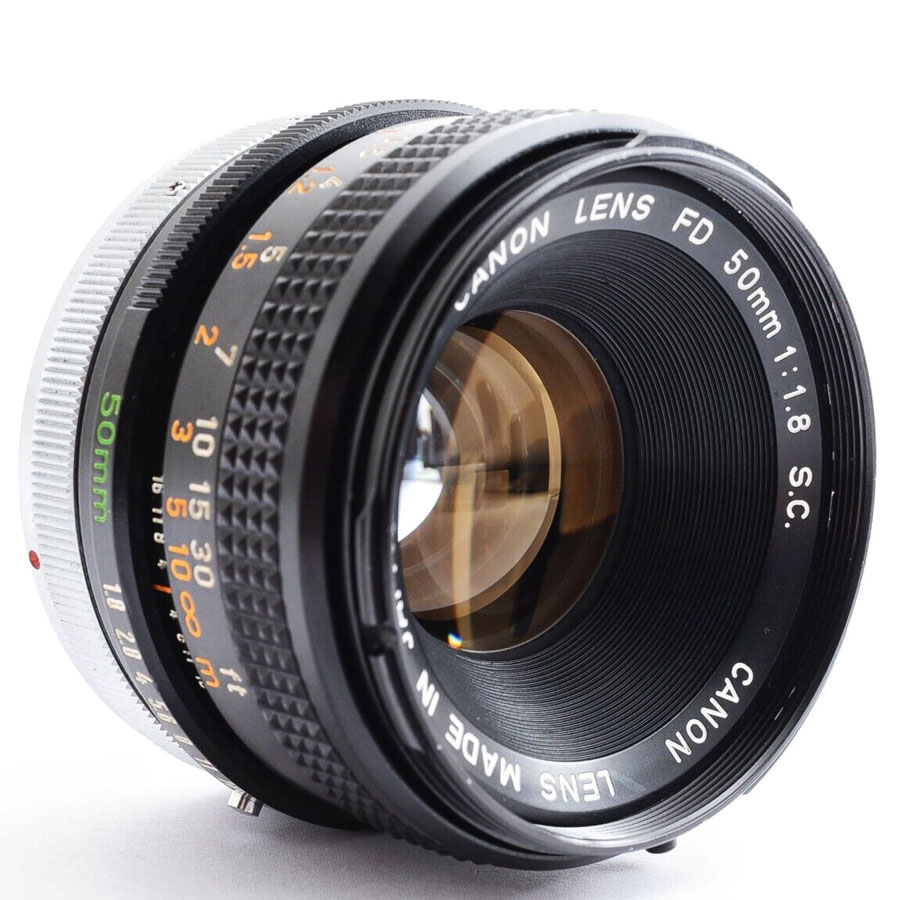 I own and use two FD-mount 50mm lenses: One is the “normal” FD 50mm f/1.8 lens and the other is Canon’s FD 50mm f/3.5 Macro lens. The latter is physically larger, slightly slower and has a much longer throw focusing-wise. I expect that’s because of it’s macro focusing ability. Like many of Canon’s FD lenses, the macro lens came in two versions: The older one. often called “chrome ring” and the newer version. sometimes called “nFD,” which mounts the way you expect a more modern lens to attach to a camera body. The newer version, that I own, will focus from one-half life-size to infinity. An extension tube (FD50) that was available from Canon takes it to 1:1 and, for some reason, I have two of them.
The FD mount system, with its limited provision for auto-focus, really focus confirmation, when used with the Canon AL-1, is theoretically obsolete in today’s digital world but Canon FD cameras and lenses are available for relatively affordable prices on the used market. This makes the system attractive not only to film photographers but also some filmmakers and video shooters, which explain the soaring prices for some FD lenses right now. Maybe that also explains why it cost eighty bucks for my mint FD 50mm f/1.8 lens from Roberts Camera.
Canon FD Resources says the FD 50mm f/1.8 lens is “one of the cheapest lens around and more importantly, also offers superb optical performance and is often referred to as the company’s yardstick in exhibiting their best in optical design and quality.” I agree.
If you are a manufacturer or representative of one and would like to send me some 35mm film or any other photography–film or digital–gear to review or write about on the blog or in one of my YouTube videos, please e-mail me to get my mailing address