
Today’s Post could be considered a follow up to this past #trickytuesday’s post, Getting Started with Boudoir and Glamour Photography and features the incredible Pam Simpson. If you didn’t get a chance to read that post, click the link and check it out when you have time
Today’s Post by Joe Farace
Emotions are the basics of any art form! —Jean-Michel Jarre
 Part of the confusion about buying and working with studio lighting equipment is some photographers think the gear is too expensive and too complicated to use. In reality it doesn’t have to be that way. Part of any misunderstanding may be created by the seemingly bewildering array of product types and buzzwords that are used to describe this equipment but if you approach the subject one small step at a time, It’s not that difficult. Let’s start with dealing with the buzzwords…
Let’s Get Started
The purpose of this post is to take some of the mystery (and misery) out of electronic flash and LED studio lighting hardware and help you better understand the technology used by photographic lighting equipment so you’re able use these tools to make better looking images
Much as a DSLR or mirrorless camera’s resolution is measured in megapixels, electronic flash output is often measured in Watt-seconds (Ws.) It’s a unit of electrical energy that’s equal to the work’s done when a one amp of current passes through a resistance of one ohm for one second. A Watt-second is sometimes called a Joule which is just is another way to measure power from an electronic flash’s power supply because Ws doesn’t consider the reflector’s design, so it’s not perfect. Electronic flash units typically produce between 15 to 50 lumenseconds per Ws and that’s why an efficiently designed 300 Ws system can produce as much light as an inefficient system that’s rated at 1000 Ws. That’s why you’ll also see Effective Watt-seconds used as a method of power measurement.
Because it considers the entire lighting package, speedlight users often prefer to use Guide Number (GN) to measure flash output. In the USA, Guide Numbers are quoted in feet and are valid for a given ISO setting, usually 100. It’s a simple measurement: The higher the guide number, the more the output from the speedlight. Guide numbers also serve as a way to calculate a lens aperture when shooting without a flash meter. To determine the correct aperture, you divide the guide number by the distance from the flash to the subject. Now on to continuous lighting…
 When talking about continuous light sources, such as LED, lux is a unit of illumination that’s equal to one lumen per square meter or the equivalent of 0.0929 foot-candles. One practical way to look at it is that a candle produces 13 lumens or 1,200 lumens can be created by a 100 Watt light bulb. A foot-candle is a unit of illuminance on a surface that is one foot from a uniform source of light of one candle and is equal to one lumen per square foot. As you can see some of these definitions are circular but don’t let that drive you crazy.
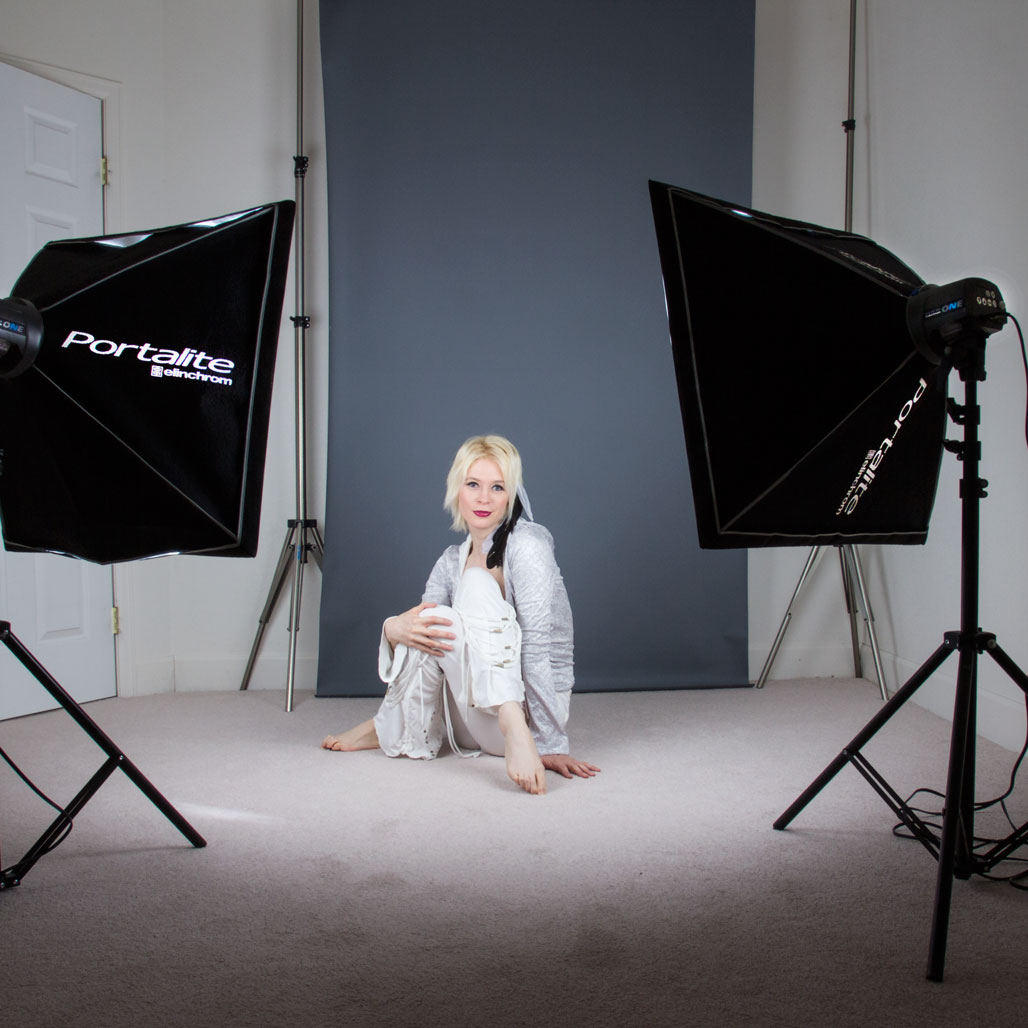
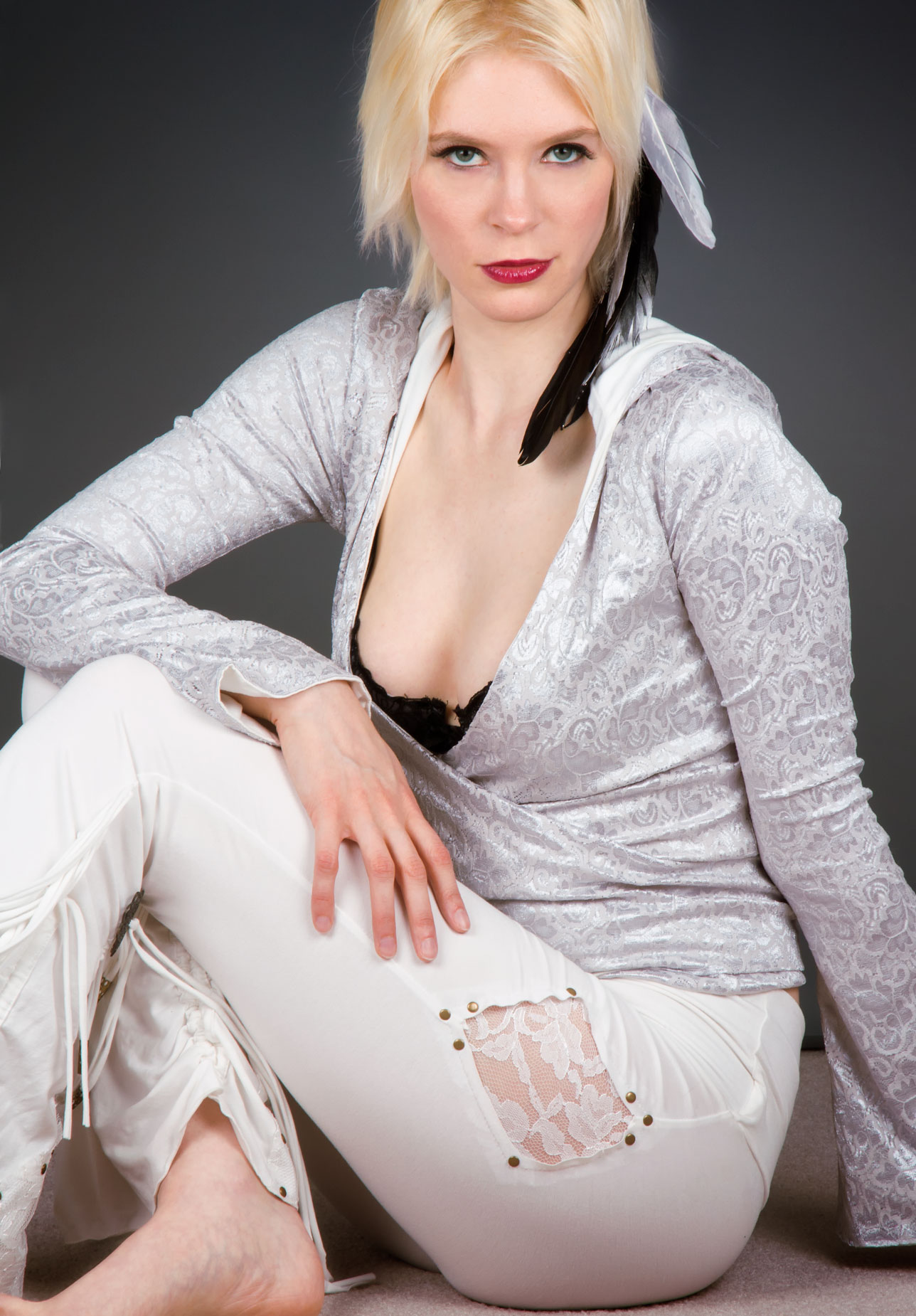
How I made this photograph: This portrait of Pam Simpson dressed in white and silver was made with her seated on my home studio’s floor. As you can see in the above right setup shot, two Elinchrom D-Lite RX monolights with a 26-inch square Portalite lightbanks attached were placed approximately 45 degrees to one another. The lightstands were lowered to match Pam’s seated pose. The output of each monolight was adjusted via my laptop computer to be approximately one-quarter power. The backdrop is a 5×7-foot Photo Gray Savage Infinity vinyl.
The camera used was a Canon EOS 60D with an EF-S15-85mm f/3.5-5.6 IS USM lens at 78mm with an exposure of 1/125 sec at f/16 and ISO 200. Get that? f/16 from two 100 Watt-second monolights set at quarter power! After light retouching, the image file was tweaked using the Glamour Glow filter that part of Color Efex and was set at 50% opacity.
A few more details: Keep in mind that all light behaves in accordance with the Inverse Square Rule. Often misunderstood but important to understanding portrait lighting, it goes like this: The power of light is inversely proportional to the square of the distance. So when you double the distance between a portrait subject and light source, it illuminates a surface area that’s four times greater than before. Or to put it another way, the subject now has one quarter— not half—as much light falling on it.
 If you enjoyed today’s blog post and would like to treat me to a cup of Earl Grey tea ($2.50), please click here. And if you do, thanks so much.
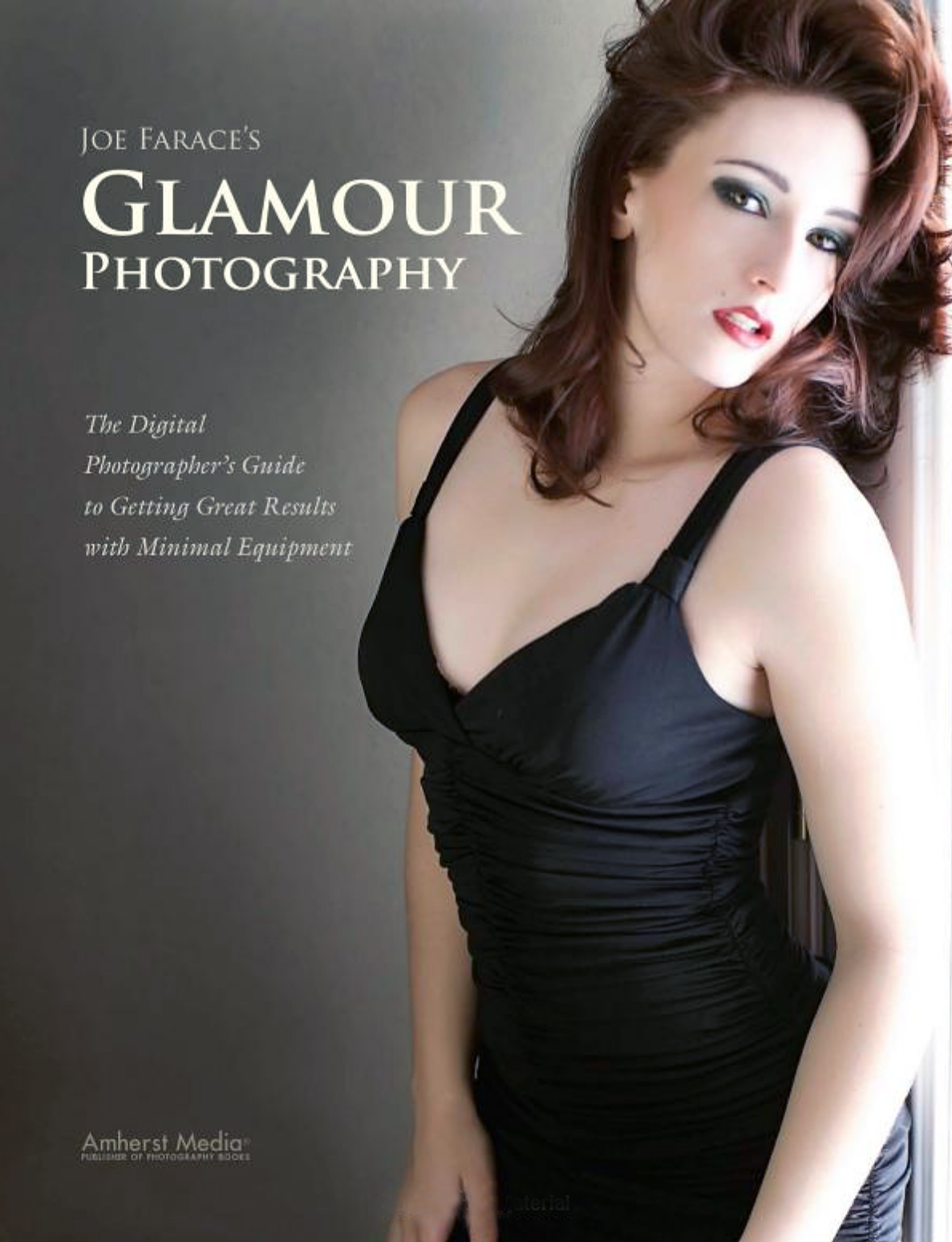
My book Joe Farace’s Glamour Photography is full of tips, tools and techniques for glamour and boudoir photography and includes information on all of the cameras I used as well as the complete exposure data for each image. New books are available from Amazon for $24.72 with used books starting around ten bucks.as I write this. The Kindle version is $19.99 for those preferring a digital format.