
It’s #anythingcanhappenday and today’s post features the dynamic Pam Simpson from a session we had during the 14 years we worked together.and during our 16’th shoot. Pam and I are in the process of scheduling a shoot for next month so stand by for some images of her as a brunette, unless she’s changed her mind!.
Today’s Post by Joe Farace
Try to be like the turtle, at ease in your own shell.–Bill Copeland
 You know any quote about turtles would get my attention, didn’t you? For information about Tortuga Racing–tortuga is Spanish for tortoise or turtle–you can read about the team’s origins and its current status here. But hey, it’s not #wheelswednesday, it’s #anythingcanhappenday,
Where Do I Find Inspiration?
It’s been my experience that photographers seem to find their inspiration for their work from many sources. One of my photographer friends discovers it in old master’s paintings. I get some but not all of the inspiration for my images from the movies, especially classic films.
My friend and former Managing Editor of Photomethods, John Hamilton–follow him on Instagram @johnchamiltonauthormn– is a film buff and once asked me, “if you could watch any movie right now, what would it be?” He warned me not to give a standard answer like Citizen Kane. So what movie was it? My immediate answer was The Adventures of Buckaroo Banzai Across the Eighth Dimension but that would not be my answer today. If he asked me the same question right now, I would say that it’s Frank Capra’s 1937 classic film Lost Horizon.
I recently re-watched the film for the who-knows-how-many times and was struck not only by the cinematography of Joseph Walker and Elmer Dyer but also by quality of the still images used to illustrate a “making-of” video on the disc that were shot by on-set photographers using 4×5 cameras. This was truly the golden age of Hollywood still photography. All this was going through my head when I was making a portrait of Pam Simpson who is today’s featured image and, for me, give off vibes of Isabel Jewell.who portrayed Gloria in the film, a character who was not in the original book.
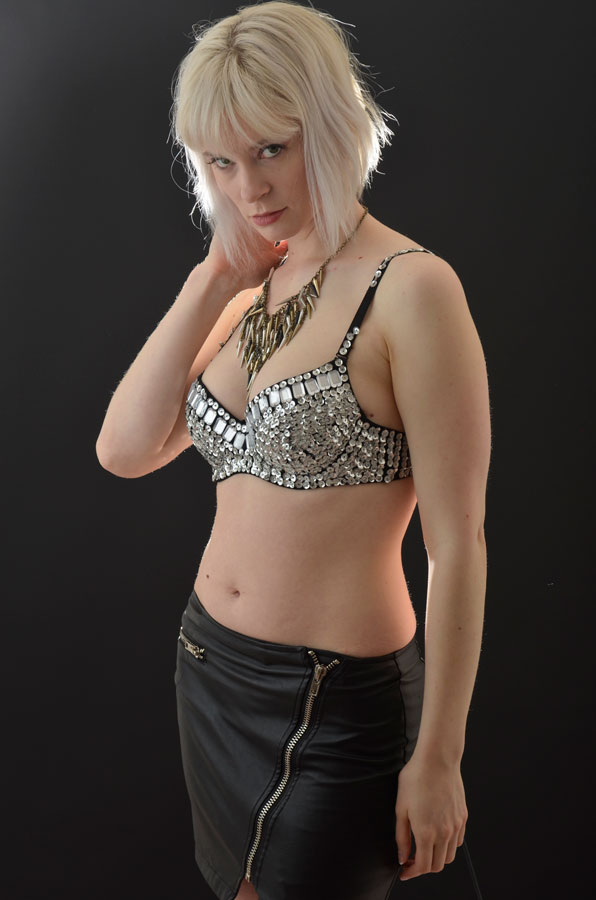
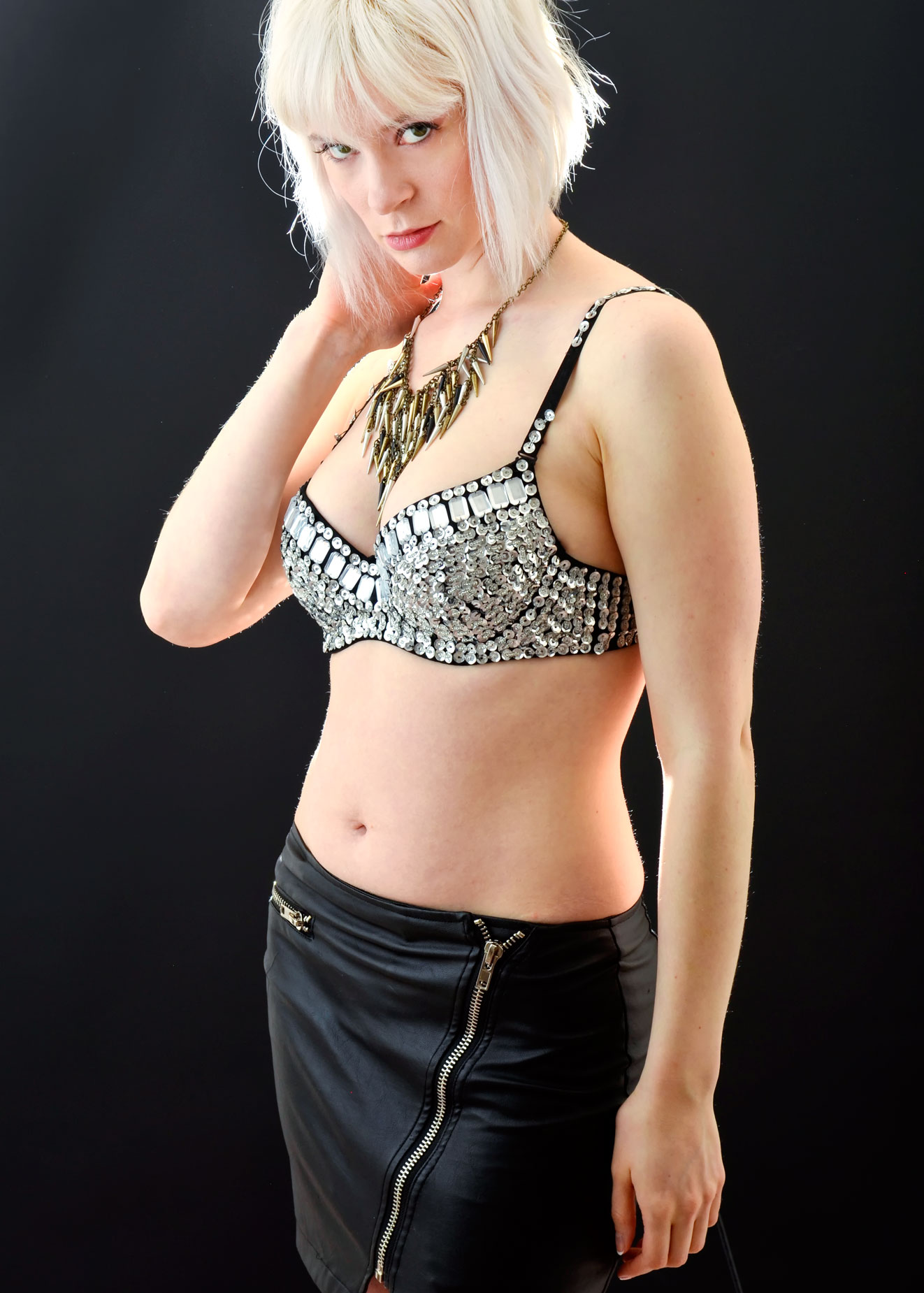 How I Made this Portrait: This portrait of Pam dressed in black and silver, started out as a slightly underexposed JPEG that you can see above right and was made before my current JPEG+RAW regimen. The lighting consisted of a Wafer HexOval 100 (37.5 x 27.5 by 12 inches deep) soft box that was mounted via a Balcar speed ring onto a Paul C Buff DigiBee 800 monolight. It was placed at camera left and close to Pam. A Paul C Buff Alien Bees 800, without any reflector was placed low and at camera right, slightly behind her for some subtle, maybe too subtle, backlighting. Paul C Buff is not a sponsor of this site and the links sshown are not “associate” so I don’t get a penny for including them. These are provided for your information and are just the lights I like and use in my studio. The backdrop is a 5×7-foot Black Savage Infinity vinyl.
For reasons I don’t remember I shot this portrait with my wife’s Nikon D5100 DSLR. (She’s since updated to a mirrorless Nikon Zfc.) The lens used was the 18-55mm f/3.5-5.6 kit lens at 55mm with an exposure of 1/200 sec at f/9 and ISO 200. Using Photoshop, the image was cropped from its as captured 3:2 aspect ratio to 5:7 because I liked the way this cropping tightened up the portrait’s composition.
Posing tip: I wanted Pam’s pose to be somewhat stagy, like movie production shots of the ‘30s and 40’s. When I work with models in the studio, I like to show them some of the photographs we’re making on the camera’s LCD, so she can see how she looks. This can give her confidence in what we’re trying to accomplish as wells as stimulate her to think about ways to improve the pose. Glamour photography, much like making movies, is a collaborative effort and the more the model is involved in the process the better the results will look.
Special Note: For some other perspectives on photographic inspiration and a wealth of other photo-related topics, please check out my YouTube podcasts with Barry Staver.
 If you enjoyed today’s post and would like to support this blog, you can help by joining my Patreon, where memberships start at just $1.25 a month, with additional levels of support at $2.50 and $5 that include special benefits. If you do, I would like to thank you for your support.
If you’re interested in learning how I use cameras, lenses and lighting in my in-home studio and on location, please pick up a copy of Studio Lighting Anywhere which is available used from Amazon.com for less than ten bucks, as I write this. The Kindle version is $19.99 for those preferring a digital format.