
My wife suggested the“Tricky Tuesday” theme as a way for me to share some of the different tricks, tips and techniques I’ve used over the years when shooting glamour images in my home studio. This post might be considered a follow-up or sequel to How to Measure Studio Flash Output from last week.
Today’s Post by Joe Farace
I think we invent jargon because it saves times talking to one-another.—John Maynard Smith
 When working with LED lighting systems you will come face-to-face with what might be unfamiliar buzzwords such as lux, lumens and foot-candles but hang in there, there was a time when megapixels were alien too.
Jargon, Buzzwords and other Ephemera
A lumen aka luminous flux is the equivalent of 1.46 mW of radiant electromagnetic power at a frequency of 540 THz. Lux is a unit of illumination that’s equal to one lumen per square meter or the equivalent of 0.0929 foot-candles. A foot-candle measures the actual brightness of a light source in a scene while Exposure Value (EV) is a combination of lens aperture and shutter speed that results in a given exposure. To put all this in perspective with terms that we’re more familiar with this chart compares Exposure Value to foot-candles and lux. Other charts convert EV numbers into shutter speed and lens apertures.
 A few years ago while attending a photo trade show, I heard a booth presenters talking about “this new thing called CRI” but the Color Rendering Index standard was introduced in 1974 by the International Commission on Illumination (CIE.) CRI uses a scale from zero and 100 to measure a light source’s ability to accurately reproduce color. A CRI rating is determined by comparing the color rendering of a test source to that of a perfect source and uses a formula that’s averaged over the number of samples to get a final rating. At CRI 80 a light source reproduces 80% of the visible color spectrum while a CRI of 100 accurately reproduces the colors found on a sunny day at noon.
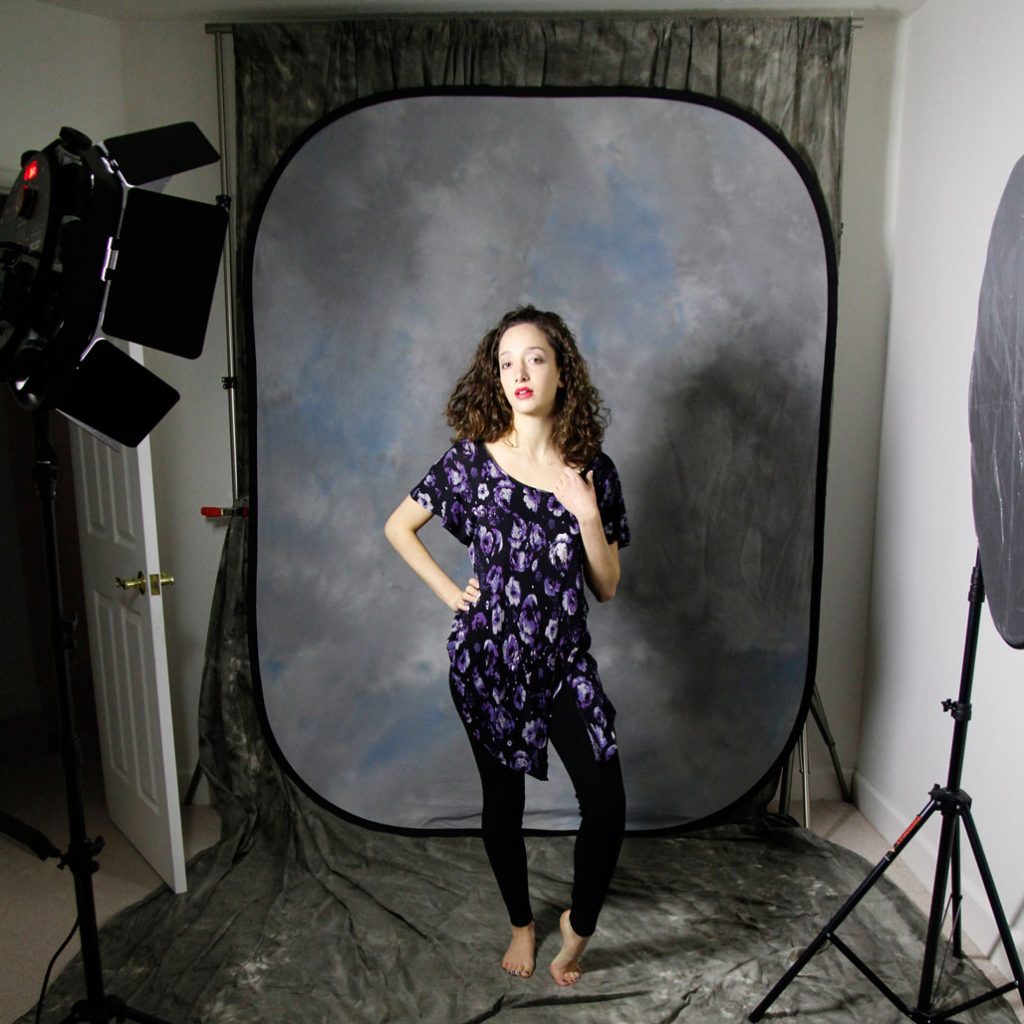
How I made this portrait: I photographed aspiring model Laura May Bachmayer in my home studio using a Rotolight Anova Pro 2 Bi-Color Standard LED Light. I placed the Anova at camera left and used a 32-inch Westcott reflector at camera right as show in the setup photo above right. The LED light was set at 5500K and at its maximum output. The camera used was a Canon EOS 60D with EF-S 15-85mm f/3.5-5.6 IS lens (at 61mm) with an exposure of 1/25 sec at f/5.6 and ISO 1250. Why such a high ISO? It’s explained here.
For photographers who are serious about their craft, it’s not just the way that light from LED sources are measured, it’s also the quality of that light that’s important.
To give me a handle on this aspect of LED lighting for evaluating lighting system I obtained a Diffraction Grating Spectroscope that lets me visually inspect a light source’s spectrum and actually see peaks and missing color bands. These devices are typically used by rock and gem collectors and you can usually find these on eBay for about $30. A modest investment for checking out LED light sources.
Not all LEDs are created equal either and based on my experience testing many different kinds of lighting systems there does not always seem to be a direct correlation between price and quality. Although some cheap LED lights reflect their price point, others are surprisingly good, just as some expensive LED systems are not that great and produce a spectrum with missing color and spikes in their spectrum. Your eyes automatically adjust for missing color bands or spikes but your camera won’t, so any difference results in more time spent in the on the computer trying to get the color and sometimes the exposure correct.
Postscript: Check out some of my other posts on LED lighting, such as Shooting a One Light LED Glamour Portrait.referring a digital format.
Note for my Patreon Subscribers. After looking at all of the images in this series, I realized I could make a Bonus post for one of my uncensored Password Protected posts using some of these images of Ms. Bachmayer. If you are interested in seeing some of the other images from this session in such a post, click CONTACT. If you are not currently a Patreon subscriber—it’s surprisingly inexpensive—details on how to sign up can be found here.