
Summer may be officially here but nobody told the weather. Last week there was a torrential thunderstorm in my neighborhood and it rained so hard that my trashcan floated two blocks down Daisy Hill! When I got up this morning, it was 52 degrees F. I’m dreaming about real Infrared Weather while looking forward to another IR photowalk with my friend Barry Staver.
Today’s Post by Joe Farace
Back when Shutterbug was still a print magazine, I received an e-mail from a reader asking, “Why do you do infrared photography, when regular photography is already so hard?”
 My answer to this person was “because it’s fun” but it also had more to do with the way that photographers go through three distinct phases when honing their image making skills:
- The First Stage occurs immediately after they get their first “good” camera and discover photography’s potential as a medium of expression. During this time, newbie shooters explore their world with lots of enthusiasm and every batch of images they produce contains photographs that look so much better than they could ever imagined. Unfortunately, this blissful period doesn’t last long and is replaced with…
- Stage Two: During this period the shooter’s level of enthusiasm is still high but is somewhat diminished when reviewing their newest images only to discover they are much worse than they expected. This is the “shoot more and enjoying it less” phase of their photographic education.
- Stage Three occurs after the photographer continues to improve their skills by reading books/blogs, attending workshops but most importantly by practicing their craft. In this phase, the images in their camera’s viewfinder exactly matches their results. There are no surprises. While reaching this phase can be fulfilling, some of the magic is gone and sometimes, photographers become discouraged and slip back into Phase 2. The downside is that the photographer keeps shooting the same kind of images over and over again without realizing it.
Here’s the short answer…
…to that reader’s question: It’s really not that hard. I even wrote a book about it. Look around this blog and you will find lots of tips on how to become an infrared shooter. Click on the small magnifying glass symbol in the upper right-hand corner and type “infrared” in the text box and you’ll find lots of how-to posts.
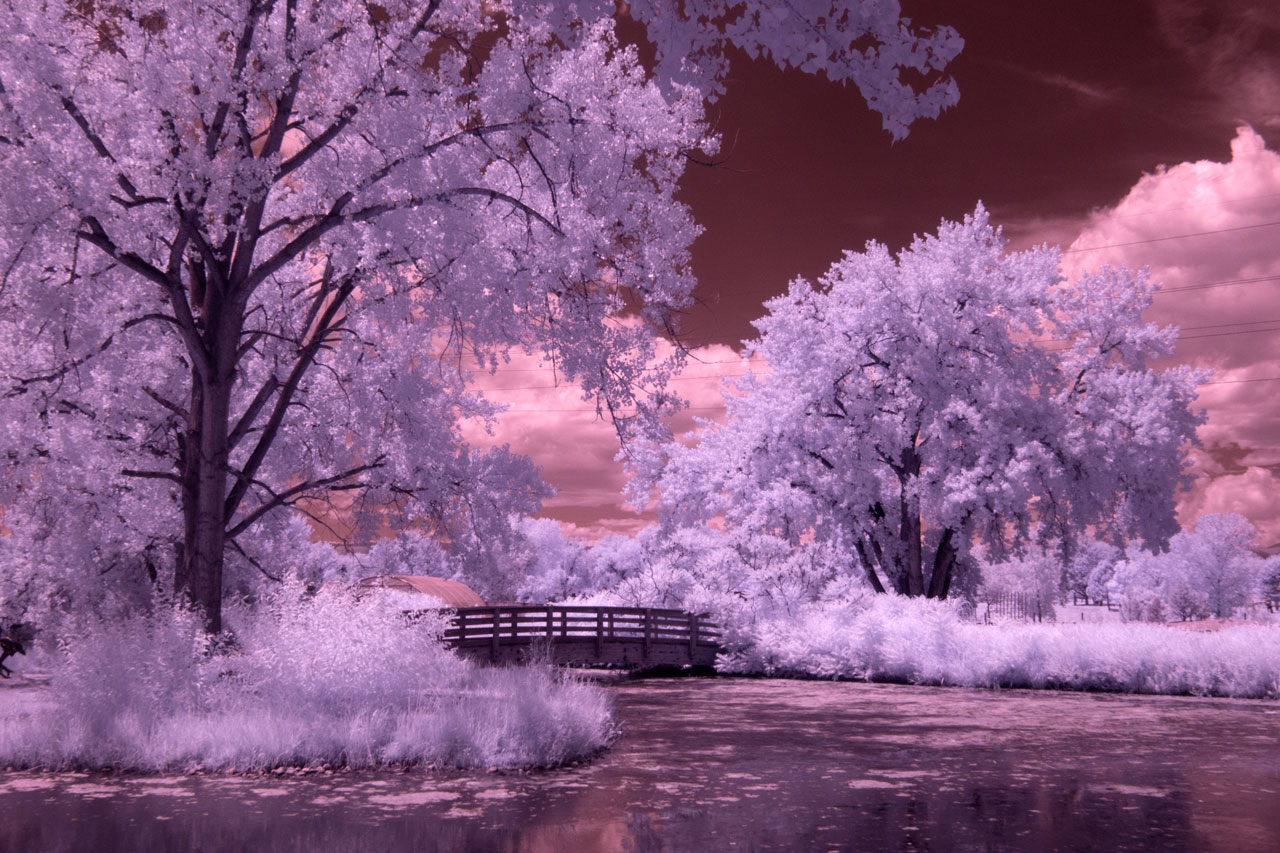
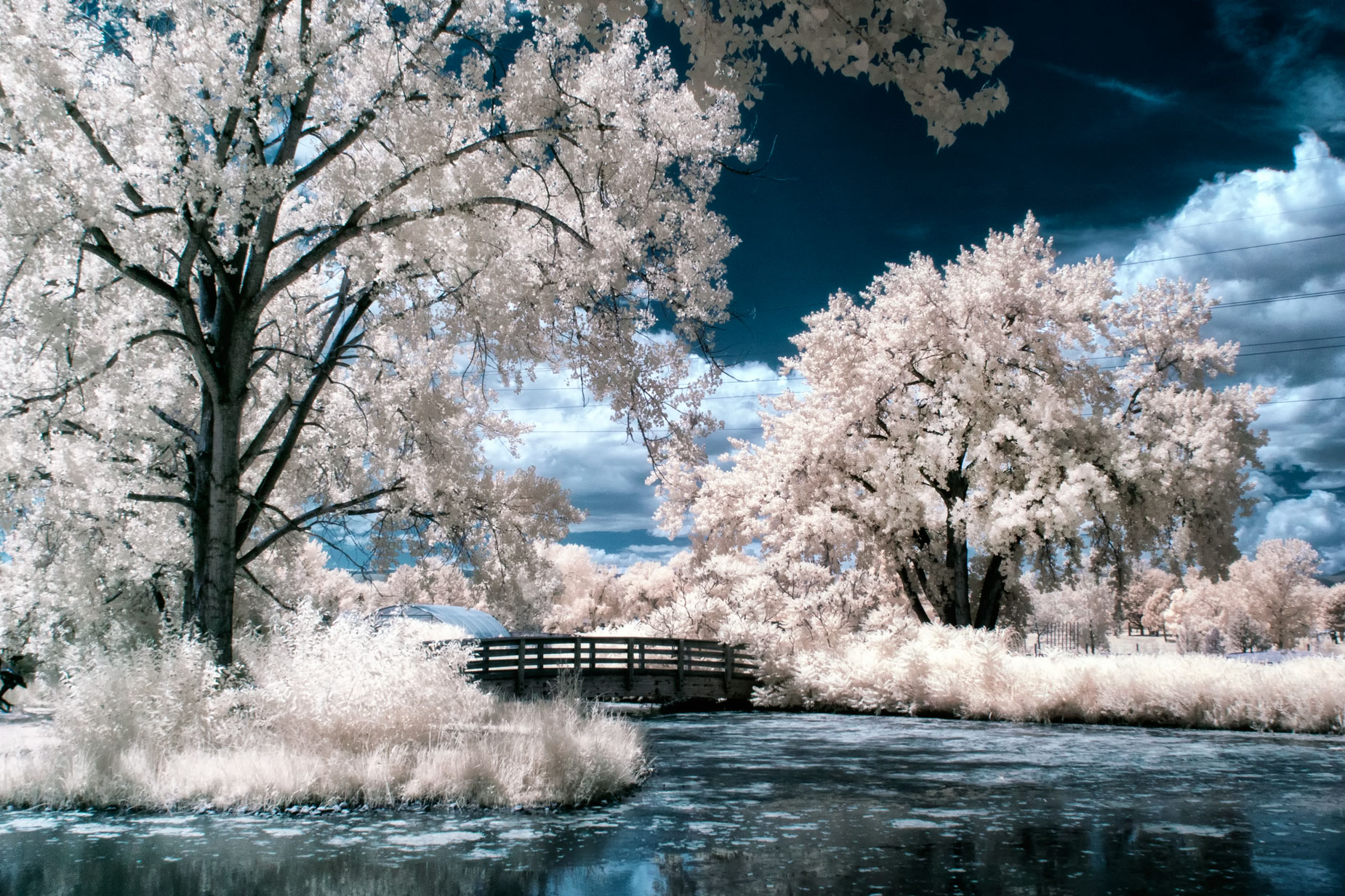
If you would like to experience some of the same thrill of discovery that occurred during the first phase of your photographic education, my suggestion is you should never stop exploring the many possibilities that photography offers. Try some new things. Maybe it’s infrared photography, as shown in the above example, because when you do you’re immediately tossed back into Phase 1 and every image you capture will be a surprise and, more often than not, a pleasant one. Whatever you do, try something outside your normal comfort zone.
How I made this photograph: This photograph was made at Littleton, Colorado’s Hudson Gardens when my friend and legendary photojournalist Barry Staver and I had an infrared PhotoWalk.The property consists of thirty acres of garden exhibits, trails, natural terrain and event venues and was opened to the public in June 1996.
The above photograph was shot using a Panasonic Lumix G6 that had the Enhanced IR (665nm) filter conversion from Life Pixel. The lens was the Olympus M.Zuiko 17mm f/2.8 with an exposure of 1/250 sec at f/16 and ISO 400. The as-captured RAW file is shown at above right. That image file was processed using a Photoshop action (IR Channel Swap w/ white foliage) that Life Pixel used to offer with their IR conversions. It was further tweaked with Vivenza to bump up the contrast, minimizing any induced noise (from Vivenza’s Structure slider) via Dfine and wrapped in the Glamour Glow layer from Color Efex to add to the dreamy effect.
 I’ve found that Life Pixel does a great job with IR conversions and they’ve done most of the conversions for some of my Canon DSLRs and all of my Panasonic Lumix G-series cameras. This is not a paid or sponsored endorsement, just my experience.
Used copies of my book, The Complete Guide to Digital Infrared Photography are available from Amazon starting around thirteen bucks as I write this. My book Creative Digital Monochrome Effects has a chapter on IR photography and is available new from Amazon for $11.46 with used copies starting around eight bucks as I write this.