
#wheelswednesday is back if only for today but who knows… It’s also National Iced Tea Day. In 1904, visitors to the St. Louis World’s Fair were greeted by especially hot weather. Tea plantation owner Richard Blechynden took advantage of the situation by selling chilled tea drinks as a cold refreshment. The rest is history
Thoughts for today by Joe Farace
Cadillac, Cadillac, long and lean, you drove my daddy to the movie screen.–Bruce Springsteen
 There’s an old expression that says, “Life isn’t given to anyone but just given on loan to everyone.” When this kind of thinking is applied to my own photography, I think, it means I should spend more time making the kind of images that I like. And believe me, at this stage in my life, that’s exactly what I’m trying to do.
I happen to believe the process of making photographs extends beyond merely clicking the shutter and “what you see,”and contrary to what Flip Wilson once said, is not always what you get.
History Lesson
William Mortensen (1987-1965) was a talented and inventive photographer who worked in the Pictorialist style and manipulated photographs using pens, paints, pumice and razor blades producing romantic painting-like effects while using the bromoil process. This style was criticized by photographers that were part of the Group f/64 movement and Mortensen carried on a debate with Ansel Adams on the pages of Camera Craft magazine in what essentially was a civil war for the soul of photography. In the end, Adams won but pictorialism carried on in withing some camera clubs for many years. During my formative photographic years, I was influenced by the work of Baltimore’s Edward L Bafford who, at the time, still worked with the bromoil process.
This style of image making didn’t completely go away because manipulating images has been part of the photographic process since Julia Margaret Cameron picked up her first camera in 1863. Yet when computers got involved in the imaging process, it seems to have set some purists hair on fire. I know this all too well because some of these critics have criticized me loud and clear. In particular, they commented about one of my motorsports images of a Ferrari F1 car that I’ve always jokingly said is “from my LeRoy Neiman period. That particular image generated some interesting comments and here are just a few of them:
One reader wrote, “Once you change an image it ceases to be a photograph, even if all you do is sharpen it.” I thought that was a bit strong until I read, “Resorting to Photoshop tricks just means you’re not a good enough photographer to actually capture the image.” Ouch, that one really hurt but I especially enjoyed, “Let’s say you take a photograph and manipulate it in some software program. If the end result is 50% photograph and 50% manipulation, you are only half the photographer you think you are.”
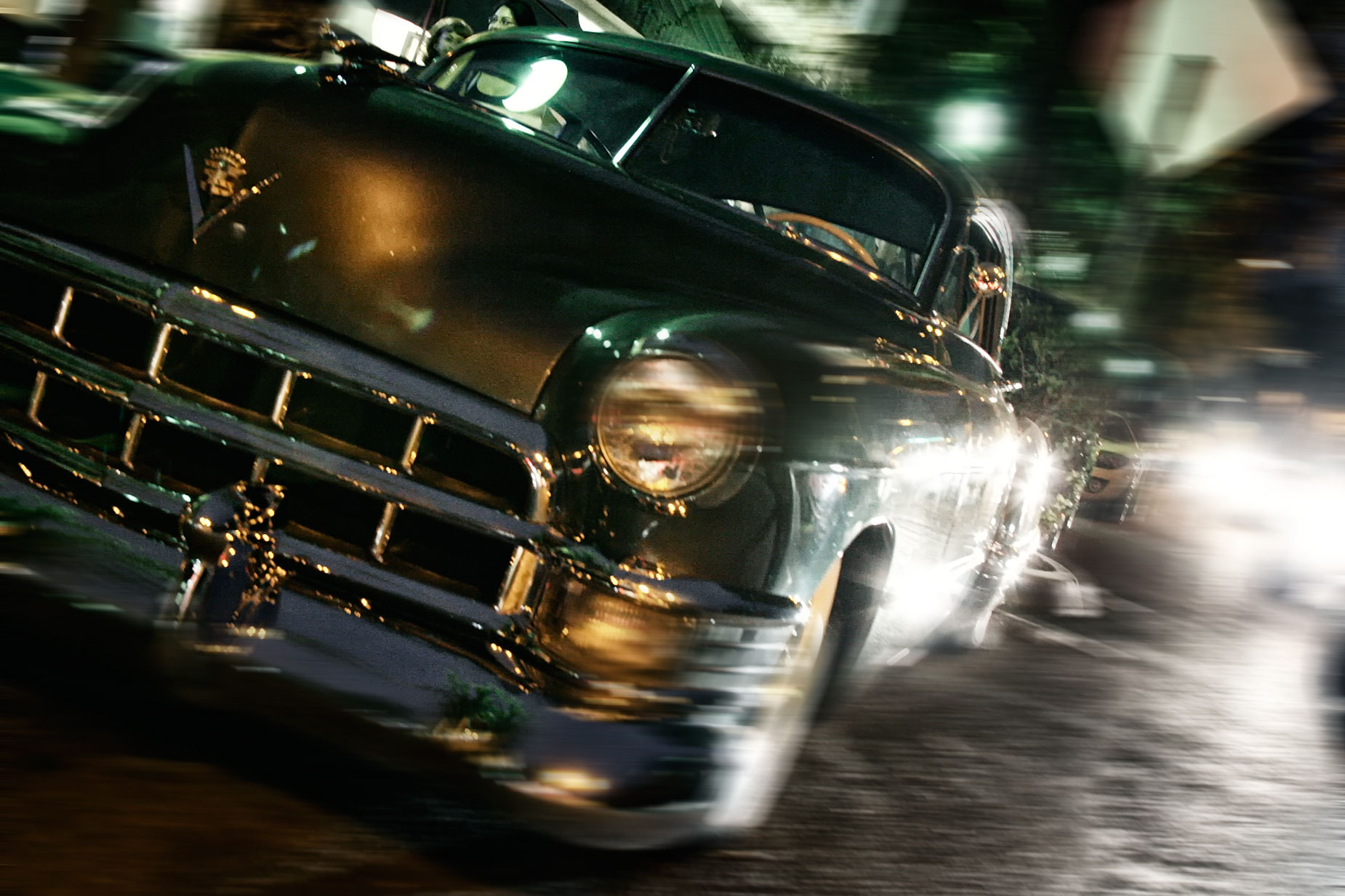
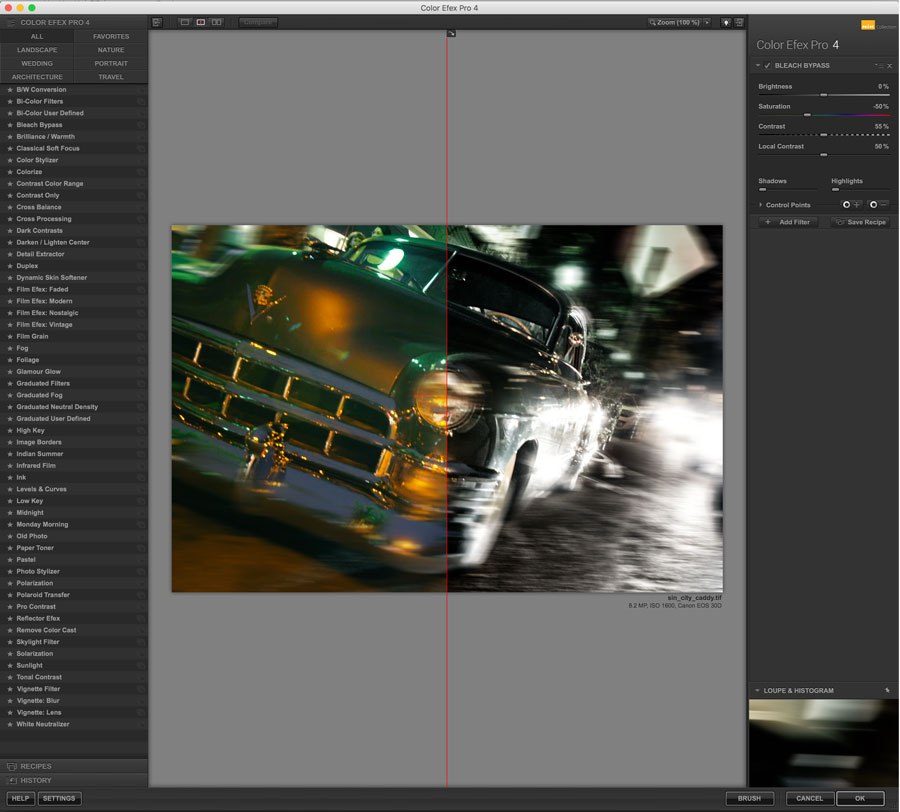
How I made this photograph: I call this image, “Sin City Caddy” and was influenced by movies rather than Frank Miller’s comic books of the same name. The image was captured during a Cruise Night on Escondido, California and was shot with a Canon EOS 50D with a EF28-135mm f/3.5-5.6 IS USM lens (at 28mm.) Exposure was 1/6 sec at f/3.5 and ISO 1600. The slightly underexposed image was tweaked using this technique, something I typically use for portraits and then Dfine was added to tame any noise. I then tweaked color balance using PictoColor Portrait, before applying Photoshop’s Motion Blur filter to a new layer. I selectively erased portions of the Motion Blur layer before flattening the layers and applying the Bleach Bypass filter from Color Efex for a final touch.
But there’s more…One photojournalism fan put it this way, “Putting anything new in a photograph makes it an illustration. Taking objectionable items out does not debase its basic photographic nature.” So let me get this straight: Removing a telephone pole in the background of a photograph, I assume, is OK but what about the case of a 1970’s Denver Post photo editor who airbrushed a photograph of a Stock Show prize-winning bull to hide its cojonés because he was offended by their depiction, I can tell you this, the bull’s owner was not amused because that photograph diminished the value of this particular animal.
Then there was a comment that stated, “Photoshopped images are drawings, not photographs.” After all these years of not even being able to draw stick figures, I can finally draw! My mom would have been so proud. Finally, there was this statement that I sorta agree with, “Why don’t we just call it all Art or at least artful.”
If you’ve been a reader of this blog for even a little while, you know the style of today’s featured image is not the typical kind of photograph I make. But it does fit the basic premise of all the different kinds of photography I enjoy creating and that’s the basis of this blog’s motto: Have fun with your photography.
 If you enjoyed today’s blog post and would like to treat me to a cup of Earl Grey tea ($3.50), please click here. And if you do, thanks so much.
Along with photographer Barry Staver, Joe is co-author of Better Available Light Digital Photography with new copies available on Amazon for $24.50 and used copies available for around sixteen bucks, as I write this.