
Today’s Post by Joe Farace
“It’s like driving a car at night. You never see further than your headlights, but you can make the whole trip that way.” — E. L. Doctorow
Let me tell you a secret: You don’t always want or need to have tack sharp images, even when making photographs of automobiles. Sometimes a soft focus image is just what the doctor or photographer ordered and the use of blur or selective blur can be used to add a film noir touch to an otherwise ordinary photograph.
Tack, meaning a small round headed nail used to hold fabric on furniture goes back to the mid fourteenth century. Sharp, in the physical sense, came into English a little earlier. Tack was also a word used in making clothes. It meant a form of stitching that could be easily undone whilst tailoring to a particular body shape.—Stuart Goddard
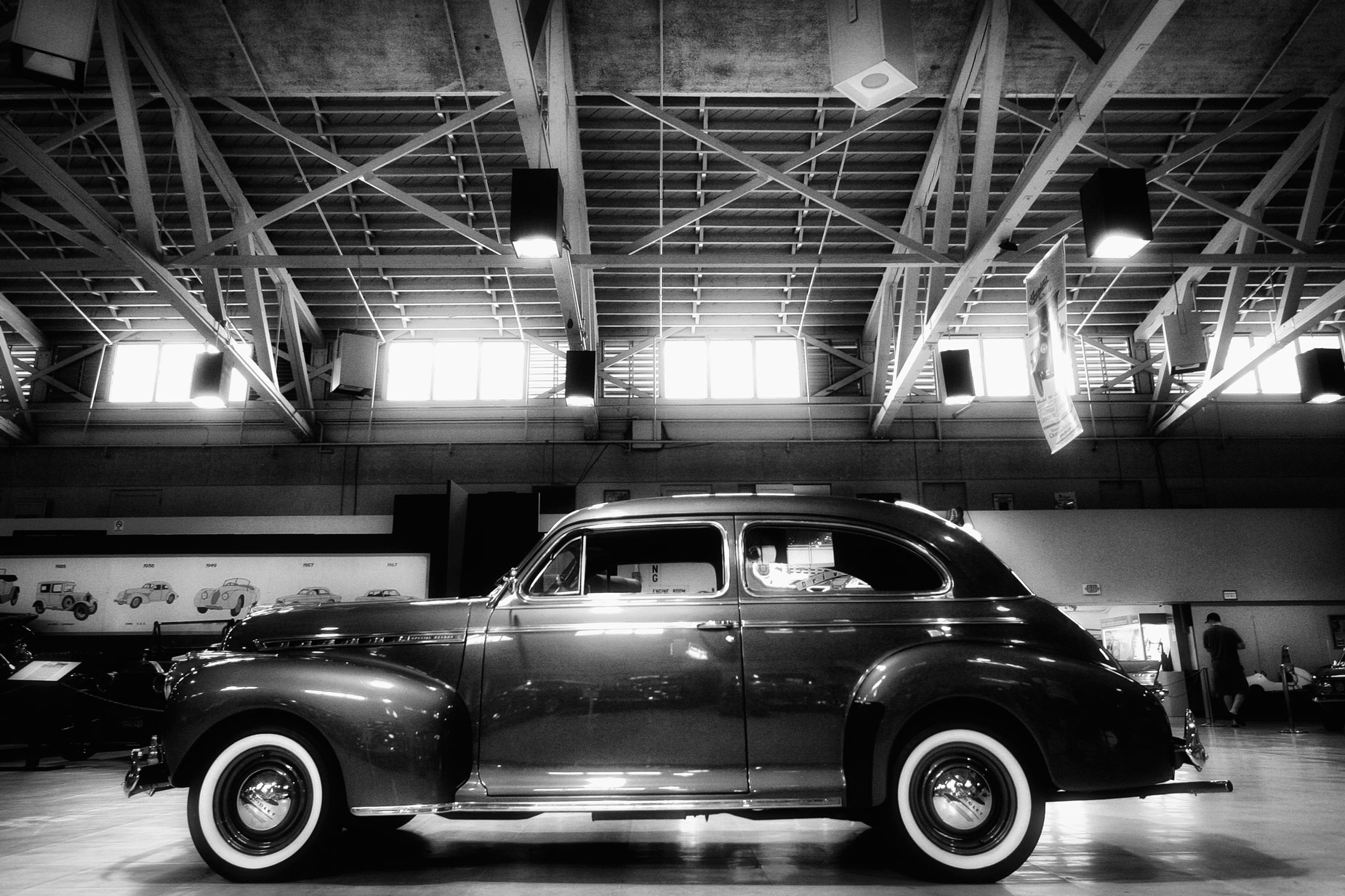
How I made this image: While many photographers, including myself, traditionally use soft focus techniques for portraiture, I sometimes use if when photographing vintage automobiles to add that “old car look” as in the above photograph of a classic Chevrolet that was made at San Diego’s Automotive Museum.which is located in Balboa Park.
For this photograph I used a Canon EOS 30D with EF-S10-22mm f/3.5-4.5 USM lens at 14mm. Exposure was 1/40 sec at f/4 and ISO 400with a plus two-thirds stop exposure compensation for the original color JPEG file that was converted to monochrome using Silver Efex with the Low Key 2 preset that added just a touch of soft focus.
Soft Focus or Blur?’
The distinction between soft focus and creative blur is often confused, so let’s look at the differences:
When all or part of a photograph lacks sharpness, it can be blurry. Blur can be caused by camera or subject motion and can be accidentally or deliberately created by an object moving while the camera’s shutter is open, by moving the camera during exposure or both. Digital blurring is typically accomplished through software averaging of pixel values to soften edge detail but there are other ways to accomplish this, such as by using Photoshop’s Motion Blur.
A lens, like those designed for soft focus, that’s not corrected for spherical aberrations will produce soft focus and create a diffused look by bending light away from the subject so parts of the photograph are defocused while the rest of it remains in focus. Highlights are dispersed onto adjacent areas and the image looks mostly focused while some of its elements are just enough out-of-focus so they’re softened. In addition, sharp lines and edges are slightly fuzzy and small details disappear. That’s why this technique is sometime used in portraits.
If you enjoyed today’s blog post and would like to buy me to a cup of Earl Grey tea ($2.50,) please click here. And if you do, thanks so much.