
Today’s Post by Joe Farace
My responsibility isn’t to paint a flattering portrait; my responsibility is to paint a real portrait, a true portrait. — Jhumpa Lahiri
During workshops and seminars, attendees often ask about how I deliver images or proofs from a portrait session to models or clients. Today’s post is all about how I do it: This that I use system may not work for you but you might find portions of my method that you can use and if you like it, give it a try.
Here’s How I Do It
Nowadays most all of my photography is done for myself, for the sheer joy of creating new images. The rest is made for online use, largely for these blog posts. I rarely deliver any kind of traditional prints or proofs to the people I photograph. Instead of paper proofs I give all of the models that I photograph their of a choice of a CD or flash drive containing all the unretouched JPEG files we make.
On-line proofing does not appeal to me and doesn’t fit the kind of photography I do but maybe it might work for you. But keep this in mind…. Several wedding photographers have told me they have seen prints sales go down after they instituted on-line proofing. The days, most wedding clients are digitally driven. As long as they can see and show photographs to their friend photos on their smartphone, it’s “real” and they don’t want or need prints or proofs or even albums.
 In my book Joe Farace’s Glamour Photography, I wrote about the TFP (Time for Photos) method that’s nowadays shorted to just TF, that I use. Originally called Time for Prints back in the film days, this concept may have started with providing subjects with hard copy but nowadays uses digital delivery in the form of a CD or flash drive. Since hardly anybody uses CDs anymore its usually flash drives that I buy from Micro Center. I always make a backup CD for myself containing all the RAW and JPEG files made during a session that are stored in archives and also entered into a database that’s searchable by date, subject’s name, keywords and have a unique number that’s written on a label for the disc’s case. These discs are stored into Swedish-made Bigso Kristina storage boxes, oirgonally made for music CDs and are now hard to find, although something similar seems to be available on Amazon.
The content of this media can vary based on whatever agreement that you make with the subject, for instance, some photographers provide only low-resolution images to their subjects and I understand that method if their goal is to sell print. If, like me, you aren’t selling prints, that may not work. One model told me she only got one photo from a TFP shoot she did in the past. It was “a great shot,” she said but she felt cheated. Some photographers only provide a few retouched photos of the photos they like. My process is different than both of these methods. The model receives every full-size JPEG image I make to take home with her on the day of the shoot. If the person I’ve photographed asks, I’ll retouch selected images for them using techniques that are covered in an entire chapter in the aforementioned book. Lest you think I’m pimping my book, you can find lots of retouching tips on this blog for free. Let the Search box (magnifying glass icon) be your guide.
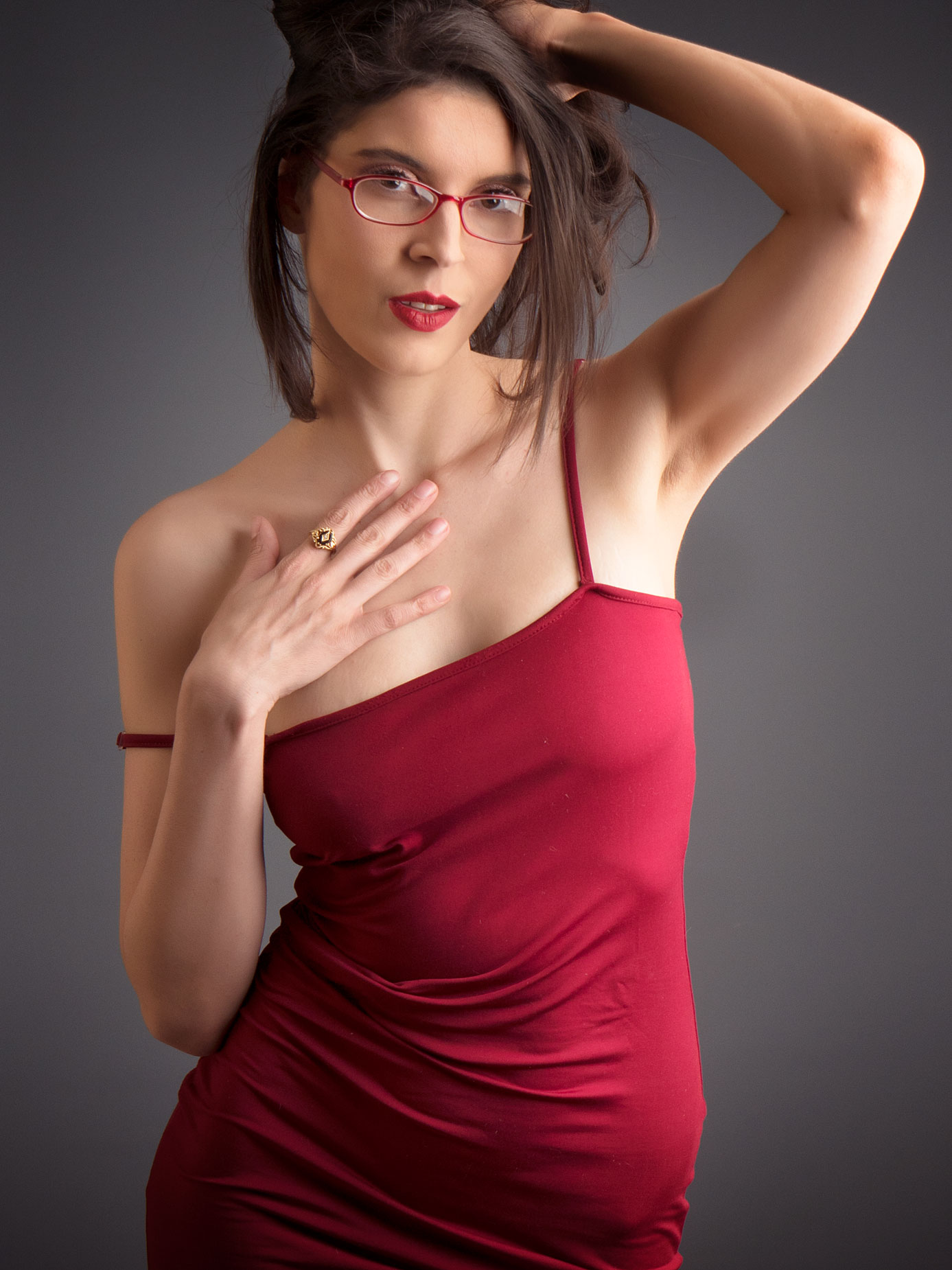
How I made this portrait: I photographed Erin Valakari in my 11×15-foot home studio with a Panasonic Lumix GH4 with Lumix G Vario 14-45mm f/3.5-5.6 lens (at 45mm.) The exposure was 1/125 sec at f/6.3 and ISO 200. Lighting was provided a Paul C Buff DigiBee 800 monolight with a Plume Ltd Wafer softbox and an AlienBees 800 monolight that was used for fill. The backdrop is a Savage 5 x 7-foot Infinity grey vinyl background. Paul C Buff is not a sponsor of me or this blog. I do not get a single penny from you clicking those links; they are provided just for your convenience.
Some final thoughts: Some photographers and models like to make the TF process complicated, I think the process boils down to a simple trade of services: A TF shoot recognizes that both model and photographer’s time is valuable. The model receives media containing all the JPEG image files from the shoot and the photographer gets to work with the model. A typical TF shoot provides both subject and photographer with photographs they both can use in their portfolios but like any contract you and she can negotiate about what you both want.
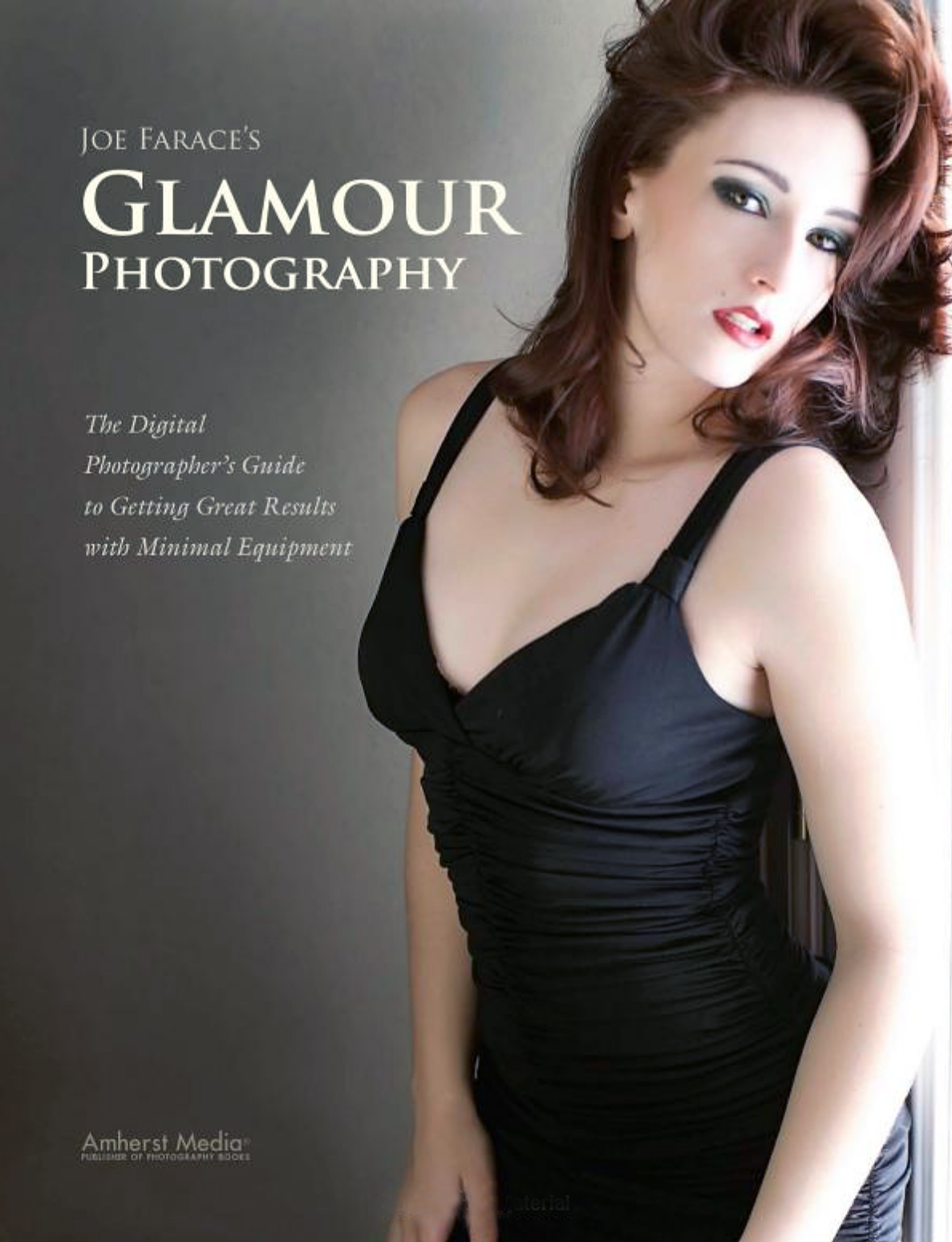
My book Joe Farace’s Glamour Photography is full of tips, tools and techniques for glamour photography and includes information on all of the cameras and lighting equipment, including setups used, as well as the complete exposure data for each image. Used copies are available from Amazon $33.63. as I write this. The Kindle version is $19.99 for those preferring a digital format