
It’s National Parker Day that’s observed annually on April 6. Parker is a name of English origin, derived from Old French, which means “keeper of the park,” which is interesting because today’s featured image was made in a park near Parker, Colorado.
Today’s Post by Joe Farace
One very important difference between color and monochromatic photography is this: in black and white you suggest; in color you state. Much can be implied by suggestion, but statement demands certainty… absolute certainty.–Paul Outerbridge
 Infrared photography doesn’t have to be in black and white. Although I recognize this is a valid interpretation on a genre that is itself not a realistic depiction of the world around it. o why not color IR? One of the best ways of creating a color infrared image is starting by using a camera that sees more kinds of light than the invisible spectrum.
Infrared In Color: An Option
I acquired my Panasonic Lumix G6 when it went on sale after the Lumix G7 was introduced. That’s my usual practice whenever I find a camera I like and know there’s a replacement coming soon. In this case, I specifically bought the Lumix G6 to be converted for infrared photography. Since I already had a Lumix G5 that was converted by Life Pixel with their Standard IR (720nm) option, I decided to have them install the “Enhanced IR” option that’s equivalent to a 665nm infrared filter. If owning more than one IR converted camera seems obsessive, I plead guilty. (I also have a Lumix GX1 with Life Pixel’s Hyper Color filter.)
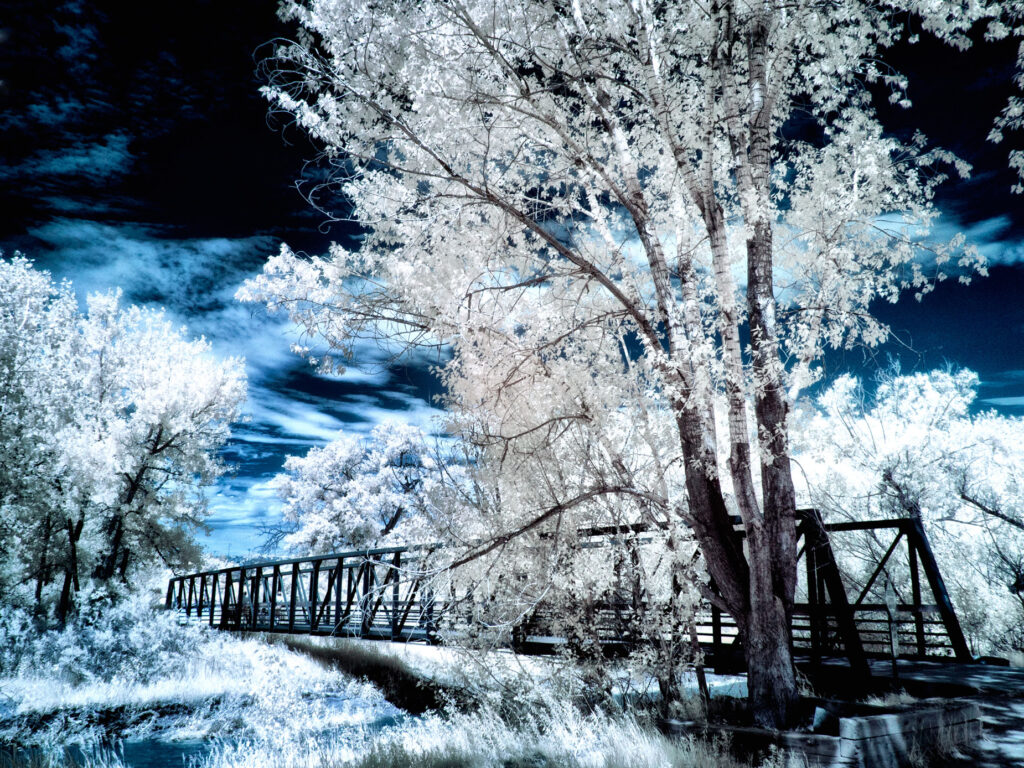
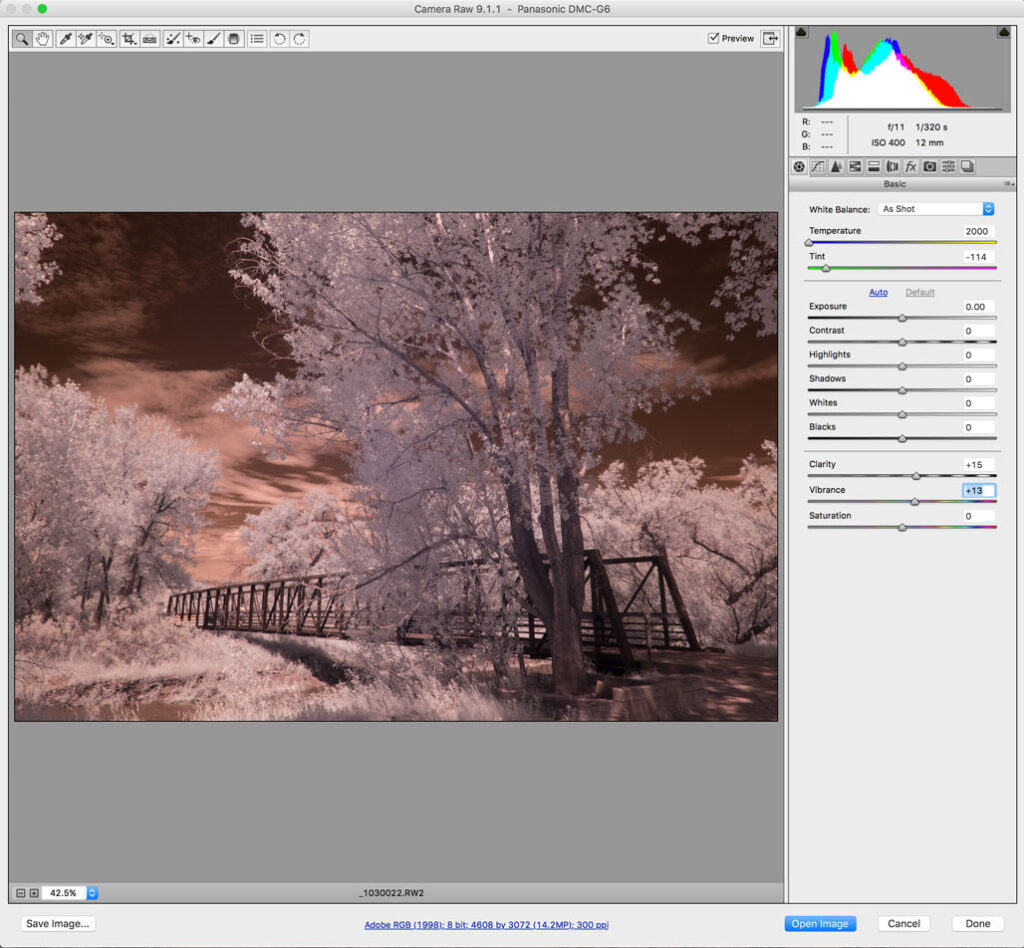
How I made this image: The above photograph was shot with a Lumix G6 with a G Vario 12-32mm f/3.5-5.6 ASPH lens (at 12mm.) Read some of my thoughts about this lens in this post. The Av exposure was 1/320 sec at f/11 and ISO 400. The original RAW file was converted to color infrared using the blue sky effect. For a comparison, you can see the RAW file, straight out of the camera at above right.
With cameras converted with filters similar to Life Pixel’s “Enhanced IR Filter” you can use Photoshop’s Channel Mixer Adjustment Layers to produce something that’s black and white while adding a “blue sky” effect, creating an image that blends color and monochrome as well as reality and unreality at the same time. As a finishing touch, I applied the Contrast Color Range and then the Glamour Glow filter from Color Efex.
How it works: The Enhanced IR and similar filters allows more natural light (approximately 400 to 700nm) to pass through onto the sensor giving you the option of adding color or converting the captured image into black and white using any number of techniques. LifePixel says that this conversion is suited for color IR photography with more saturation and color range. They also claim the black and white infrared effect “looks quite good although with a bit less contrast,” when converted into monochrome. This filter does produce black and white images but based on my experience is that the overall effect is less dramatic than images produced by camera’s with the company’s Standard IR conversion.
 I’ve found that Life Pixel does a great job with IR conversions and they’ve done some of the conversions for my Canon DSLRs and all of my Panasonic Lumix G-series cameras. This is not a paid or sponsored endorsement, just my experience.
New copies of my book, The Complete Guide to Digital Infrared Photography are available from Amazon for $41.98, with used copies selling for around $14, as I write this. New copes of my book Creative Digital Monochrome Effects that has a chapter on IR photography are available from Amazon for $16.15, with used copies selling for around eight bucks, as I write this.