
Today’s Post by Joe Farace
“Landscape is to American painting what sex and psychoanalysis are to the American novel.” ―
Because of the nearly white reproduction of most vegetation’s chlorophyll, digital infrared photographs can render landscapes as if they were glowing, moonlit or immersed in an extraterrestrial light. That’s the good news. The bad news is that exposure meters, either hand held or in-camera, are not inherently sensitive to infrared light.
The Right Exposure
While the fact that most exposure meters cannot see infrared light, neither can our eyes! On the surface that might make it seem as if it would be difficult to calculate exact exposures when shooting infrared with either on-camera filters or when using an IR-converted camera, as was the case with the featured image. For example, two subjects that appear equally bright under normal, visible light might reflect infrared radiation at significantly different rates and have different brightnesses when captured with an IR-converted camera or infrared filters.
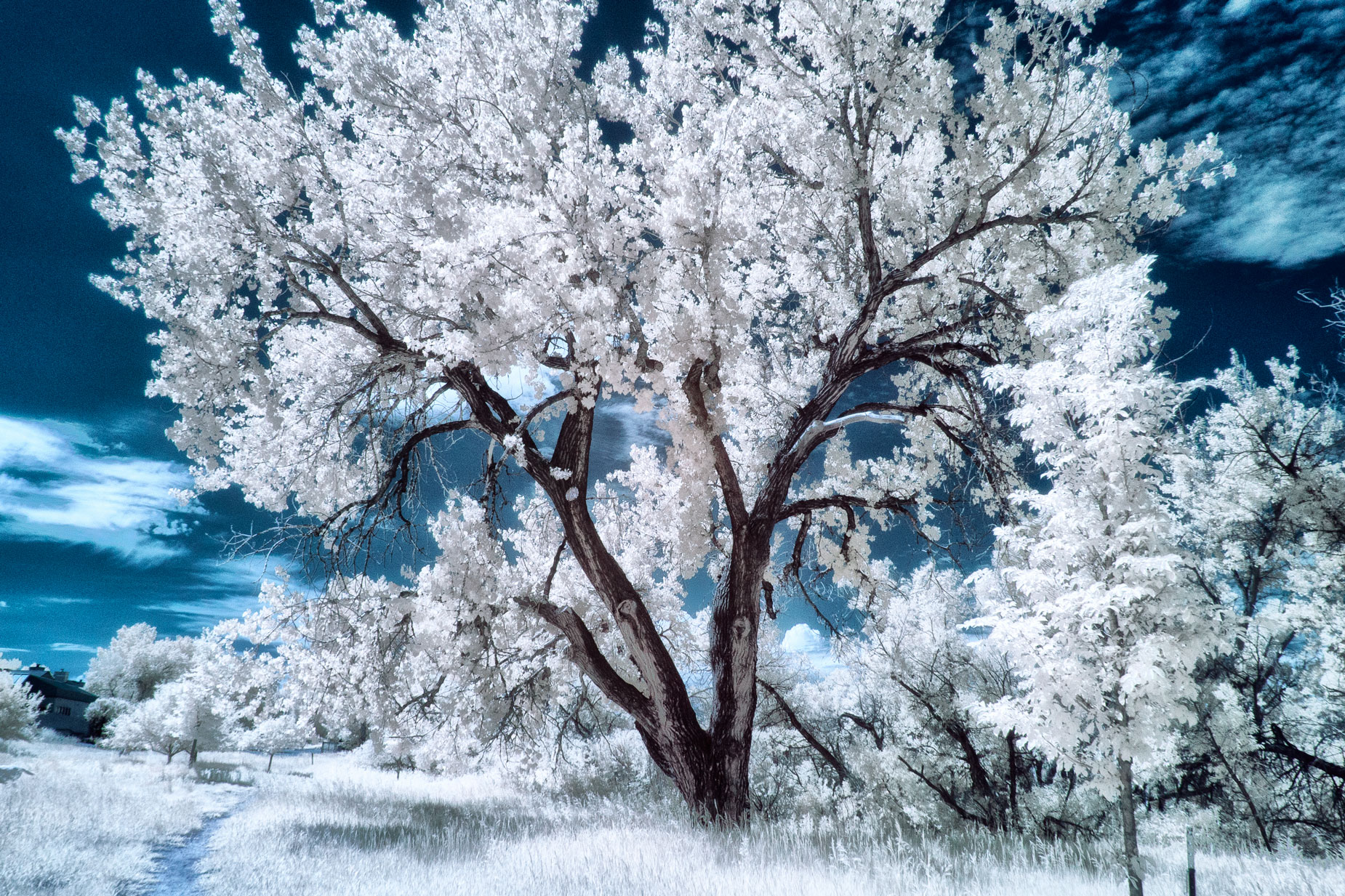
How I made this shot: I photographed my favorite tree in McCabe Meadows in infrared using a Panasonic Lumix G6 that had been converted by LifePixel using their Enhanced Color IR (665nm) filter. Yes, I have a favorite tree, not a favorite species and I’m not sure what species this tree is other than it’s old and has an interesting shape. My friend Barry Staver think that it’s a cottonwood aka Populus deltoides. The lens used was the Lumix G Vario 12-32mm f/3.5-5.6 at 12mm with an exposure of 1/400 sec at f/11 and ISP 400. That link has an image of the same tree made with a camera that has a different infrared filter.Even though the image on the LCD may look perfect, the Panasonic Lumix G6 I used to make the above photograph it tends to slightly underexpose when shooting landscape images like this one. Because they are also based on a visible light spectrum, histograms aren’t always a good indication either.
Why Not Bracket?
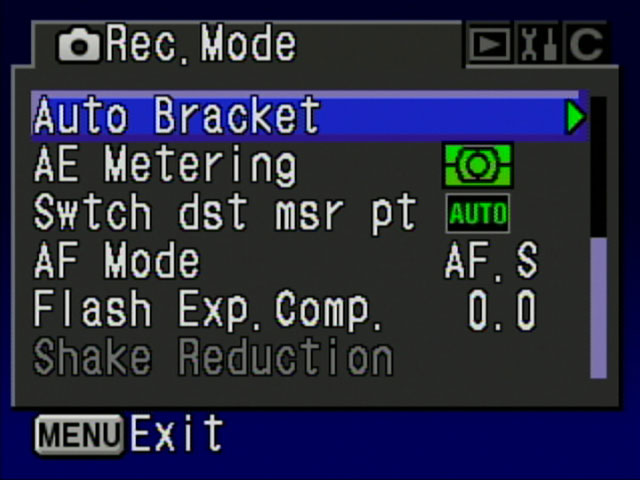 Even though the image on the LCD may look perfect, the Panasonic Lumix G6 I used to make the above photograph tends to slightly underexpose when shooting landscape images. Because they are also based on a visible light spectrum, histograms aren’t always a good indication either.
If you are just getting started in digital IR photography, I think it’s a good idea to bracket three to five different exposures because you can’t count on your LCD screen to show you the exact results when viewing the files later on your computer’s calibrated monitor.
Most cameras offer a built-in bracketing function but even if your camera doesn’t have one it should have an Exposure Compensation control that will let you adjust exposures on one-half or one-third stops while in any of the various automatic exposure modes. After you get more experience you will learn what you have to add (and probably not subtract) but you never know until you try. I almost always have to add PLUS one- or two-thirds stop exposure compensation to images shot with this camera. This is easy to do with the Lumix G5 and G6 because ther]y both have a convenient sliding switch atop the camera near the shutter release.
All of these reasons is why, when shooting infrared, I \ often shoot in manual mode. You don’t need a hand held exposure meter to get started shooting in manual mode. I typically look through the lens with the camera in Program mode and see what the suggested exposure is, then transfer that shutter speed and aperture to the camera after switching to manual mode. You are now free to change the shutter speed or aperture just like in the good ole days.
 I’ve found that Life Pixel does a great job with IR conversions and they’ve done most of the conversions for my Canon DSLRs and all of my Panasonic Lumix G-series cameras. This is not a paid or sponsored endorsement, just my experience.
Used copies of my book, The Complete Guide to Digital Infrared Photography are available from Amazon starting around nine bucks as I write this. My book Creative Digital Monochrome Effects has a chapter on IR photography and is available new from Amazon for $11.46 with used copies starting around six bucks as I write this.