
It’s Swallows Depart from San Juan Capistrano Day. On or around October 23rd, swallows gather in a swirling mass before making a 6,000-mile journey to their their winter home in Corrientes, Argentina. Then, with what seems like clockwork precision, they return to the exact spot in San Juan Capistrano on or about March 19th, which is happens to be St. Joseph’s Day.
Today’s Post by Joe Farace
“True hope is swift, and flies with swallow’s wings.”–
 In la previous Monochrome Monday post, I offered my take on digitally recreating the kind of bromoil print that the Dark Magician himself, William Mortensen might have produced.
Today I take a look at another photographic pioneer, Frederic Evans (1853-1943.) He began his career as a bookseller but retired in 1898 to become a full-time photographer and adopted the Platinotype technique for his photography. No books about Evans are currently in print, but you can pick up affordable, used copies of
Ferric salts are chemical compounds containing iron in its +3 oxidation state, meaning the iron atom has lost three electrons to form the ferric ion.
The Platinotype Technique
Platinum prints are based on using the light sensitivity of iron ferric salts. In the presence of oxalate ions, They use light to produce iron compounds that react with platinum salts to produce platinum metal. The salts are then removed leaving a stable image. Like other iron-based processes, platinum printing is slow and requires a large UV light source like the sun and large format negatives for contact printing.
 Palladium is a rare metal that was discovered in platinum ores in 1803 and named after the asteroid Pallas by William Hyde Wollaston, an English chemist who developed a way to process platinum ore. Palladium prints use another iron-based process that is similar to platinum printing, except they typically look warmer. Palladium is usually less expensive than platinum and is often used in the darkroom for platinum printing. Most platinum prints, in fact, contain a mixture of platinum and palladium.
Platinotype is a monochrome photographic printing process that is based on the light-sensitivity of ferric oxalate that reacts with platinum or palladium reducing it to basic platinum, which creates the image. Ferric oxalate is an inorganic compound commonly appearing as a pale yellow-green or brownish-green crystalline powder.
How I Made These Images
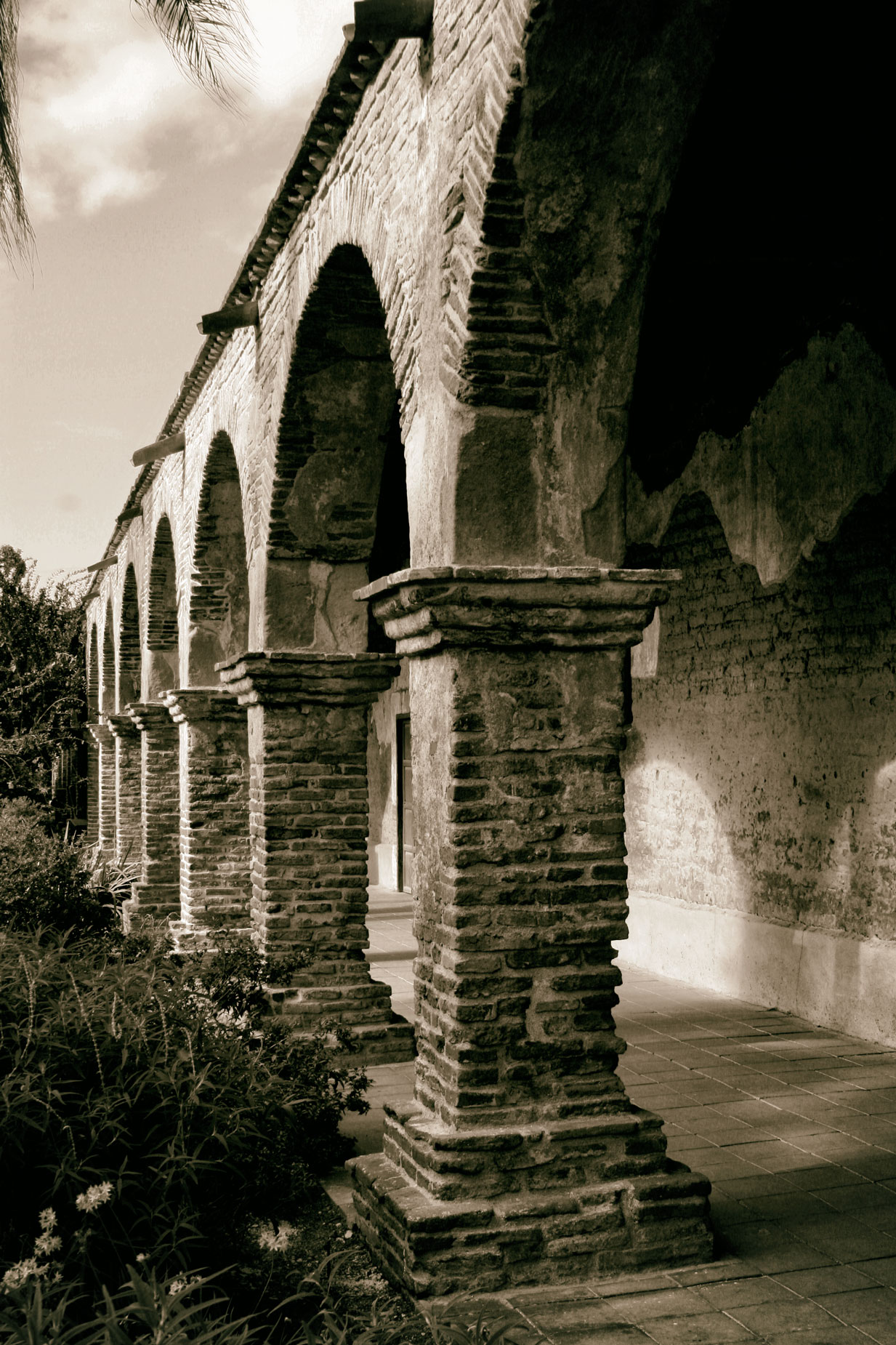
The color image file (upper right) was made at Mission San Juan de Capistrano and was originally shot as an homage to the work of Frederick Evans. The camera used was a Canon EOS 30D with an EF28-135mm f/3.5-5.6 IS USM lens at 28mm)with a Program Mode exposure of 1/200 sec at f/10 and ISO 200.
For the image at left, I began by using PhotoKit, a photographer’s plug-in toolkit that includes 141 effects that replicate analog photographic effects. Its B&W Toning Set can apply a Platinum toning effect that produces results that are similar to traditional chemical toning effects and are applied to a separate layer. Next, I used the Tonal Contrast filter from Color Efex to add some depth and sharpness to the image. Lastly, to produce a more Palladium appearance, I used the Analog Efex plug-in with it’s Camera 2 preset with just a slight adjustment to the sliders to produce the final look.

My book Creative Digital Monochrome Effects is available from Amazon with new copies at $13.78 with used copies starting at a little more than seven bucks, as I write this. There’s no Kindle version available, sorry.