
I was introduced to the work of Gustave Doré (1832 – 1883) in Ray Harryhausen’s landmark book The Art of Ray Harryhausen. He, in turn. was introduced to Doré by Willis O’Brien who designed the iconic stop-motion sequences for the original (1933) King Kong and used that inspiration for the jungle scenes depicted in the film.
Today’s Post by Joe Farace
Those who dream by day are cognizant of many things which escape those who only dream by night.–Edgar Allen Poe
I’ve been passionate about photography since I was eight years old when my parents gave me a hand-me-down Kodak box camera. That lifelong passion is one of the reasons I created this and my car photography site but a year or so ago what I thought was an undying obsession was tested while working on an assignment requiring me to shoot my Canon full-frame and APS-C DSLRs along with a bunch of different lenses.
When I went to the UPS Store to return these lenses to the manufacturer, I felt a sigh of relief as if a burden had been lifted from me. The three lenses along with shipping box and brown crunchy packing paper weighed 25 pounds. You should know that I don’t get to keep all the gear that’s loaned to me by camera manufacturers although I suspect that’s not the case of some bloggers and YouTubers, especially those that are personally sponsored by manufacturers.
Monochrome Can Add Character
While working on this project I engaged in all kinds of shoots from macro photography, studio portraiture, outdoor portraits, documentary photography and low light imagery. These are all genres I enjoy but as the month progressed I dreaded each additional shoot. Why? For these old bones of mine, the gear was heavy and awkward to use. From time to time during the time of these shoots, I used my Olympus and Panasonic gear for some personal photography and the comparison when it came to ease-of-use was striking. A Canon EOS 5D Mark I, for example, weighs 59% more than a Panasonic Lumix GH4.
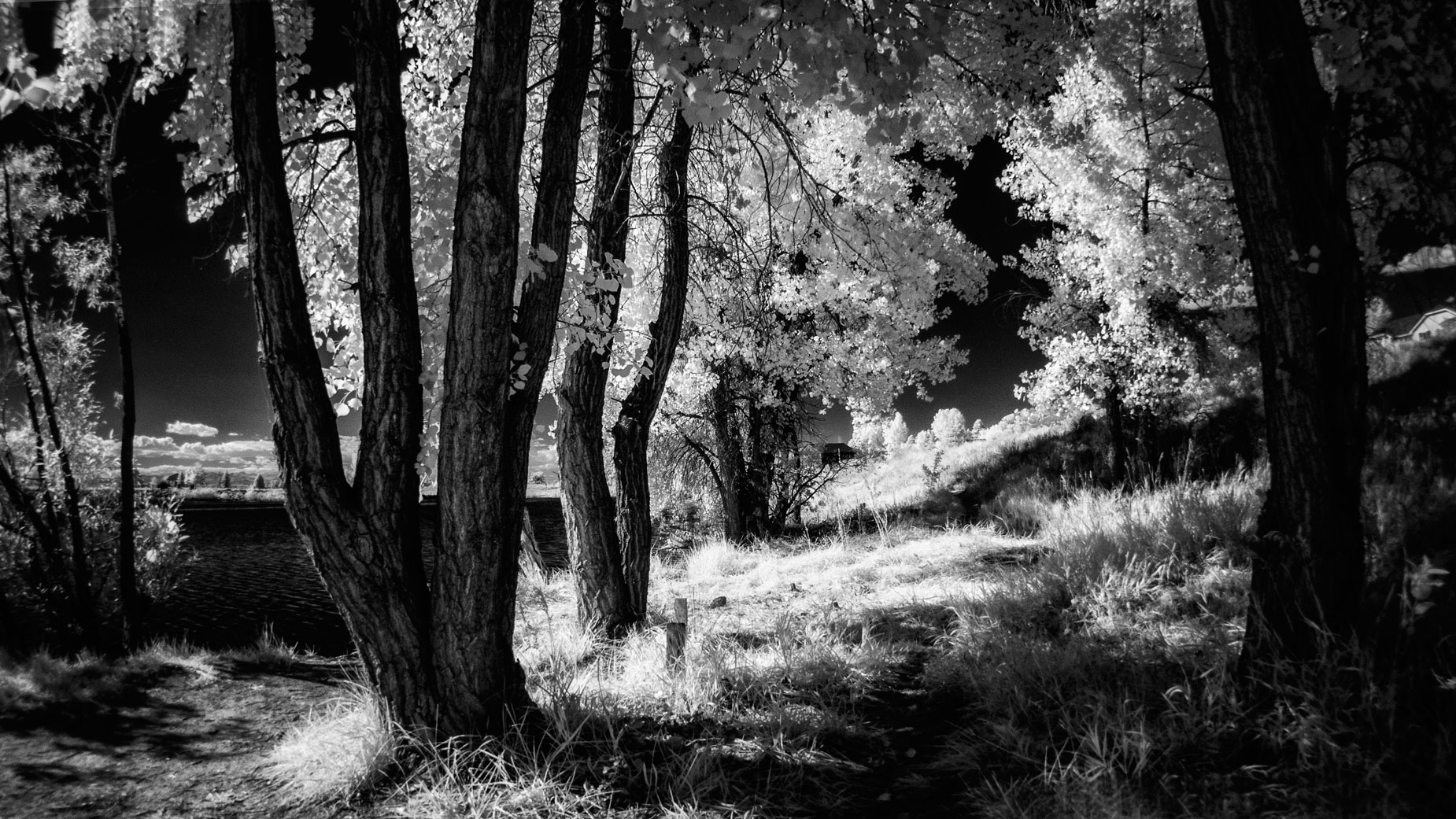
How I Made this photograph: Black and white photography can, but maybe doesn’t have to, offer better focus on light and shadow. This image is an homage to the work of Paul Gustave Doré (1832 – 1883) who was a French artist, engraver, illustrator and sculptor. It has strong contrast with luminance transitions that help define the shape and depth of a scene.
This image was made in the wooded area that surrounds Barr Lake using a Panasonic Lumix G5 that was converted for infrared capture by Life Pixel using their Standard IR (720nm) conversion. The lens was the unique 9mm f/8 Olympus fish-eye lens cap lens with an exposure of 1/640 sec at f/8 and ISO 400, that for some reason, this image was cropped, in camera, to 16:9. adding a cinematic look as am nod to the work of Willis O’Brien. There’s more on how I made this image in this post, although I think the image shown there is cropped into a 4:3 ratio.
Nobody’s Perfect
This is not to say that all of my experience with Micro Four-thirds system cameras from Olympus and Panasonic has been perfect. While I own a bunch of MFT bodies and some lenses, my personal mirrorless system lacks the depth of focal lengths I would like to have but I can’t afford to add more, at this time, because for some reason Micro Four-thirds lenses seem priced high, especially when compared to some DSLR lenses.
The image quality of even some of the high-end Micro Four-thirds cameras, including the Lumix GH4 I typically use for portraiture, occasionally produce noise in the shadows even at modest ISO settings that would have pixel peepers running for their 4.7-lb 100-megapixel Hasselblads. Me? I’ll just remove any noise with the Dfine plug-in and enjoy the experience of shooting the photographs.
Lots of people are pleased as can be shooting their DSLRs and I am genuinely glad they’re happy and would not dream of dampening their enthusiasm for their gear. Photography is all about having fun with your camera. It doesn’t matter what kind of camera you prefer to use, whether it’s a DSLR, APS-C, mirrorless or even a film camera. What matters is that you are enjoying the process. And, to me, that’s what photography is really all about.
 I’ve found that Life Pixel does a great job with IR conversions and they’ve done conversions for some of my Canon DSLRs and all of my Panasonic Lumix G-series mirrorless cameras. This is not a paid or sponsored endorsement, just my experience.
New copies of my book, The Complete Guide to Digital Infrared Photography are available from Amazon for $43.66, with used copies selling for around nine bucks, as I write this. Copes of my book Creative Digital Monochrome Effects that has a chapter on IR photography are $13.78 with used copies selling for around seven bucks, as I write this.