
Today’s Post by Joe Farace
“Landscape photography is the supreme test of the photographer and often the supreme disappointment.” – Ansel Adams
 Everybody who’s involved in infrared photography has a different perspective on this genre. That’s part of what makes shooting IR so much fun. When my pal Barry Staver and I do our more-or-less-annual PhotoWalk at Denver’s Hudson Gardens, he typically uses different cameras and lenses than I do. Even his Panasonic Lumix GH4 had a different Life Pixel conversion than the two Lumix cameras I typically bring, one is 720nm and the other is Hyper Color, so his images always look different than mine.
The Infrared Perspective
Because of the kind of infrared photographs I make, I like to use wide-angle lenses because I think the resulting images have more impact than those I shoot with longer or even “normal” focal length lenses. Hey, maybe I’m wrong. That was one of the points I made in my look at lens sharpness for my post, Not the Sharpest Knife in the Drawer. In that post I said, “…I noticed that the manual focus Rokinon 12mm f/2 NCS CS lens is available (used) for a little over one hundred bucks…” That’s statement is only somewhat true these days. What about the relatively affordable 12mm Panasonic Leica DG Summilux f/1.4 ASPH lens that I used to make the featured image? This is, not surprisingly, a beautifully crafted lens and I guess it should be for almost $1200.
I also used the Leica DG Summilux with my Olympus E-M10 Mark I to photograph cars at a Cars & Coffee \ and on that particular camera the lens didn’t feel as balanced, even though I was using Oly’s grip, which adds a tiny bit of heft to the camera. The lens felt more balanced on the Lumix, yet looked awesome on the E-M10.
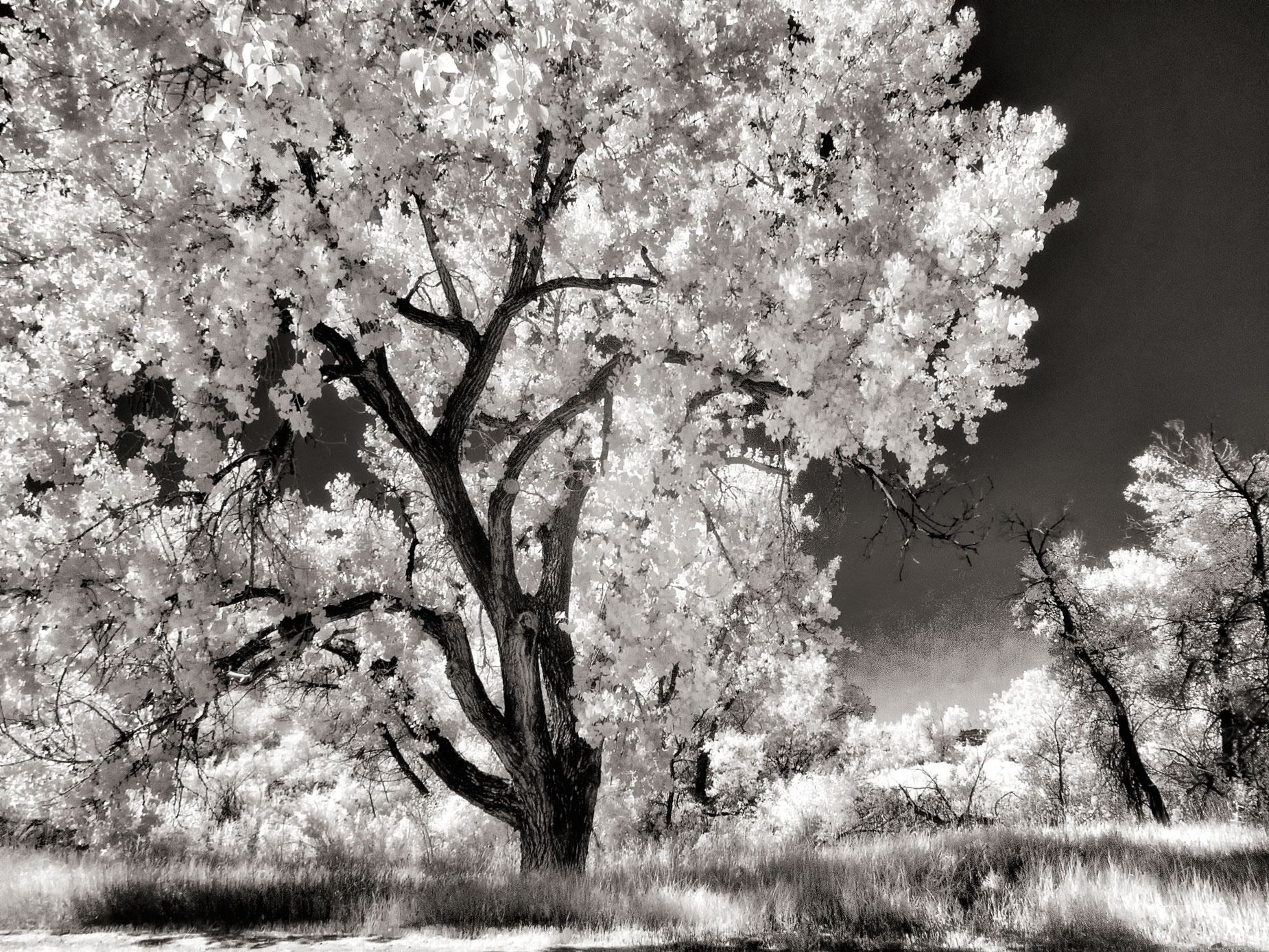
How I made this shot: It was late fall and about the time when the Wood Effect was beginning to fade for the year when I received a 12mm Panasonic Leica DG Summilux f/1.4 ASPH lens for testing. One of my favorite trees at McCabe Meadows already had a number of leaves wilting and falling off. If I didn’t shoot infrared in the Meadows right away, later on will be too late. This is a good tip no matter what kind of photography you do: Don’t think about it, shoot it now.
When I was making these images, even close to noon MDT, flare kept creeping in and for some of the shots I had to use my hand to shade the front element of the lens. The camera used was a Panasonic Lumix G6 with Life Pixel’s Enhanced IR Conversion (665nm). Th exposure was 1/125 at f/16 and ISO 400 with a plus one-third stop exposure compensation. With the 12mm Summilux mounted on the lightweight (less than 14 oz) Lumix G6 the balance was surprisingly good.
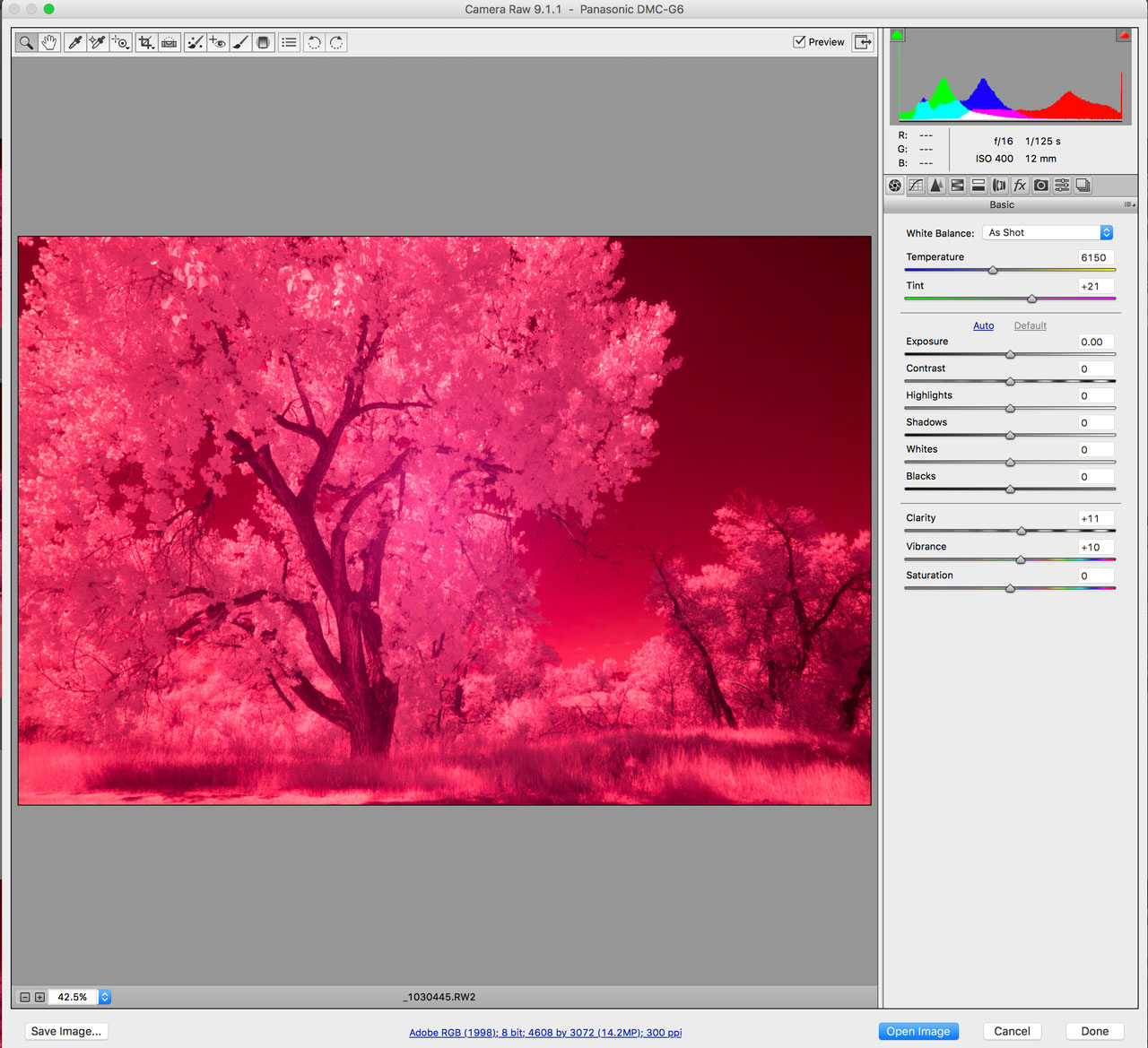
To create the above image, the RAW file (above right) was slightly tweaked in Adobe Camera RAW before cropping into the 4:30 ratio that I should have shot it in the first place. Look for an updated post on my current approach to cropping real soon now. The image was converted to monochrome with Silver Efex applying their Full Spectrum preset along with further tweaking of the sliders before hitting it with the Tonal Contrast filter that’s part of Color Efex to get some of the contrast under control. I finished up with PhotoKit to add a Platinum tone before applying Glamour Glow from Color Efex for some infrared glow.
When to Shoot: Not only is noon the best time to shoot infrared photographs but because the sun is directly above, flare is usually less of a problem when shooting with wide-angle lenses. If you’ve shot infrared away from the prime-time IR hours, you know that hot spots (see below) and flare can be an issue. Alas, the nicely made lens hood that Panasonic includes with the lens is not much help under these conditions.
A few words about Hot Spots: All photographs lenses are designed and optimized for the visible range of light. This applies to sharpness and lens coatings that are designed to protect against ghost images in backlighting with the most common problem is probably the infrared hot spot. Using small apertures can cause a hot spot but infrared images are is much more likely to be affected by diffraction that’s also caused by shooting at smaller apertures.
 I’ve found that Life Pixel does a great job with IR conversions and they’ve done some of the conversions for my Canon DSLRs and all of my Panasonic Lumix G-series cameras. This is not a paid or sponsored endorsement, just my experience.
New copies of my book, The Complete Guide to Digital Infrared Photography are available from Amazon for $43.65, with used copies selling for around eight bucks, as I write this. New copes of my book Creative Digital Monochrome Effects, which has a chapter on IR photography, are selling for around $29.92 with used copies available for around seven bucks, as I write this.