
Today’s Post by Joe Farace
A Shutterbug reader once sent me an email asking, “Why do you shoot infrared, when regular photography is already so hard.” My feeling was then and still is that IR photography isn’t that difficult and is as hard as you want to make it.
I always enjoy hearing from readers of this blog and if you have any questions about digital or film photography just click CONTACT and ask. Unlike some, I don’t claim to know everything about photography but based on a lot of years in the school of photographic hard knocks–and stupid photographer;s tricks– will ry to answer your questions the best that I can
Sometimes the questions readers ask may be similar to ones that you might have. Like the e-mails I received about my personal infrared photography: While this reader’s question was mostly about IR conversions for his Olympus cameras, my answer could apply to anybody who wants to convert their camera for infrared capture.
A Question & a Long Answer
Q: I have three Olympus E-1 cameras and thinking about having one converted to infrared. I’m thinking of the 715nm conversion similar to my current IR filter method. My latest attempts have been with an Olympus Pen E-P2 with a Hoya R-72 filter. When I use the filter with a mirrorless camera, I can see the image in the viewfinder but dimly. I’m wondering what the experience will be with a DSLR? Focusing might be an issue, although I tend to use a short focal length lens and small apertures to maximize depth-of-field. I’m wondering what you think about this?—Bill, Sarasota, FL
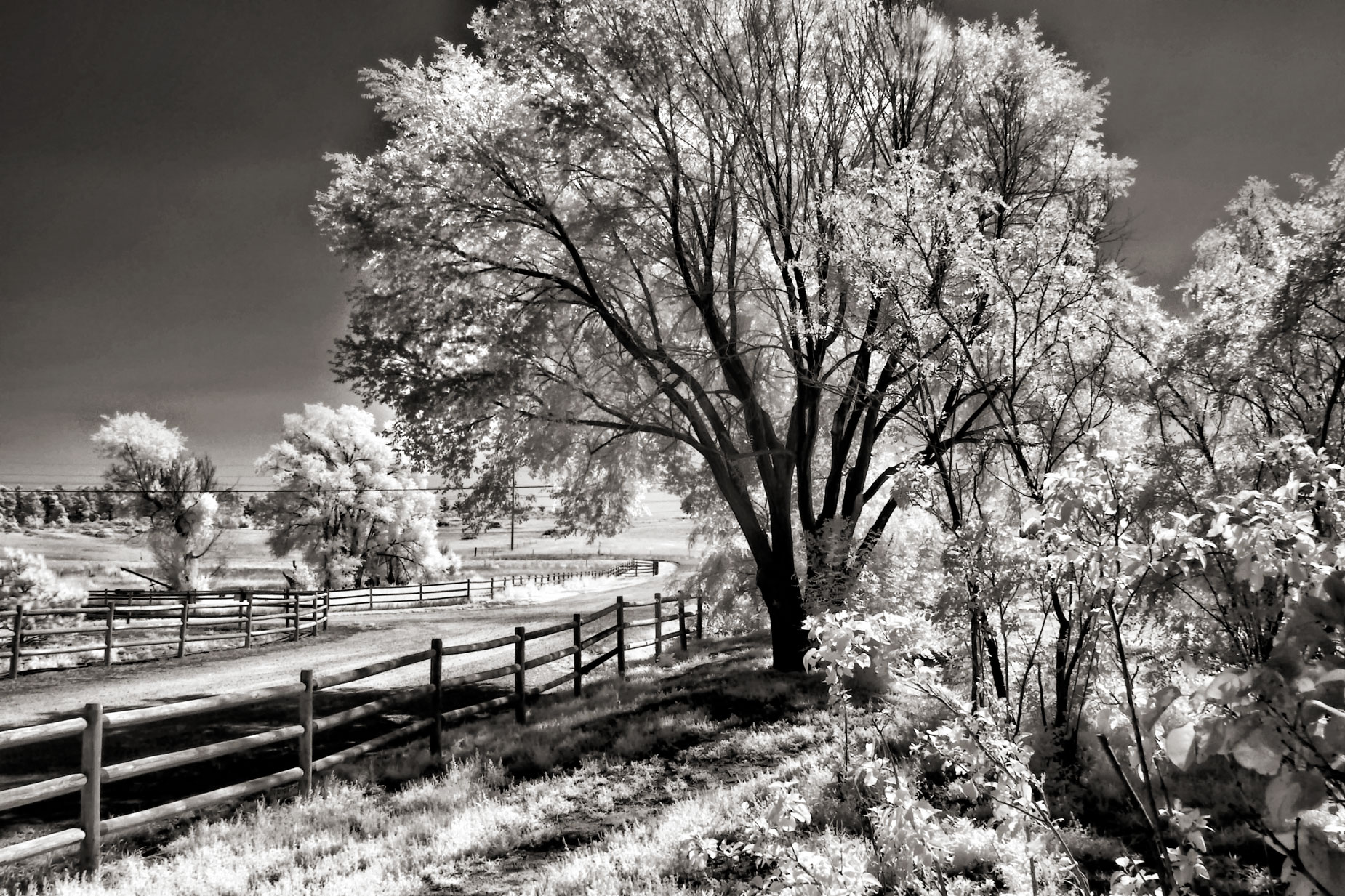
How I Made this Photograph: I captured this scene at the Hidden Mesa Open Space using a Panasonic Lumix G5 that was converted for infrared by Life Pixel using their Standard IR (720nm) Filter. Lens was a Leica M-Mount Voightlander Super Wide-Heliar 15mm f/4.5 Aspherical III. It was attached with a Fotodiox M to Micro Four-thirds adapter. The exposure was 1/250 sec at f/16 and ISO 400 with a minus two-thirds stop exposure compensation., The RAW file was converted to monochrome with Silver Efex and then toned in PhotoKit 2 and tweaked using the Glamour Glow filter from Color Efex to add a soft glow and warm up the image.
A: Because they use a mirror, any DSLR, like the E-1, is going to have viewfinder visibility problems when used with an infrared filter on the lens. The E-1 and early cameras in their Four-Thirds (not Micro Four-thirds) system do not have Live View and that feature might have helped somewhat, since the camera is probably going to mounted on a tripod because of the slow shutter speed any filter will produce. Beginning with the E-330, Olympus Four-Thirds cameras,do have Live View as do all contemporary mirrorless cameras. That’s bacuse mirrorless cameras have electronic viewfinders that typically compensate for any filter, especially dense ones like IR filters, making them easier to use. Your dim view with the Olympus E-P2 surprises me somewhat. The E-P2 has no viewfinder and while its preview screen is good, its successor, the E-P3, has a much better screen: The E-P2 screen’s resolution is 230,000 dots, while the E-P3 is 614,000. One thing I’ve noticed is that almost every new mirrorless camera has an even better viewfinder and LCD screen than the one that came before it. 
Help is on the way: Using an Olympus VF-2 external viewfinder might work better for your E-P2, The VF-2 has a flip-angle eyepiece, allowing viewing from 0–90 degrees and with 1.44 million dots, it has a pretty good screen. The bad news is that these devices whale really useful can be expensive to find on the used marketplace. I use the similar and also expensive Panasonic LVF1 on both my standard Lumix GX1 and Hyper Color-converted GX-1 and like using it a lot.
Life Pixel converts many Olympus cameras to infrared but I don’t know of any company that will convert the E-1 for IR capture. Since the sensors are the same size as a Micro Four-thirds camera some companies should be able do it. Contact LifePixel (info@lifepixel.com) and ask them if they will do it. If any readers do know of a company that does this conversion, please let me know and I will update this post.
Focusing?
Any approach to the challenge of focusing in infrared when using filters or a converted camera is the same one I’d been using for many years but I recently found out that while that it will sometimes work, it is not infallible. When you get a chance take a look at my post It’s Not the Sharpest Knife in the Drawer and then do some of your own lens tests as I’ve described in the post to find the infrared “sweet spot” for your lens. It may be different from the visible light sweet spot- and then chose that aperture for your infrared photography.
My opinion
Having a DSLR converted for IR capture will be a revelation; you can shoot images hand-held and use it like any other camera. I previously owned a Canon 50D that LifePixel converted with their Standard IR (720nm) filter and it was the best of the several IR-converted DSLRs I’ve owned over the years. I’ve since sold it and most of my IR photography these days is done using either a mirrorless Panasonic Lumix G5, G6 or GX1, all of which LifePixel converted for me using three different filters. Like you, I shoot with wide-angle lenses and prefer small apertures. They seem to capture the IR experience best but be aware of the sharpness and focusing challenges related to diffraction that I’ve described in the above linked post.
Hope I answered your question.
 I’ve found that Life Pixel does a great job with IR conversions and they’ve done conversions for some of my Canon DSLRs and all of my Panasonic Lumix G-series mirrorless cameras. This is not a paid or sponsored endorsement, just my experience.
New copies of my book, The Complete Guide to Digital Infrared Photography are available from Amazon for $43.65, with used copies selling for around nine bucks, as I write this. New copies of my book Creative Digital Monochrome Effects that has a chapter on IR photography are $13.78 with used copies selling for around seven bucks, as I write this.