
Today’s Post by Joe Farace
“View life through a wide angle lens attitude and see your horizons broaden.” ―
Over many years of shooting infrared images, whether it was using film or digital technology, I’ve gotten the best, or at least the most interesting, to me, results when shooting with wide-angle lenses. For instance…
A Zeiss Lens in Infrared
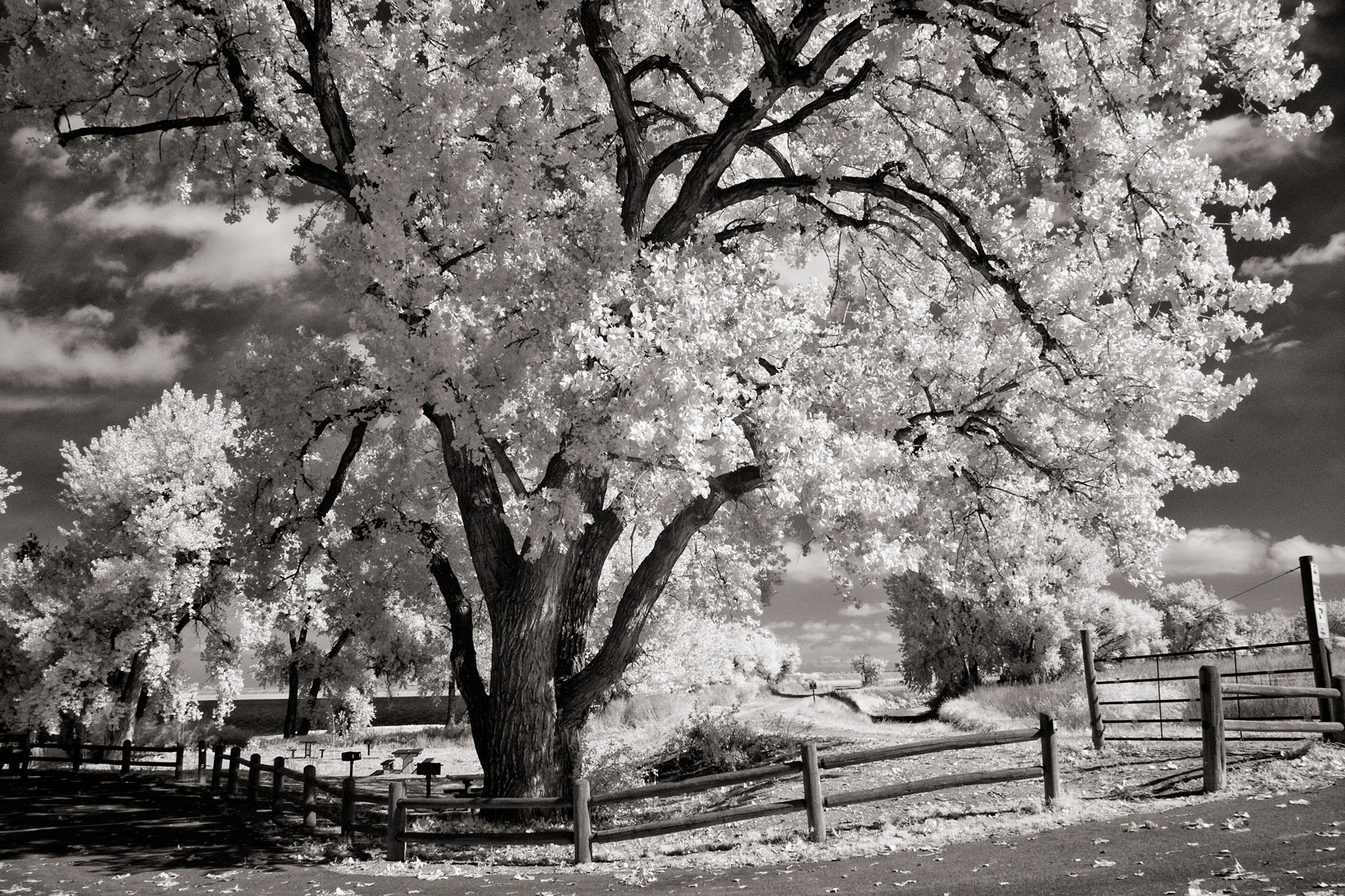
How I made this photograph: The digital infrared shot above was made near the entrance to Barr Lake State Park the day before a big snowstorm was due to blow most of those leaves away. The camera used was a Canon EOS Digital Rebel Xti that was converted by Life Pixel using their Standard IR (720nm) filter with a Zeiss 18mm Distagon T* f/3.5 ZF lens mounted. The balance of this 1.03-lb lens on the lightweight (1.23-lb) Xti body was superb. The Digital Rebel’s 1.6x multiplication factor alters the lens’s field-of-view to the equivalent of a 29mm lens but that’s just a fact of APS-sized sensor life. Exposure was 1/125 sec at f/16 and ISO 400 with a plus one-stop exposure compensation. The RAW file was converted to monochrome using Silver Efex, with a Platinum tone added with PhotoKit.
Distagon is a name that Zeiss bestows on its wide-angle lenses that use a retrofocus design. The “Dista” in Distagon is derived from the word “distance. Zeiss wide angle lenses all share the common “-gon“ ending, which is derived from the Greek word “gonia” meaning “angle.” —A Comprehensive Guide to Camera Lens Design and Zeiss Nomenclature
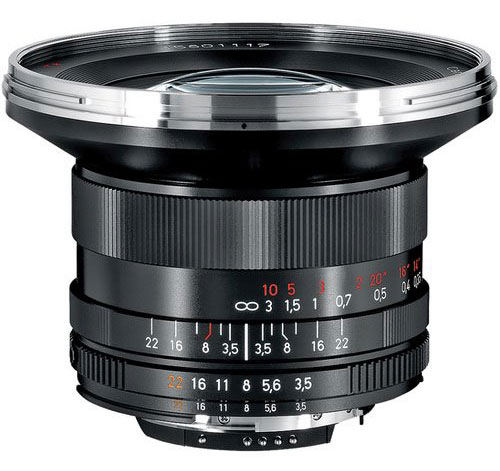 Short focal lenses are typically composed of glass elements whose shapes are symmetrical and placed in front of and behind the diaphragm. As the focal length decreases, the distance from the rear element to the film plane or digital sensor decreases and can even protrude into a camera’s mirror box requiring the mirror to be locked up in order to use the lens. A retrofocus lens solves this problem by using an asymmetrical design allowing the rear element to be further away from the plane of focus than its effective focal length might otherwise suggest.
The Zeiss Distagon T* 18mm f/3.5 lens that I used to make the above photograph was replaced in the Zeiss line-up with the sleek looking Milvus 18mm f/2.8 ZE Lens. although I prefer the traditional look off the Distagon. That original 18mm Distagon is small and light (1.12 lbs vs. 1.59 lbs for the Milvus) for its wide 90 degree angle-of-view with full-frame sensor cameras where’s it capable of delivering true wide-angle lens performance. I’ve seen used Distagon lenses on sale for as low as $765 while these days a used Milvus is comparably priced, as I write this.
PS. Not everyone agrees with my “wide-angle for infrared” philosophy. My pal, Barry Staver likes to shoot infrared images close up, sometimes even using a macro lens.
 I’ve found that Life Pixel does a great job with IR conversions and they’ve done some of the conversions for my Canon DSLRs and all of my Panasonic Lumix G-series cameras. This is not a paid or sponsored endorsement, just my experience.
New copies of my book, The Complete Guide to Digital Infrared Photography are available from Amazon for $38.79, with used copies selling for around eight bucks, as I write this. New copes of my book Creative Digital Monochrome Effects that has a chapter on IR photography are available from Amazon for $41.01. with used copies also selling for around seven bucks, as I write this.