
Today is National Camera Day, celebrating the journey of photography from complicated science to an everyday art form. This day encourages everyone to pick up a camera and capture the world around them and sharing your unique perspective through the lens. That’s something I;m trying to do today with this tutorial.
Today’s Post by Joe Farace
My dream concept is that I have a camera and I am trying to photograph what is essentially invisible. And every once in a while I get a glimpse of her and I grab that picture.–Leonard Nimoy
I have many fond memories of working with Kodak’s graphic arts film, Kodalith, back when I was a photography student at the Maryland Institute College of Art.
 What is Kodalith? During the original film era, Kodalith film was the gateway film/media for working in the wet darkroom for techniques that reproduced old and lost printing techniques. Kodalith was a extremely high contrast, orthochromatic film (see bottom of this post) primarily designed for making line and halftone negatives for photomechanical reproduction. The material was also used when making duplicate transparencies to produce highlight masks that preserved important highlight detail. Photographers interested in trying older, more arcane printing techniques would typically make contact-sized negatives with Kodalith sheet film that ere produced from 35mm or even larger format film originals. This was often the only way to make prints using these processes. If you’re interested in these sorts of wet darkroom techniques, you should own a copy of Bea Nettles’ landmark book Breaking the Rules.
That was Then; This is Now
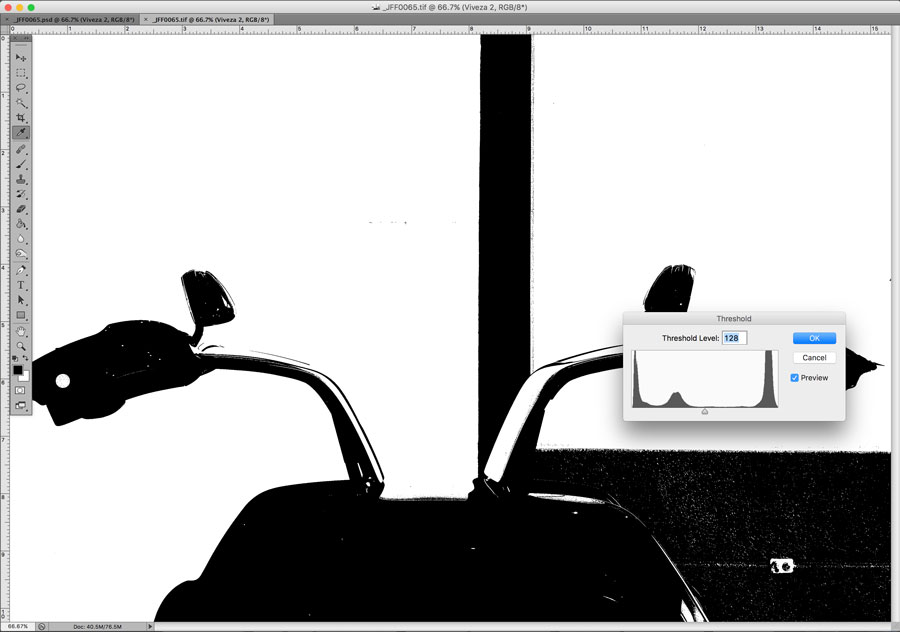 There’s a digital way to accomplish a look that’s similar to old processes that formerly required you dunking your fingers or tongs into smelly and potentially hazardous chemicals. Since many of these old processes required the use of Kodalith, it’s worth a look at a technique for producing Kodalith-like effects in the digital darkroom.
How I made the original color shot at above left: One of my favorite places to make car photographs is the monthly Cars & Coffee events that are sponsored by the Vehicle Vault in Parker, Colorado. This McLaren automobile with its signature dihedral (or butterfly) doors was photographed using an Olympus E-M5 Mark I and M.Zuiko 14-42mm f/3.5-5.6 II R lens. Exposure was 1/500 sec at f/16 and ISO 400.
Here’s how to do it: Start with Photoshop’s Thresholds (Image > Adjustments >Threshold) command. This lets you create high contrast images from within Photoshop. To identify a highlight, drag the slider to the far right until the image becomes pure black. Then drag the slider slowly toward the center until some solid white areas appear in the image. Or you can drag the slider to the far left until the image becomes pure white then drag it slowly toward the center until some solid black areas appear in the image. Either way works and then you’re done!
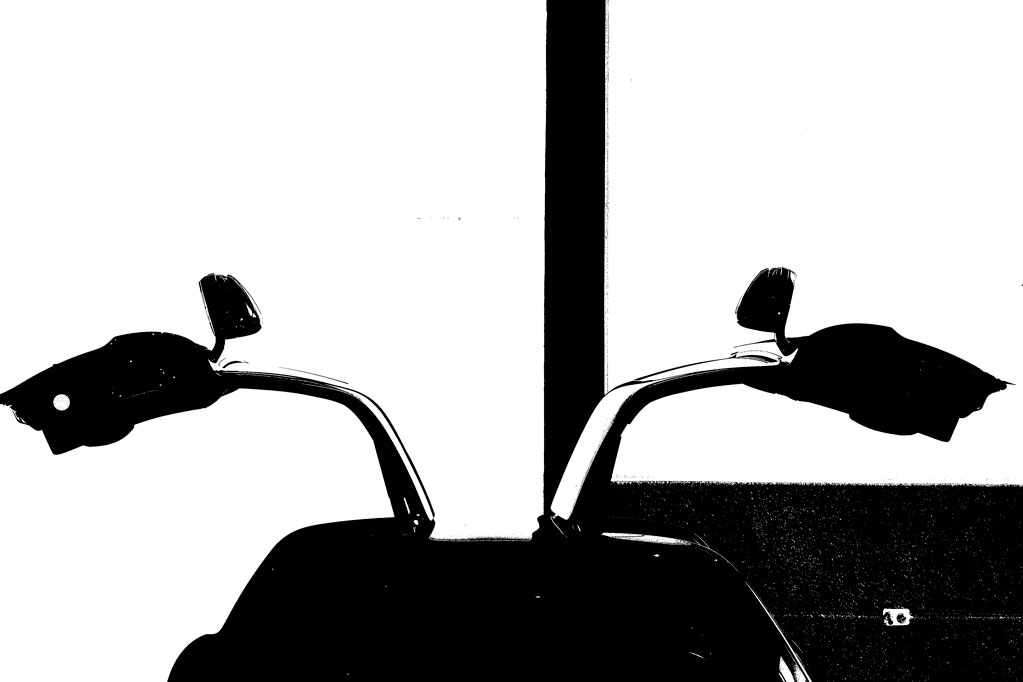
Tip: Photoshop’s Stamp or Torn Edges filters are other ways that you can use to create high contract images but Thresholds also does the same thing, so it’s your call. If there’s interest, let me know and I’ll post something on these techniques in a later post.

My book Creative Digital Monochrome Effects is still available from Amazon and (I think, anyway) is a fun read. There’s even a chapter on infrared photography. It’s available from them for $33.02 but bargain shoppers can pick up used copies starting around eight bucks as I write this. No Kindle version is available at this time, sorry to say.