
It’s #monochromemonday and today’s subject is an answer to a question that people often ask me about me about infrared photography. I’ve written about this subject before, but my mind has changed somewhat and today I want to share my current thoughts on focusing for infrared capture.
Today’s Post by Joe Farace
“I feel I change my mind all the time. And I sort of feel that’s your responsibility as a person, as a human being – to constantly be updating your positions on as many things as possible. And if you don’t contradict yourself on a regular basis, then you’re not thinking.” ―
I originally wrote a version of this post and, at the time, I thought I had the subject of focusing IR images all figured out. It turned out that I didn’t. For more on what I discovered about lens sharpness when making infrared photographs, please read my post, Not the Sharpest Knife in the Drawer when you have the time. And to tell the truth, I am still learning more…
Part of what this topic is all about: Chromatic aberration is an effect that’sproduced by the refraction of different wavelengths of electromagnetic radiation through slightly different angles, resulting in a failure to focus. It causes colored fringes in images produced by uncorrected lenses that’s sometimes knows as Longitudinal chromatic aberration (LOCA.)
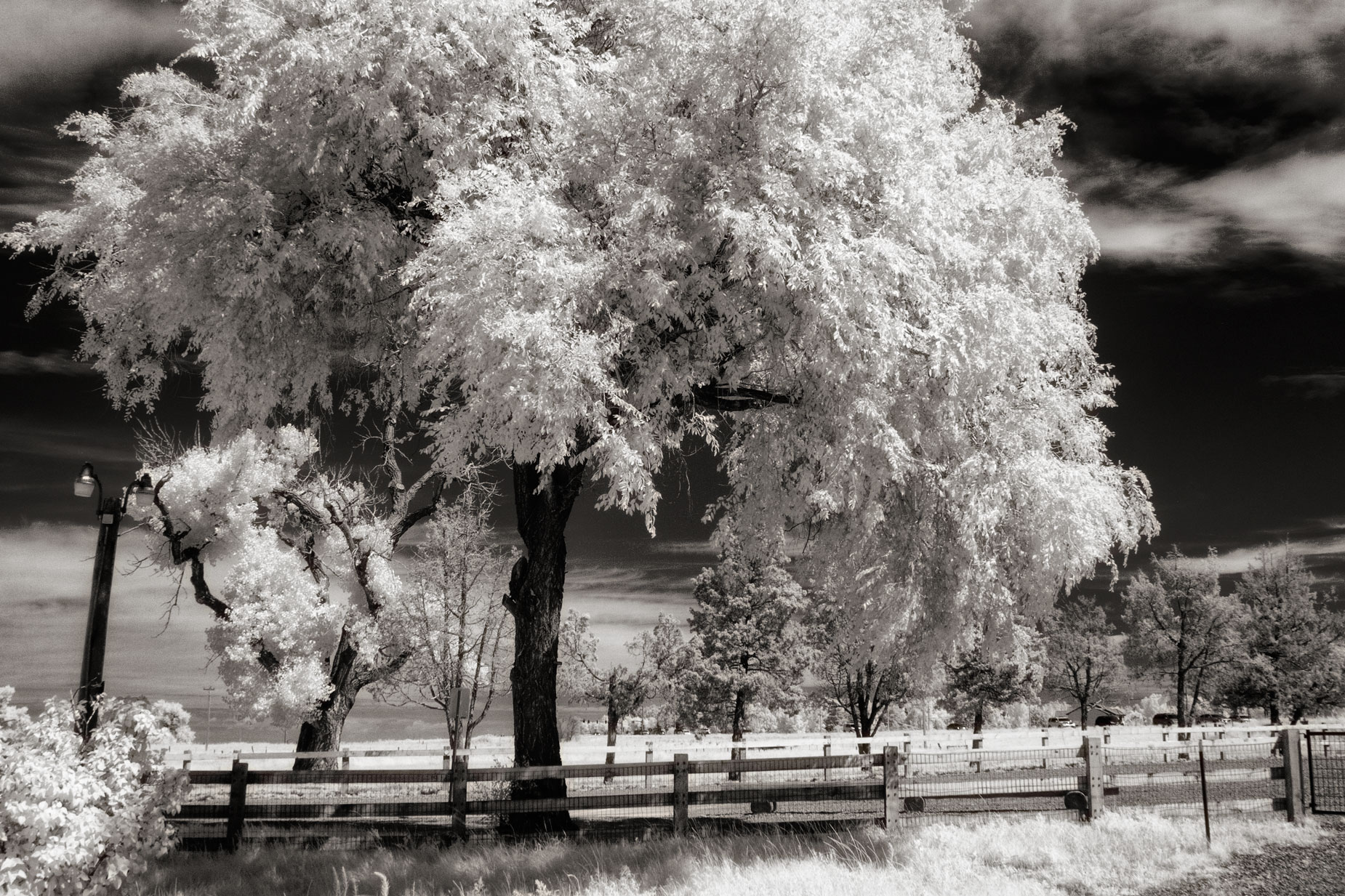
How I Made this Photograph: I made this image at 20-Mile Historic Park near Parker, Colorado using a Panasonic Lumix G5 that was converted by LifePixel using their Enhanced IR filter (665nm.) The lens used was the Lumix G Vario 12-32mm f/3.5-5.6; The same lens that the aforementioned linked post had so much to say vis-a-vis image sharpness.The RAW file was opened in Adobe Camera RAW and converted to monochrome using Silver Efex with Platinum toning added by PhotoKit.
The Infrared Difference.
The focusing-relaated problem for IR shooters is that most lenses can’t focus infrared wavelengths on the same plane as they can do with visible light. That’s why the classical advice when shooting infrared images is that it may be necessary to slightly shift the lens’s focus to maintain image sharpness. How much? Typically, the smaller the lens aperture and the longer its focal length the greater this shift will be. That’s why lens manufacturers used to place an infrared mark on their lenses (at right) to help you make this shift.
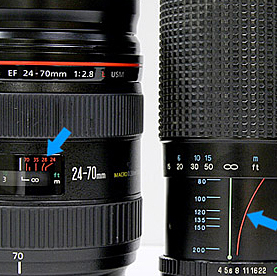 Unfortunately these marking do not appear on newer and autofocus lenses. So what do I do? When shooting infrared images with my Canon or Lumix gear, I put the camera into Aperture Preferred (Av) mode, set the lens aperture at smaller apertures and just shoot expecting —key word—the image to be in focus because of depth-of-field. This technique can work for landscape images and if you’re worried about the effects of diffraction, some experience will with your cameras and choice of lenses show you what works best for the lenses you’re using. More about diffraction next.
Hyperfocal Focusing & Diffraction
Here is another way of focusing I often use when shooting infrared. It’s called Hyperfocal Focusing. It’s all based on using the hyperfocal distance, which is the point of focus where any object located between half that distance and infinity is in focus. Here’s how it works: You pick an aperture, such as f/8 then rotate the focusing ring setting so that aperture is opposite the infinity mark. On a lens like the 15mm f/4.5 Voigtlander that technique produces depth-of-field from about five inches to infinity, which is more than enough to take care of any focus shift caused by invisible infrared light waves. With other lenses, it will be different. If you haven;t been happy with the sharpness of your infrared images wit certain lenses, a little research and testing on your part should help you figure the depth-of-field for your specific lens.
Diffraction is an optical effect that limits the resolution of your photographs no matter how many megapixels your DSLR or mirrorless camera’s sensor may have. Diffraction occurs when light passes through an aperture that has a small size and the wavelength of the light and the opening itself are roughly the same size. Sadly the only way to avoid the negative effects of diffraction is to use a larger (wider) aperture. Finding a lens’s “sweet spot” is the only way to avoid any effects of diffraction. For my take on how to handle diffraction, I again refer you to my post Not the Sharpest Knife in the Drawer.
 I’ve found that Life Pixel does a great job with IR conversions and they’ve done some of the conversions for my Canon DSLRs and all of my Panasonic Lumix G-series cameras. This is not a paid or sponsored endorsement, just my experience.
New copies of my book, The Complete Guide to Digital Infrared Photography are available from Amazon for $43 with used copies starting around thirty bucks as I write this. My book Creative Digital Monochrome Effects has a chapter on IR photography and is available new from Amazon for $11.46 with used copies starting around nine bucks as I write