
Today’s Post by Joe Farace
“There is nothing so American as our national parks…. The fundamental idea behind the parks…is that the country belongs to the people, that it is in process of making for the enrichment of the lives of all of us.”—Franklin D. Roosevelt
When someone is learning how to previsualize infrared imaging possibilities, I suggest the first thing you do is forget everything they think they know about photography with visible light. That’s because when shooting infrared images everything you know about visible light is wrong.
In fact, one reader once told me the main reason he enjoyed shooting IR was because he could only shoot during his lunch hour, which is the worst time for color photography but is the absolutely best time to shoot infrared.
Exposing for Infrared
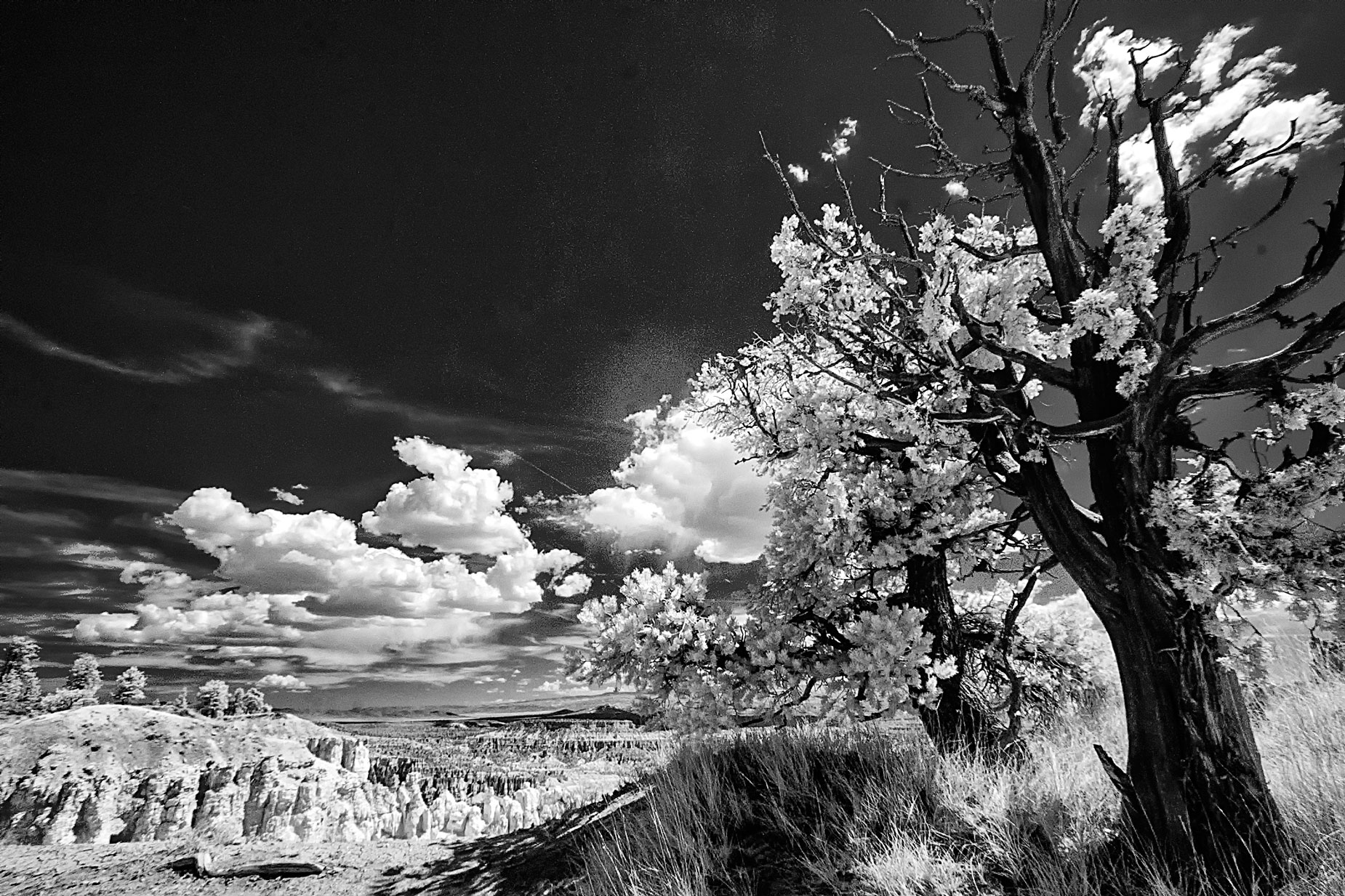
How I Made this Photograph: Mary and I went on an extended PhotoWalk with a bunch of other photographers in Zion National Park. It was the first time I was there and I brought two cameras: One was a Pentax K100D and the other was a Canon EOS D50 that was converted for infrared capture by Life Pixel using their Standard IR (720nm) conversion. The lens used for this images was a Tamron 11-18mm f/4.5-5.6 XR DI-II LD Aspherical (IF) at 11mm (17.6mm equivalent.) The exposure was 1/100 sec at f/14 and ISO 400 with a plus two stop exposure compensation. The RAW file was converted to monochrome with Silver Efex.
Exposure meters aren’t typically sensitive to infrared light, so theoretically it’s difficult to determine exact exposures when making infrared images but that doesn’t mean you shouldn’t try. Your camera’s LCD screen will provide a reasonable amount of feedback but resulting histograms may be misleading. That’s because subjects that seem equally bright when viewed under visible light may reflect infrared radiation at different rates and exhibit different IR brightness levels. So here’s a few tips for your first infrared shoot:
- The simplest approach is to shoot a bracket of three to five different exposures until you discover where the best exposure for your converted camera or filter lies. Because some camera’s LCD screens can be unreliable, you may not be able to fully evaluate your infrared images until after you look at your files on a computer. When you do, make a few notes about the results so you’re ready the next time you shoot IR.
 If your camera doesn’t have an auto bracketing function it should have an Exposure Compensation feature that lets you adjust exposures in one-half or one-third stops. If all else fails, your DSLR or mirrorless camera will have a Manual mode. I will often look through the viewfinder in Program mode to see the suggested exposure, then transfer that shutter speed and aperture to the camera in manual mode and then manually bracket on the overexposure side because most times your infrared image files may be slightly underexposed when using any kind of automatic exposure mode.
- Just because you don’t have a converted IR camera doesn’t mean you can’t use all these same tips when shooting with IR filters. When using these dark (you can’t really see though them) filters you’ll need a tripod because of the long exposure times they will produce. And don’t forget to use a cab;e release/
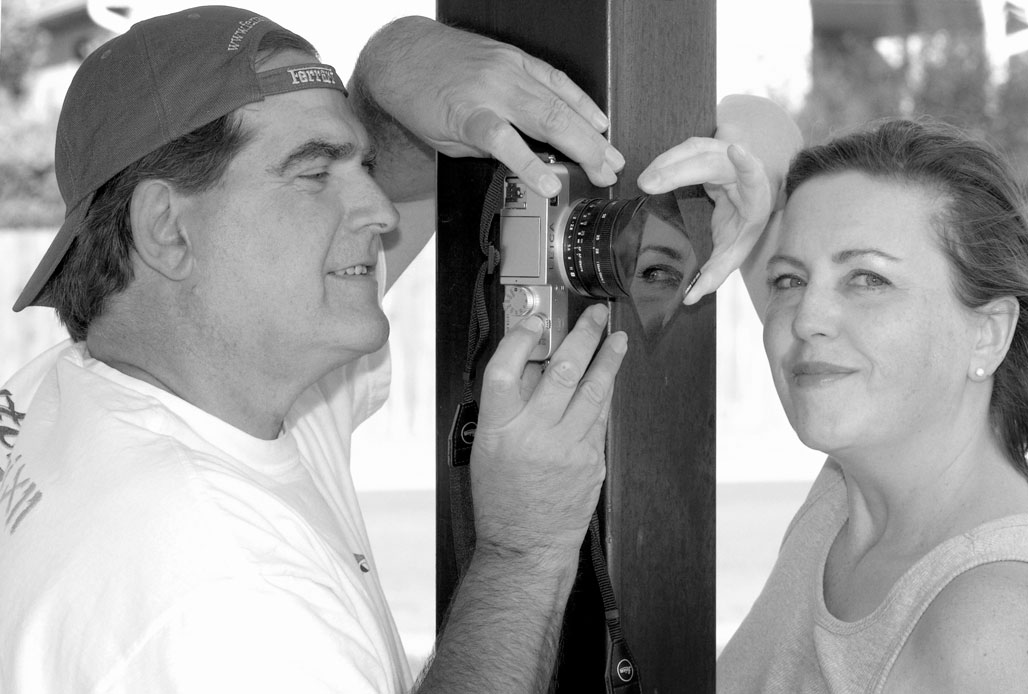
- When using IR filters, I suggest you focus on your subject first, then put the filter in front of the lens. With some filters I just hold them with my fingers during the exposure or have somebody else, as Mary is doing above right, hold it, which is just another reason why a tripod will come in handy when your shooting by yourself.
 I’ve found that Life Pixel does a great job with IR conversions and they’ve done some of the conversions for my Canon DSLRs and all of my Panasonic Lumix G-series cameras. This is not a paid or sponsored endorsement, just my experience.
New copies of my book, The Complete Guide to Digital Infrared Photography are available from Amazon for $44.34, with used copies selling for around nine bucks, as I write this. Used copes of my book Creative Digital Monochrome Effects that has a chapter on IR photography are available from Amazon for around eight bucks, as I write this.