
Today’s Post by Joe Farace
“A portrait is not made in the camera but on either side of it.” — Edward Weston
All modern cameras have some kind of built-in light meter and many have spot metering capabilities. When you have time, you might want to read my post Understanding Camera Metering Patterns. When photographing people outdoors, I still occasionally find myself using a hand-held light meter, .
 My current hand-held meter is a Gossen Luna Star F2. I’ve been using it for many years, and yes, it’s old but it’s also small, lightweight and takes reflected as well as the incident readings I prefer use when making outdoor portraits. Rather than measuring the light what’s reflected by the subject, using an incident meter reads the intensity of light that falling on the subject. The Gossen meter also measures electronic flash, making corded or non-corded flash readings that I use in my home studio.
Making Portraits Outdoors
How I made this portrait: The portrait of Shea at right was made with a Canon EOS D60 and one of my favorite lenses, the EF 28-105mm f/3.5-4.5 II USM at 105mm. The exposure was 1/200 sec at f/46.3 and ISO 200 with a minus one-thirds stop exposure compensation. Some fill was provided by a Canon 420EX speedlight with a Sto-Fen Omni-Bounce diffuser attached.
When using flash outdoors there are all kinds of rules telling you what the ratio of flash to ambient light is supposed to be but the “right” lighting ratio for you will vary depending on the location, the shape of the subject’s face and the overall look you want to accomplish.
Shooting portraits outdoors not only present a few technical considerations but you will also face some inevitable environmental challenges. That’s why when working outdoors I always have a LensPen handy to keep my lenses clean and my images sharp.
Using a LensPen
To clean my lenses when shooting outdoor portraits, I like to use a LensPen Black Series. The LensPen’s understated design makes it inconspicuous so when traveling light I can stick one in a shirt pocket.
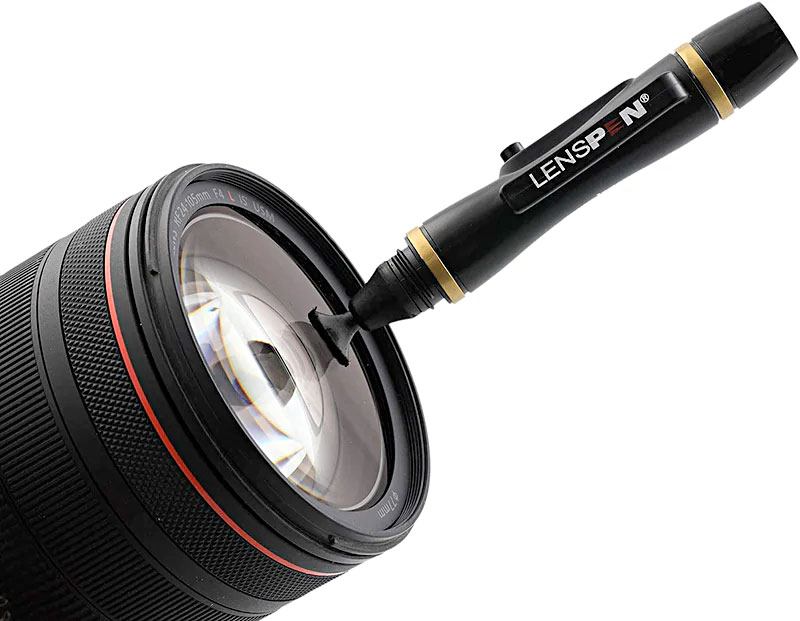 A LensPen Black Series has a retractable natural hair brush that you can use to knock off any chunks of dust that land on your lens along with a soft chamois-like tip on the other end that can be used to remove smudges. The carbon based cleaning compound found on its tip reduces electrostatic charges that attract dust to a lens and it replenishes itself by putting its cap back on after use. A LensPen can be used for cleaning camera lenses, binocular lenses and telescope eyepieces.
A LensPen Black Series measures 4.33-inches (11cm) long and has a round cleaning tip that measures slightly less than one-half-inch (12mm) in diameter and has a non-liquid cleaning element that’s designed never to dry out. Since a LensPen doesn’t require cleaning fluid or lens tissue, it creates no trash, so its ecologically friendly. A LensPen is also easy to use. Here’s how:
- Start by using the retractable brush to lightly remove any dust on the lens.
- Twist off the cap and move the cleaning tip in circular motions on the lens to clean it. If any smudges remain, gently breath on the lens and repeat.
Best of all a LensPen Black Series only costs $12.95, so you can afford to put one in all your camera bags or photo vests. Be wary of imitations and fake products can have nothing on the cleaning tip because they can actually damage the lens surface they’re meant to clean. A brand-new LensPen makes a perfect companion for yourself or your favorite photographer!
LensPen is a long-time sponsor of my sites and blogs but I was using their products long before I even had a blog. My wife bought my first LensPen for me in 1994 just after I acquired a Nikon N90s film-based SLR! I would like to thank LensPen for their continued support.