
It’s Anything Can Happen Day, which may have just been what Thursdays were called on the Mickey Mouse Club where I stole the idea! It’s also National Buttermilk Biscuit Day!
Today’s Post by Joe Farace
The second day of a diet is always easier than the first. By the second day you’re off it. —Jackie GleasonHow Sweet it Is —Jackie Gleason
I was always a fan of Jackie Gleason and even now, I enjoy listening to some of his albums late at night. You may not know that Gleason had a prominent secondary music career during the 1950s and 1960s, producing a series of bestselling albums. Known as “The Great One,” he was an comedian, actor, writer, and composer and developed a style and characters from growing up in Brooklyn, New York,and was known for his brash verbal comedy, exemplified by his city bus driver character Ralph Kramden in The Honeymooners.
Working in the Studio
 Over the years, I’ve met many photographers at social activities and workshops and, to tell the truth, I love talking with them. If you happen to bump into me whether I’m out shooting or maybe just shopping at Home Depot, don’t be bashful, come right on up and say “Hello!” I’m always glad to meet and talk with other photographers. That’s one of the reasons I started my Cameras and Coffee meet ups and while they aren’t as popular as they once were, I’ve noticed that some people have been inspired to hold similar kinds of gatherings, including Beer and Cameras.
One of the things that I’ve learned from all these conversations, including those from on-line, is that some photographers don’t like to clean their lenses, believing that “a little dust won’t hurt anything.” Their concern seems to be is that the more you clean a lens, the more likely you are to scratch it. Not true. According to several optical experts I’ve spoken with, the biggest mistake photographers make when trying to clean their lenses is they don’t first blow them off. Sometimes a lens can be covered with is a microscopic layer of dust that can quickly turn into fine grade sandpaper when trying to clean it. To remove this layer of grit, you can blow off the glass or give it a light dusting with a soft brush, which is why…
How I made this portrait: The vivacious Pam Simpson looks great wearing red. She really pops out of the background when I photographed her in my home studio against a Savage Translum backdrop hung on JTL background stands. Lighting for this shot could not be simpler: The set-up uses a Paul C Buff DigiBee 800 monolight inside a 28 x 28-inch Westcott Medium Apollo soft box that was placed at camera right with an AlienBees 800 with the reflector removed–in bare tube mode– located behind the Translum background. The camera used was a Panasonic Lumix G4 with Lumix G Vario 14-45/mm f/3.5-5.6 lens at 45mm with an exposure of 1/.125 sec at f/8 and ISO 200.
Why Not Use a LensPen!
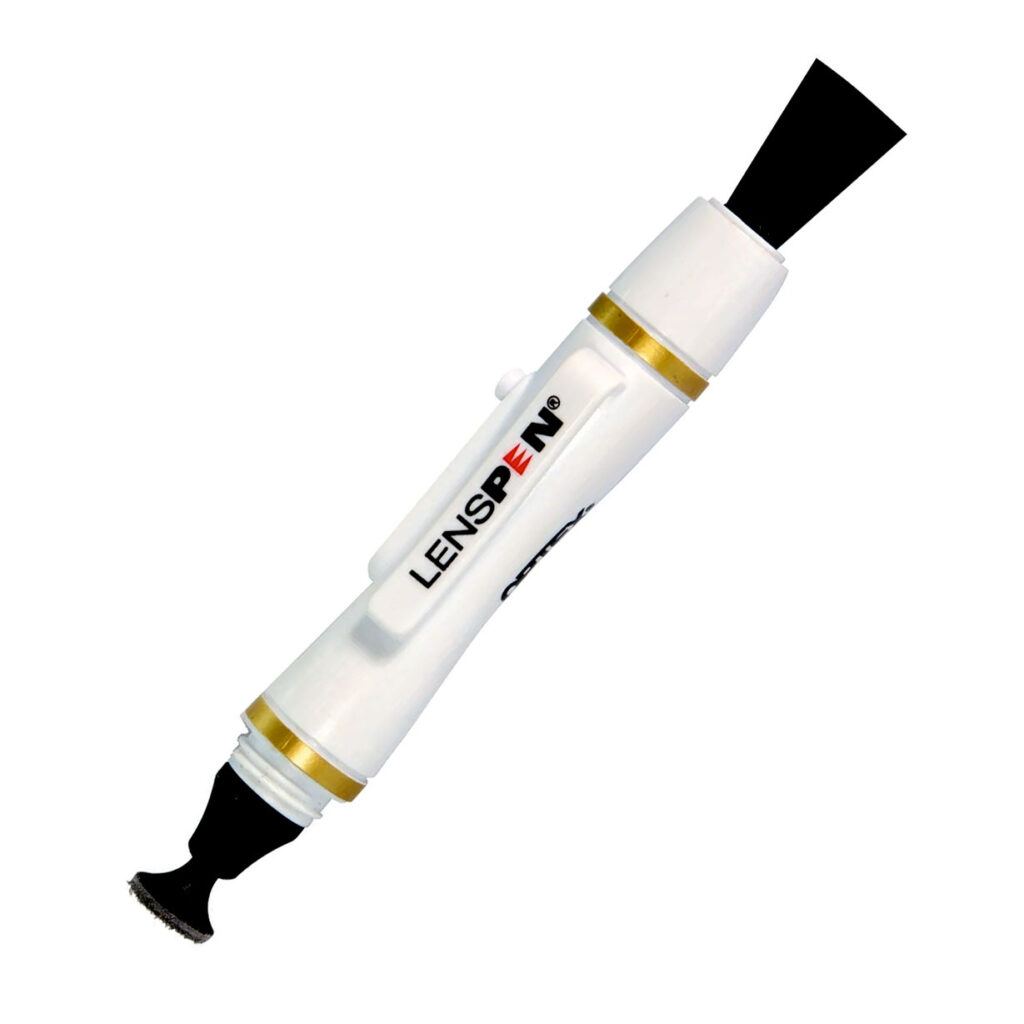 To keep my lenses clean, I like to use a LensPen like the ones from the LCF Collection that use a patented cleaning compound tha’s been redeveloped into an invisible white carbon. I use a LensPen for cleaning smudges on all of my lenses or filters and keep one in each of my camera bags.
A LensPen has a retractable natural hair brush that’s useful for knocking off that dust on your lenses and has a soft chamois-like tip on the other end to remove smudges. The carbon based cleaning compound it uses reduces electrostatic charges that can attract more dust to a lens surface and replenishes itself after each use. Since a LensPen doesn’t require cleaning fluid or lens tissue, it creates no trash, so it’s ecologically friendly.
A LensPen measures 4.33-inches (11cm) long and has a round cleaning tip measuring slightly less than on-half-inch (12mm) in diameter that has a non-liquid cleaning element designed never to dry out. It’s also easy to use. Here’s how:
- Start by using the retractable brush to lightly remove any dust from your lens
- Next, twist off the cap and move the cleaning tip in circular motions on the lens to clean it. If any smudges remain, gently breath on the lens and repeat.
- You can use the LensPen on all optical lenses, LCD, plasma and glass surfaces. It’s perfect for cleaning camera lenses, binocular lenses, small aperture spotting scopes and telescope eyepieces.
Beware of imitations and fake copies of LensPen products that sometimes have nothing on the cleaning tip so they can damage the lens and surfaces they are meant to clean. Best of all an original LensPen only costs $12.95, so you too can afford to put one in each of your camera bags.
LensPen is a long-time sponsor of my sites and blogs but I was using their products long before I even had a blog. My wife bought me my first LensPen in 1994 just after I acquired a Nikon N90s film-based SLR! I would like to thank LensPen for their continued support.