
Today’s Post by Joe Farace
Bear in mind that you are not making music for your own pleasure, but for the pleasure of your audience. –Richard Strauss
 Late in his life Richard Strauss was constantly being approached by adoring fans asking, “what is the story behind this music?” His reply was, “It’s just a piece of music.” Or, as Freud once noted, “Sometimes a cigar is just a cigar.”
I’ve always believed that photography was the universal language but that doesn’t mean that during all these 150 years or so we didn’t evolve a jargon all our own and every now and then it changes. One of the more interesting examples is that sometime during the 1930’s the meaning of ‘burn’ and ‘dodge’ in the darkroom swapped meanings. Don’t know how or why that happened but it did.
Let’s Make a Photo
For reasons known only to Theia, Greek goddess of sight and the shining light of the clear blue sky, some people have re-imagined the terms ‘take a picture’ or ‘make a photograph’ to tossing around the epithet ‘nice capture’ as a way of complimenting a photographer’s images as if they were chasing butterflies instead of the light.
All of this popped into my head as I was pondering a response to a reader’s comment about one of the automotive images that I posted on social media. The commenter asked if he could see the photograph straight out of the camera and not the processed image I posted.
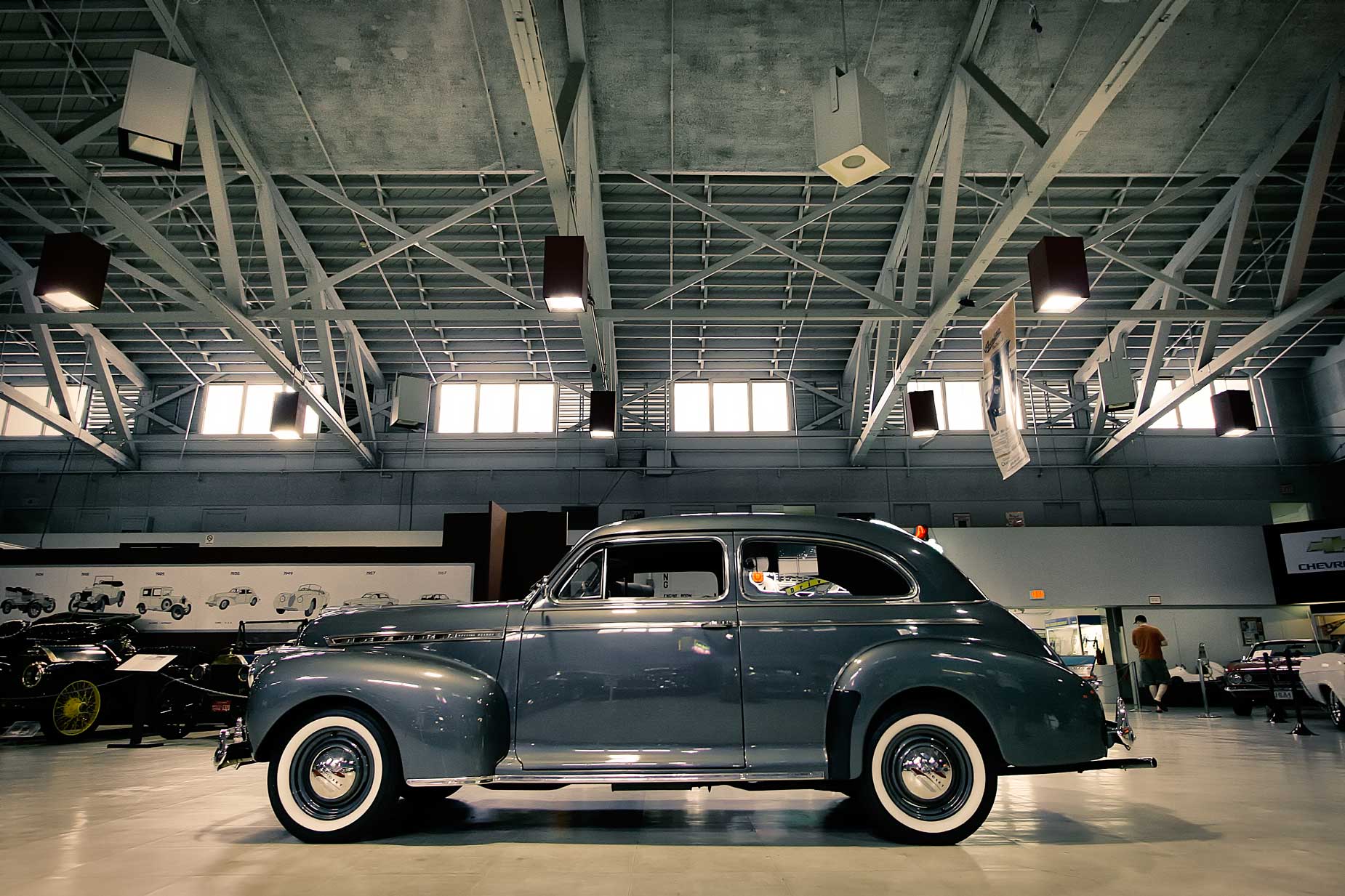
How I made this photograph: The above photograph was made at the San Diego Automotive Museum and reminds me of an photograph I made of a classic Buick that I made previously in a private Denver collection. This image was somewhat underexposed with an exposure of 1/40 sec at f/4 and ISO 400 and a minus two-thirds stop exposure compensation. It was shot with a Canon EOS 30D and a EF-S10-22mm f/3.5-4.5 USM lens at 14mm, a setting that could not quite make the wheels perfectly round. I tried to compensate by using Photoshop’s Lens Correction and Transform commands but my efforts were “close but no cigar” so I decided to just live with it. Instead, the image was tweaked using one of Exposure Software’s Cinema presets and enhanced with Color Efex’s Tonal Contrast filter.
The truth is that the finished image is not radically different from the underexposed image I originally made (upper right) or what you may be have seen with your own eyes in the museum. Maybe that’s why I don’t understand the SOOC movement; it seems akin to asking Edward Weston if you could look at his negatives to compare them to the finished print of Pepper #30 asking why he couldn’t just make a straight print. My friend Mark Toal answered that question from a reader of our former mirrorless photography blog more eloquently that I could and this is what he said:
Question: Do you post process images on this blog and social media sites like Facebook and Instagram?
Mark: Yes, they have almost all had some post processing done to them. These day, I shoot almost all of my images in RAW format.
When you shoot RAW the camera does not apply sharpening, noise and other corrections that it does to a JPEG file. Just like when I shot film I want to be able to apply my own look to all the images that I shoot. Most of the images you see from me have been sharpened slightly, had contrast added and color corrected to add more warmth.
I worked in the photo processing industry for 30 years and almost every negative that we processed in the lab had some correction done to them. SOOC (Straight Out Of the Camera) makes no sense to me. The original image is a starting point for me to make it my original creation.
For another take on this subject, please read my book review of Gordon Laing’s In Camera: Perfect Pictures Straight out of the Camera. For some thoughts on the whole RAW vs. JPEG kerfuffle, you might want to watch Barry Staver and my most recent Pixels, Grain and Cookies podcast.
My own answer to the SOOC question is simpler: It’s just a photograph that I made because I’ve always believed that photography should be fun. And that’s all there is to it.
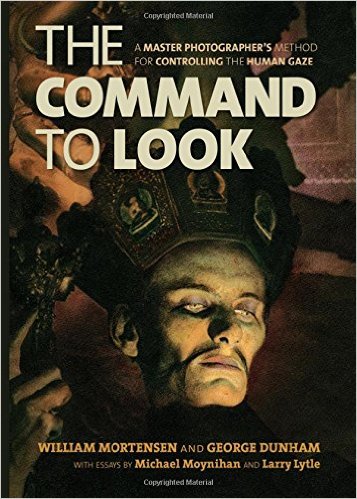
One of my earliest photographic influences is William Mortensen (1897-1965) even though my images could not be more different than his. His book The Command to Look details a completely unique approach to photographic composition and the 2014 reprint is now out-of-print, much like its original 1937 edition. It is, however, available as a digital copy from Amazon or as a “real” book from all the usual used book sources, including eBay. It’s not an easy read but Mortensen’s words and images are well worth the effort.