
Recently, my wife and I were having lunch and I mentioned I was having trouble coming up with a new theme for Tuesday’s posts and she suggested “Tricky Tuesday” to share some different tricks, tips and techniques I’ve used over the years when shooting portrait and glamour images. Today features the amazing Pam Simpson showing the true art of posing.
Today’s Post by Joe Farace
No matter how you feel, get up, dress up, show up, and never give up. – Regina Brett
I have always preferred using monolights in the studio because of their simplicity of setup and general usage. I know that not all photographers agree with this approach but that’s how I work in the studio, which is the focus of these Tricky Tuesday posts.
A monolight is a self-contained studio electronic flash that can be powered by AC or DC battery power and like any other studio light allows the fitting of light modification devices, such as reflectors, umbrellas or soft boxes. Within a single, compact housing, the light contains a power source, modeling light, flash tube and controls. It’s the simplicity that appeals to me.
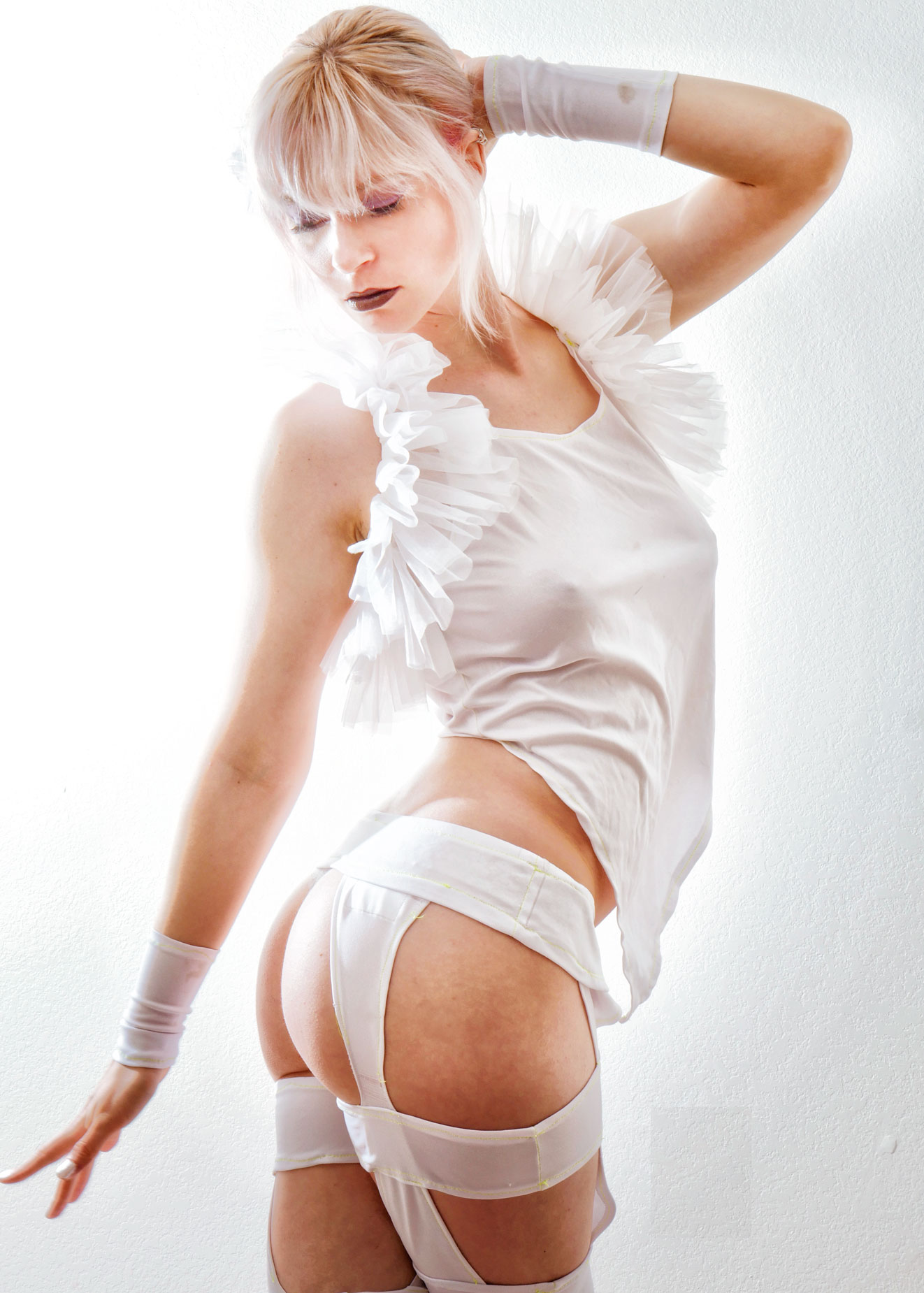
In High Key
 A monolight’s controls typically let you change output power from full, half, quarter and sometimes 1/32’nd power, either in stepped increments or as continuously variable output. One of any lighting system’s, including monolights, most valuable features is having a modeling light that allows you to preview what the flash will look like on your subject and whose output can be varied to match the output power setting, full power or even off.
How I made this portrait: I photographed Pam Simpson in my 11×15-foot home studio; Before I painted the walls grey; they were originally white. I used a single monolight—a Paul C Buff DigiBee with Plume Wafer softbox attached and placed high and at camera left, spilling light on both Pam and the back wall. The camera used was a Panasonic Lumix GH4 and Lumix G Vario 14-45mm f/3.5-5.6 lens (at 45mm) with an exposure of 1/125 sec at f/16 and ISO 200. The background was the while walls in my studio, before I painted them (more or less) 18% grey I’m still wondering whether the paint job was a good idea.
Like most electronic flash studio lights, monolights typically include a sync cord for attaching to your camera’s PC (Prontor-Compur) connection which triggers the light when you trip your camera’s shutter. These days, not every DSLR or mirrorless camera even have a PC connection and you might have to use a hot shoe to PC adapter to connect the sync cord from camera to the main light. Because of the high voltages across the tip of a sync cord, you should avoid using a cheapo adapter because it can fry the electronics inside your camera. If you want to eliminate the sync cord entirely, here’s another suggestion:
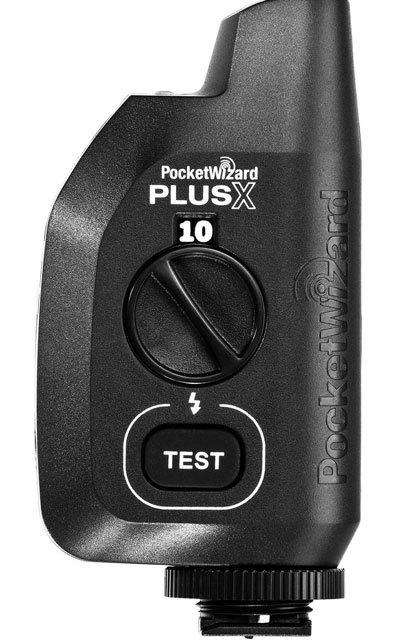
I’m a bit of a klutz when working in the studio and have, more than once, stumbled over a power cord and more times than I can count,got snagged with a sync cord. For me, and others like me, a wireless trigger, like the inexpensive ($105) Pocket Wizard PlusX is the best and safest solution for tripping the light fantastic. This unit has a range of (up to) 1600-feet and offers 10 channels that are backward-compatible with all other PocketWizards and PocketWizard-enabled devices. My pair of Pocket Wizard were a gift from my wife. Thanks, Mary!
 If you enjoyed today’s blog post and would like to treat me to a cup of Earl Grey tea ($2.50), please click here. And if you do, thanks so much.
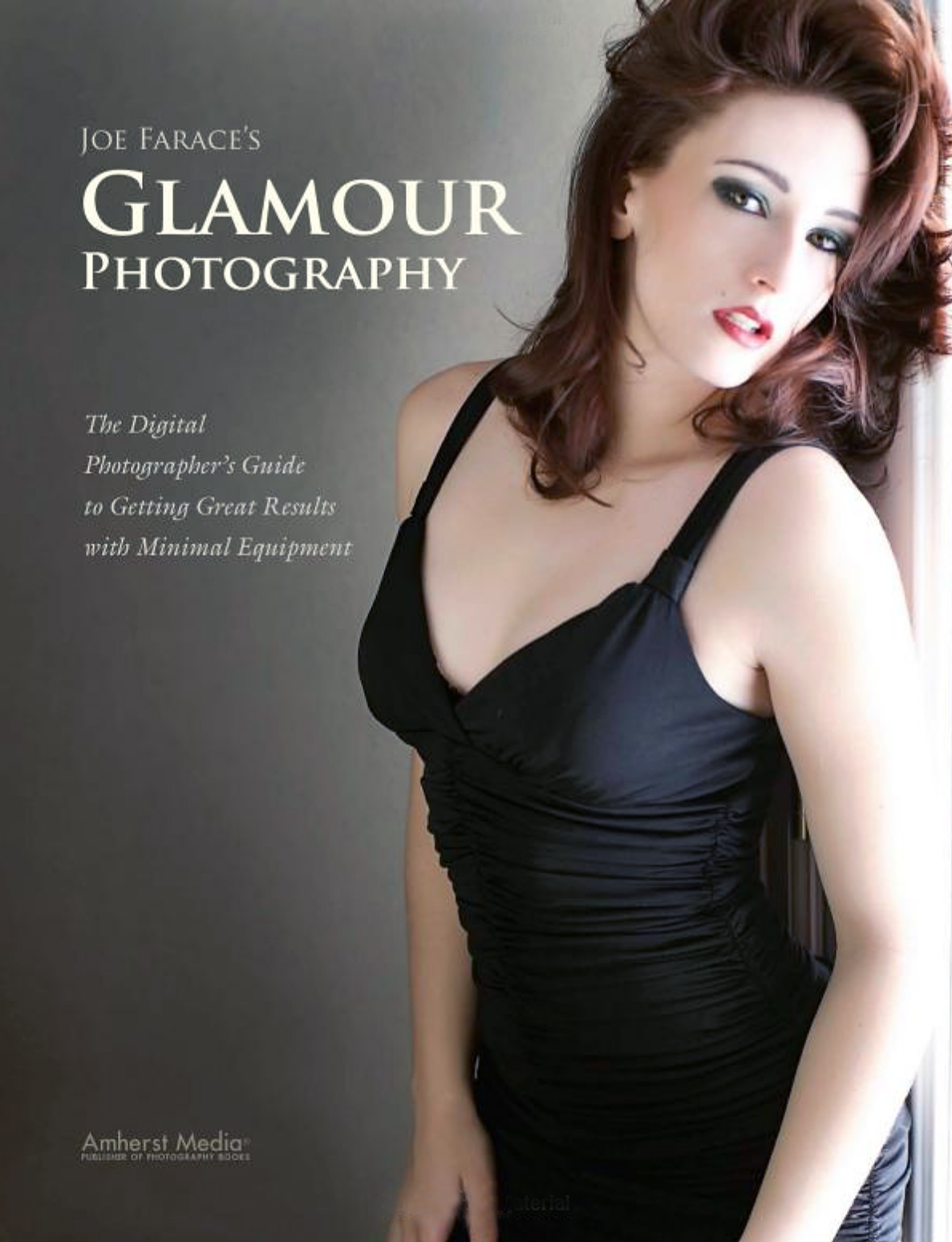
My book Joe Farace’s Glamour Photography is full of tips, tools and techniques for glamour and boudoir photography and includes information on all of the cameras used as well as the complete exposure data for each image. New books are available for $22.26 with used copies available from Amazon starting around ten bucks.as I write this. Kindle version is $19.99 for those preferring a digital format.