
Today’s Post by Joe Farace
“Bridges symbolize change and flexibility! They show us this simple philosophy: When you are on one side, you can easily move to the other side!” ―
In the past I’ve written posts about my favorite photograph and my favorite portrait but today’s post recalls a series I posted several years ago and was originally titled Wordless Wednesday and featured a single image. Over time = it slowly migrated into Wordy Wednesday in which that single image was front and center but I provided detailed information on how that particular image was made. That’s the format you’ll see today( and maybe in future) in a series I’m calling Friday Favorites.
People tend to choose a favorite because the brain uses favoritism as an emotional, cognitive, and social shortcut that can simplify choices, protect energy, and build self-identity. While a favorite is technically a superlative, the process of choosing one is deeply subjective and driven more by psychology rather than with technical merit.–excerpt from the Internet
Today’s featured image is taken from my book The Complete Guide to Digital Infrared Photography. By the way, this was not my title for this book. As is quite common in the photo book world, this title was shoved down my throat by the publisher. I preferred something much less pretentious and more accurate, such as Getting Started with Infrared Photography. This image can be found in Chapter Four on “Capturing Options.”
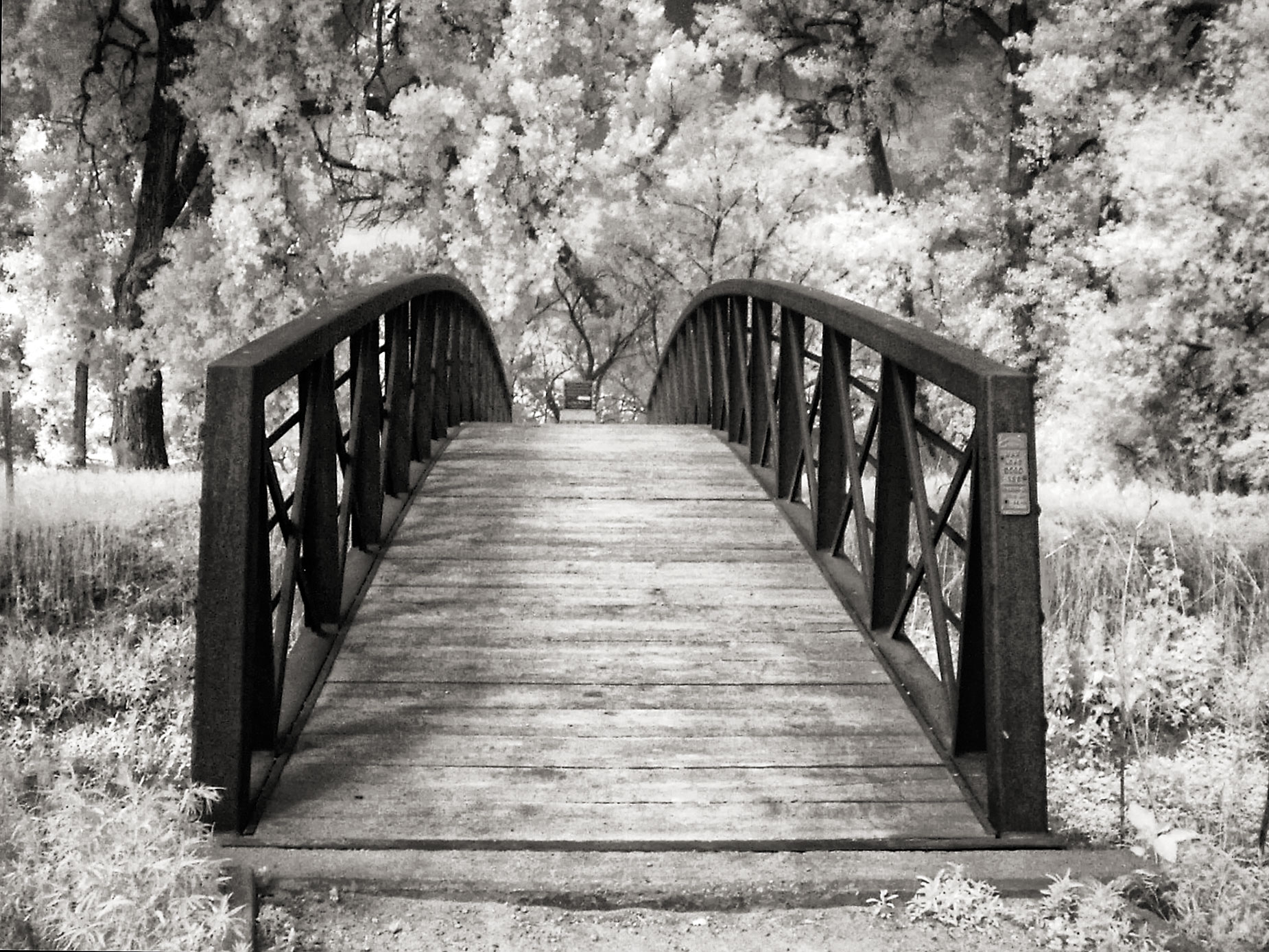
How I made this photograph
The above image was made at Barr Lake State Park that’s located in Adams County, not far from Brighton, Colorado and was one of my favorite places to shoot infrared as well as outdoor portraits when I lived nearby. The featured image was made using a Tiltall tripod-mounted 3.1-megapixel FujiFilm S20 Pro camera with a Super EBC Fujinon 6x zoom lens (equivalent to 35 – 210mm) with a 58mm Hoya R72 Infrared filter (720nm) that, at the time, was the least expensive way to create IR images with a on-camera filter.
At seventy bucks today, a 58mm Hoya R72 is no longer the bargain it once was but remains the least expensive way to get into infrared photography. It’s also one of the three basic filters found in my infrared filter kit. The exposure was 1/5 sec at f/2.8 and ISO 200. The original JPEG image was processed in Silver Efex using the default preset with some tweaking of the sliders before having Pixel Genius’ Platinum tone filter, that’s part of PhotoKit, applied.
While the above image was made using an infrared filter, this method does is not without some limitations, mainly the slow shutter speeds that can be produced by the dense IR filter. The Hoya R72 infrared filter, for example, has a filter factor of 16 that corresponds to an exposure compensation of approximately four stops or up to 4–6 stops depending on the ISO chosen,
The requirement for wide open apertures and slow shutter speeds, although they may be hand holdable with some DSLR or mirrorless camera, along with having to shoot while looking though a really dense filter (with DSLRs) are just a couple of the reasons why almost all my recent IR photography has been done using infrared-converted cameras. For a look at a comparison of the two methods, please read my post Infrared Capture Choices: On-Camera Filter or Conversion? when you have time.
 I’ve found that Life Pixel does a great job with IR conversions and they’ve done conversions for some of my Canon DSLRs and all of my Panasonic Lumix G-series mirrorless cameras. This is not a paid or sponsored endorsement, just my experience.
New copies of my book, The Complete Guide to Digital Infrared Photography are available from Amazon for $43.66, with used copies selling for around nine bucks, as I write this. Copes of my book Creative Digital Monochrome Effects that has a chapter on IR photography are $13.78 with used copies selling for around seven bucks, as I write this.