
Today’s Post by Joe Farace
Its all so simple, no one believes me … you strike a pose, then you light it. Then you clown around and get some action in the expressions. Then, you shoot.–George Hurrell
 What inspires your photography? For me, I often find inspiration in the kind of scenes I see in the movies! I recently re-watched Frank Capra’s 1937 classic film Lost Horizon for maybe the eighth time and was struck not just by Joseph Walker and Elmer Dyer’s cinematography but also by still images that were shot with 4×5 cameras and used to illustrate a “making-of” documentary. This was truly the golden age of Hollywood still photography as exemplified by the work of pioneers such as George Hurrell. All this was going through my head when I made this portrait of my former muse Tia Stoneman who has the classic look of a 1940’s film star, such as Patrica Neal.
Made Using Fluorescent Lighting
On the surface fluorescent lights seem to be the perfect light source for digital photography. By comparison, tungsten hot lights produce 93% heat and 7% red light. Daylight-balanced fluorescent light is cooler, brighter and the RGB output closely matches the receptive RGB spikes of a camera’s imaging chip. Tungsten light has the least output in the blue and when combined with its infrared (heat) output it can overcome a chip’s spectral response. For a long time fluorescent portrait lighting kits were all the rage but not anymore because of environmental concerns over the fact that FLD bulbs contain between 1.4mg and 5mg of mercury. If you use fluorescents. please dispose of the spent bulbs safely.
How I Made this portrait: For this nostalgic image of Tia, who gives off Old Hollywood vibes, I used a Westcott Spiderlite TD6 fluorescent light in a 24×32-inch soft box as the main light. Fill light was provided by a 30-inch reflector that was placed at camera left to kick back light into the shadow side of the model’s face. The exposure was 1/180 sec at f/ 5 and ISO 640 using a Canon EOS 20D’s exposure compensation and increasing exposure in one-third stop increments until I got the look I wanted. The lens used was Canon’s EF 75-300mm f/4-5.6 lens at 140mm. I converted the original color JPEG file into black and white with Exposure Software’s Exposure software using its Ilford XP2 film emulation, then the Sunlight filter from Color Efex was added to give the portrait a warm Old Hollywood look.
Here’s What You Need
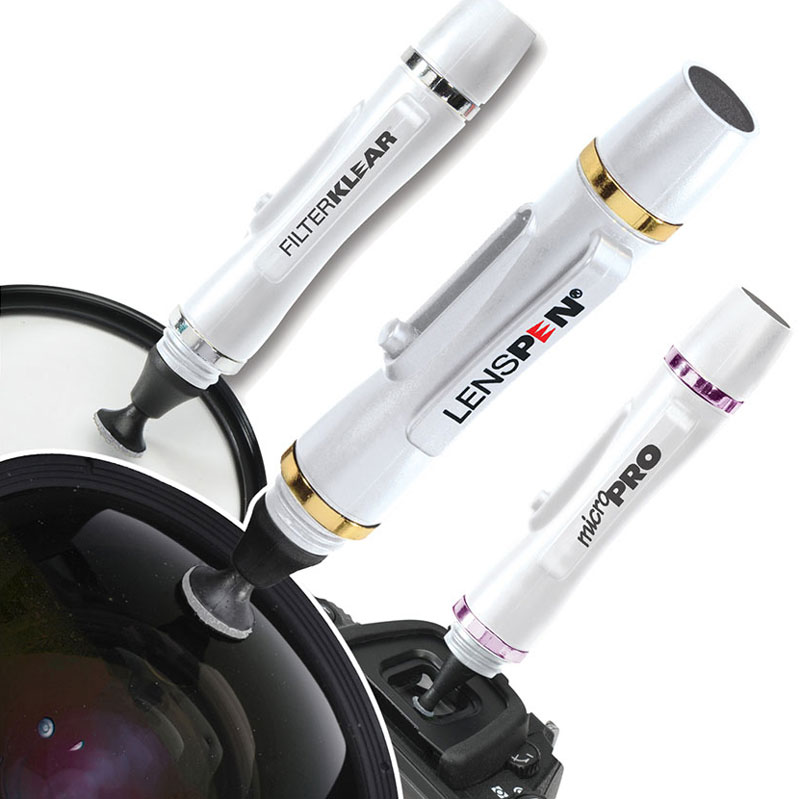 It’s a DSLR-Pro Kit ($28.95) that includes everything digital and film shooters need to keep their lenses, viewfinders and filters clean and dust free. Here’s what’s in the kit:
- An original LensPen. For more than twenty years, I’ve used these tools to remove smudges and fingerprints from lenses on my DSLRs, mirrorless and film cameras.
- The FilterKlear pen has a 12mm flat, round cleaning tip that’s designed to clean lens filters. This is a useful tool that’s especially important for film photographers, since they seem to use more on-lens filters than digital shooters, digital infrared shooters excepted, of course.
- The MicroPro has a smaller (4mm) cleaning tip that’s useful for cleaning eyepieces and the kind of small lenses found on smartphones.
- The kit also includes a handy microfiber carrying pouch that doubles as a cleaning cloth for wiping down a camera body.
Both the Original LensPen and its various cousins clean your optical surfaces in a few easy steps:
- Start by using the retractable natural hair brush to remove any loose dust that’s floating on the optical surface.
- Next, twist off the cap and move the cleaning tip in a circular motion on the lens to clean it. If any smudges remain, gently breath on the lens and repeat.
- You can use LensPen on all optical lenses, LCD, plasma and glass surfaces. It’s perfect for cleaning camera lenses, binocular lenses, small aperture spotting scopes and telescope eyepieces.
The LensPen’s twist cap is important because putting it on and off re-charges the carbon compound on the cleaning tip and ensures that the cap won’t pop off in your pocket or camera bag, like my film camera’s lens caps and eye cups tend to do. LensPen products are environmentally friendly and safe to use. There’s no expiration date and they perform well in arctic cold or desert heat.
LensPen is a long-time sponsor of my sites and blogs but I was using their products long before I even had a blog. My wife bought my first LensPen in 1994 right after I acquired a new Nikon N90s SLR! I would like to thank LensPen for their continued support.