
As the most amateur of amateur horologists, I am happy to report that June 19 is National Watch Day. It celebrates an invention that ensures every action is taken at the correct time. In Barry Staver and my most recent Pixels, Grain and Cookies podcast, we talk about a Kickstarter campaign for a combination watch and light meter! You might enjoy our comments about watches (not much) and light meters (more about them.)
Today’s Post by Joe Farace
Digital photography is a science, film is a chemical miracle—Steven Spielberg
 If you’re new to film photography you may have a question about a particular film emulsion’s latitude or more accurately what exposure latitude means to your own photography. Here goes…
Basically, latitude is the number of stops that a specific film stock can be overexposed or underexposed and still produce an acceptable result. Color negative film generally possesses a broader latitude compared to slide (transparency) film, which has a narrower latitude. For example, Kodak’s Ektacolor Pro has +3 or even +4 stops of overexposure latitude that compensates for minor exposure errors while retaining image quality. Latitude also depends on the film’s dynamic range and emulsions with greater dynamic range let you capture more detail in the darker and lighter areas of a photograph. Digital capture has it’s own version of latitude and, if you’re interested, I equate it with film’s latitude in my post, Comparing Exposure: Film or Digital Capture.
The Push and Pull of it All
What anyone writing about film photography sometimes forgets to say is that any measurement of exposure latitude is ultimately subjective and depends on your own aesthetics and artistic choices. When I was teaching Basic Photography at Howard Community College in Columbia, Maryland back in the film era, I told my students that the correct exposure was “the one they liked.” which brings me to…
 Push processing in a darkroom technique that increases a film’s effective sensitivity by processing it longer than the manufacturer’s standard recommendations and sometimes in combination with using higher temperatures. At its most basic level, this technique overdevelops the film, compensating for any underexposure that occurred when shooting it at a higher than its normally rated ISO setting. Pushed film typically looks grainier with more contrast and often has fewer details visible in the highlight and shadow areas of the image.
Why do it? One obvious possibility is there’s not enough light for you to use hand holdable shutter speeds. Currently, the highest ISO rated stocks are 3200 speed films such as Ilford Delta 3200 Professional and Kodak Ektapan P3200, while DSLR’s like the Pentax K-1 Mark II use a Ricoh-developed Accelerator Unit that boosts the camera’s sensitivity up to ISO 819,200. Look for a post tomorrow that has some examples from the camera that ere shot at that top ISO.
Pull processing film, on the other hand, typically produces cleaner-looking images with less grain making the negatives more flexible for printing and post-processing that may appeal to photographers using a hybrid film/digital workflow. Pulling film tends to mute an image’s colors and produces less contrast. Why do it? It’s a good technique to use under really sunny, bright and high-contrast light because the reduced contrast can bring out more detail in the shadows.
Push or pull film processing is not some exotic process and most photo labs offer the service and usually only charge a modest fee to do it. The Darkroom, for instance, charges three bucks per roll for push or pull processing.
Why I’m Shooting Expired Film…
and what it has to do with latitude and pushing and pulling your film. Here;s why…
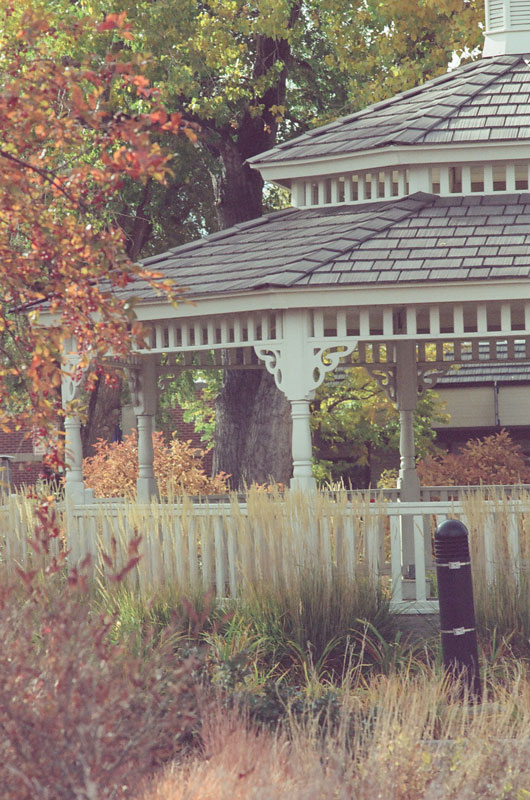
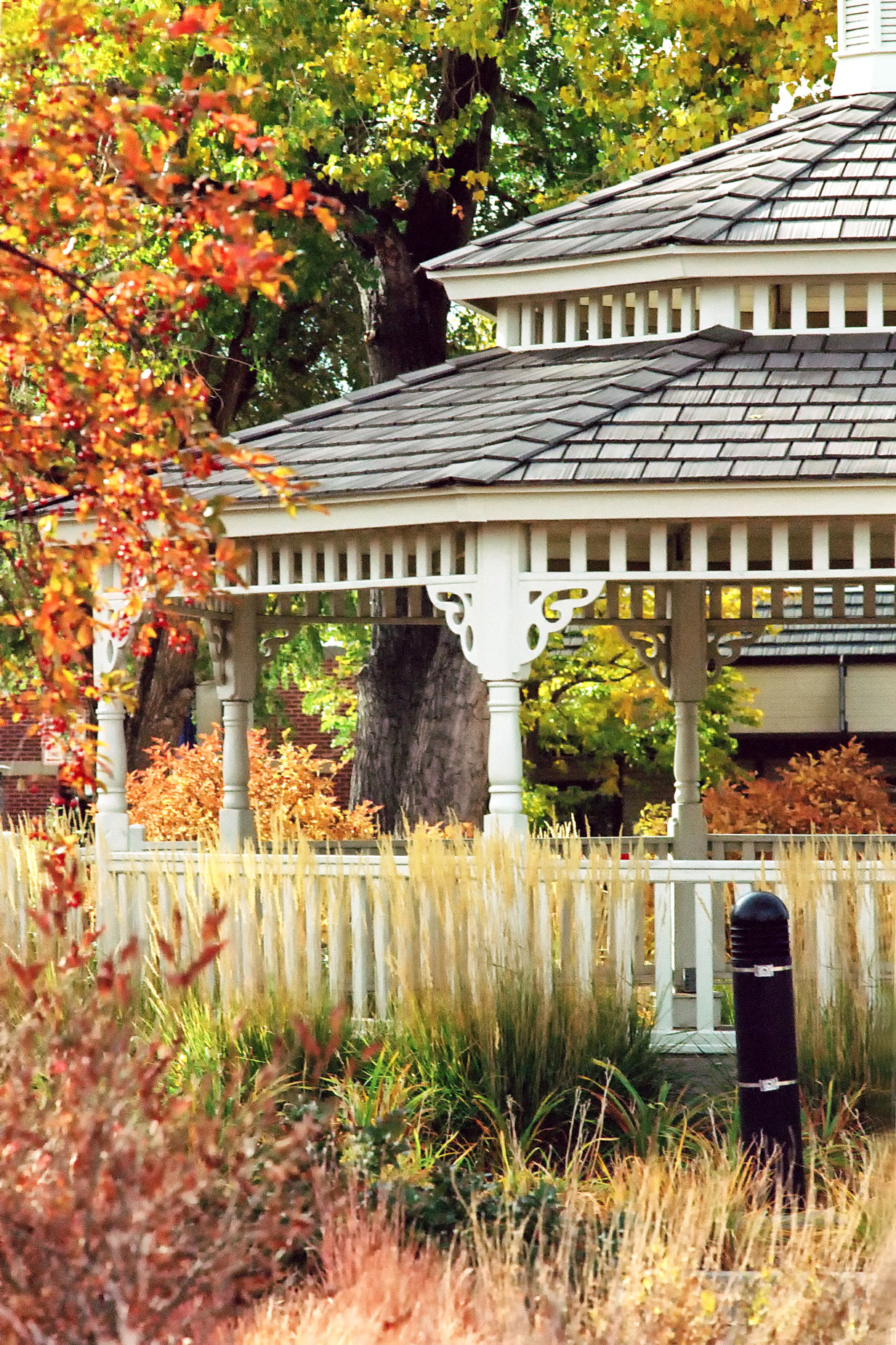
How I Made this Photograph: I made the photograph (at left) of one of my favorite subjects, the gazebo in O’Brien Park in Parker, Colorado. The camera used was my 37-year old Canon AE-1 Program with a FD 50mm f/1.8 lens (exposure unrecorded) with a roll of Kodak Portra 160 that had an expiration date of 09/2003. I shot the film at its “box speed” of ISO 160. The film was normally processed and scanned by The Darkroom and you can see the straight-out-of-the-scanner scan at top right. With a little adjustment in Photoshop and some additional tweaks in Vivenza, I produced the image at left. It’s better, but not perfect. I could never get the color balance right to show the gazebo’s true white painted finish.
The process I used was not pushing or pulling film but when shooting the image I should have adjusted the exposure. There is a so-called “rule” for shooting expired film that states that you should add one stop of exposure for each decade between when it expired and when it’s being exposed. My experience with expired black and white film shows that shooting it at ”box speed”–nobody ever called it that back in the film era–doesn’t seem to matter. On the other hand, I tried this overexposure technique later with another roll of color negative film by cutting the ISO in half and the results were impressive. So that’s my plan going forward with all the expired film that’s still in my refrigerator,
If you would like to send me a roll of fresh or even expired film to review or any other stuff that could be used for these posts and my YouTube videos please send me an e-mail and I will get back to you with shipping address.