
Today’s Post by Joe Farace
“The successful warrior is the average man, with laser-like focus.:– Bruce Lee
The AL-1 was Canon’s first attempt at integrating a form of autofocus into an SLR but it was far from true AF. Instead the camera featured a system Canon called QF (Quick Focus) aka focus confirmation. The system used phase detection linear CCD arrays and in the viewfinder, red LED arrows indicated the direction you were supposed to turn the lens to achieve sharp focus. Optimum focus was indicated when a green LED dot lit up between this two directional arrows.
Focus Confirmation, Not Auto Focus
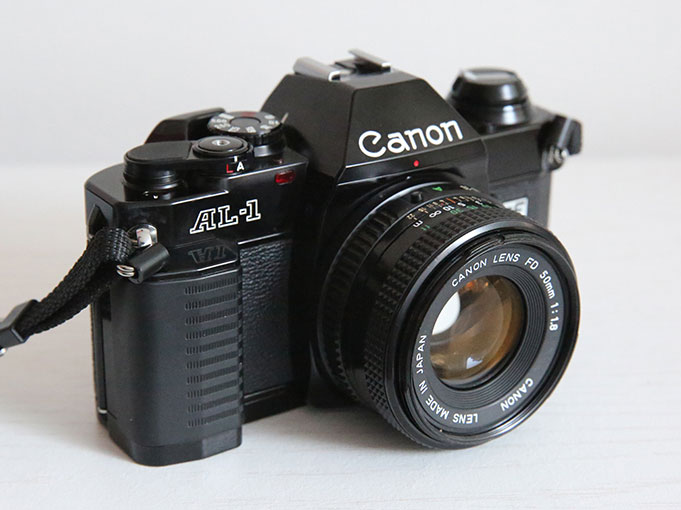 The camera features aperture-priority auto exposure and has a few shutter speeds for its Manual exposure mode. There’s a self-timer too. The AL-1 has a hot shoe, winder connections and was the last SLR to carry Canon’s 1960s-era logo on its pentaprism. The film reminder holder found on the back of most A-series cameras was left off both the AL-1 and AV-1. Canon may have saved a few pennies by eliminating it but I missed this feature. According to Canon’s numbering system, my camera was built in April 1982.
Like other A-series’ bodies, the AL-1 was made from polycarbonate and Canon tried to conceal its use of plastic by giving the top cover either a satin chrome or black metallic feel and finish. Mine is a black body. Yet like all the other A-series cameras, the AL-1 seems better made and finished than many new entry-level DSLR or mirrorless cameras. Back in the eighties the camera cost the equivalent of $1,689.80 in today’s money, so it was never cheap. In my video on The Pros & Cons of Film Photography at 5:56, I say “photography has never been cheap.” The A-series SLRs were not professional cameras but were aimed “at the newcomer market” and were the first SLR’s the public purchased in the millions.
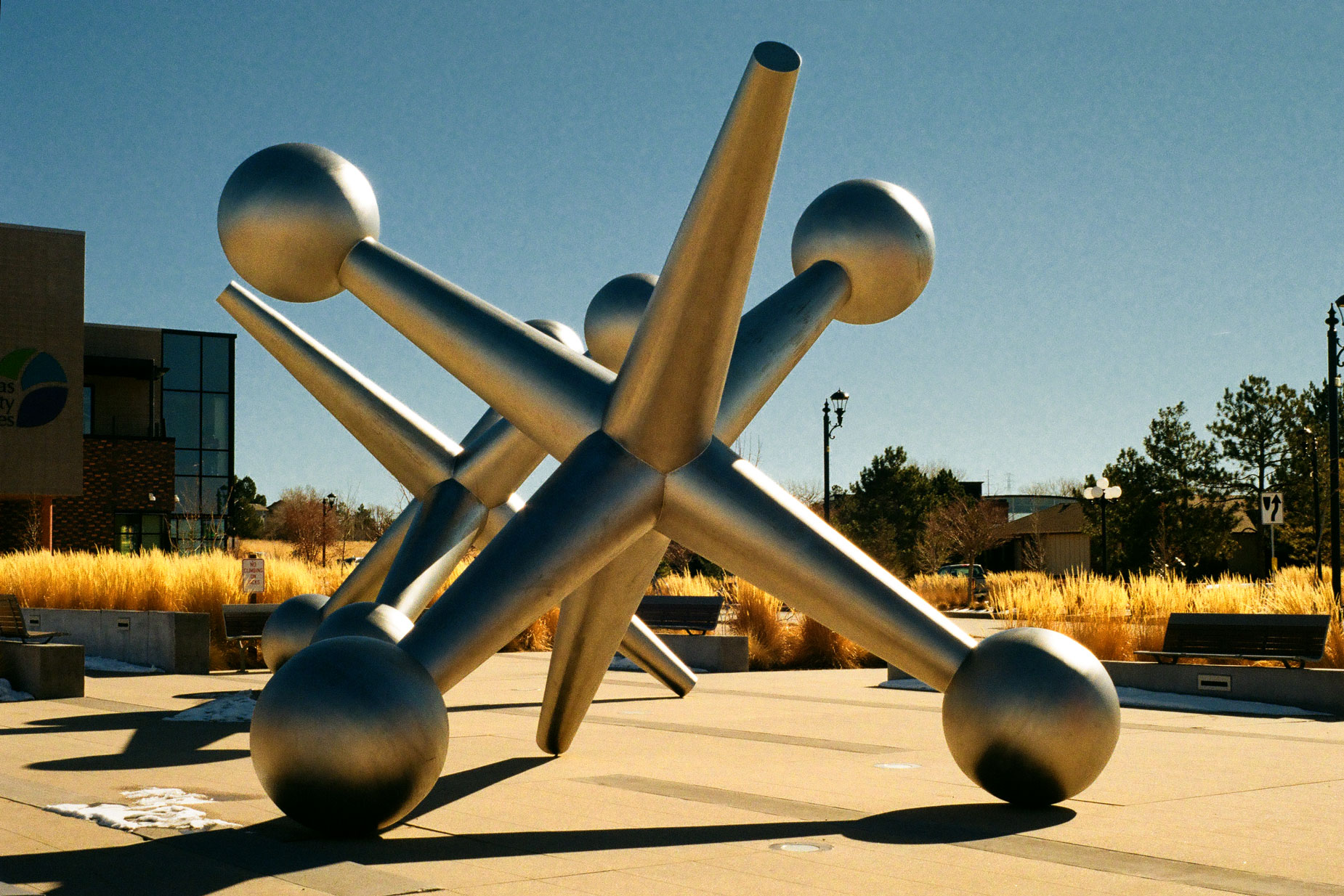
I loaded my AL-1 with a roll of Kodak Gold 200 and headed out to run some errands. Since I was going to the library I stopped by Discovery Park and photographed the Jacks and Ball sculptures. The AL-1’s handling is superb and it’s ergonomics, except for the placement of the on-off switch, are the best of the A-series camera, thanks in large part to a larger grip that holds two AAA batteries.
I mounted the FD 50mm f/3.5 macro lens on the AL-1 mainly because it was handy but that proved not to be the best choice because of it’s long focus throw and the smooth, highly reflective surfaces of the silver jacks and shiny red ball, challenged the camera’s focus confirmation. When I moved the focus area located at the center of the viewfinder to an object’s edge, it gave the QF something to focus on and the camera did its focus confirmation job pretty well. The results showed me that If you take the time to use it as designed, the system works great producing sharp images. If using focus confirmation gets annoying and I can see how that could happen under some conditions, you can just ignore the LEDs in the viewfinder and focus using the smooth and bright ground glass-style focusing screen. This doesn’t affect my feeling that this is my second favorite A-series camera after the semi-professional A-1.
Later in the day I met up with Mary at a local Starbucks and since she brought her Nikon Z fc along we decided to take an impromptu photo walk down a path next to the coffee shop. It turned out to be a long, meandering one going through tunnels and we ended up walking under a couple of roads that I filed for the future as a great place to shoot some black and white film.
If you would like to send me a roll of film to review or any other stuff that could be used for these Film Friday posts and my videos click the Contact tab and ask for my mailing address and I’ll get back to you right away,
If you enjoyed today’s blog post and would like to treat me to a cup of Earl Grey tea ($3.50), please click here. And if you do, thanks so much.