
Today’s Post by Joe Farace
In the Spring, I have counted 136 different kinds of weather inside of 24 hours.— Mark Twain
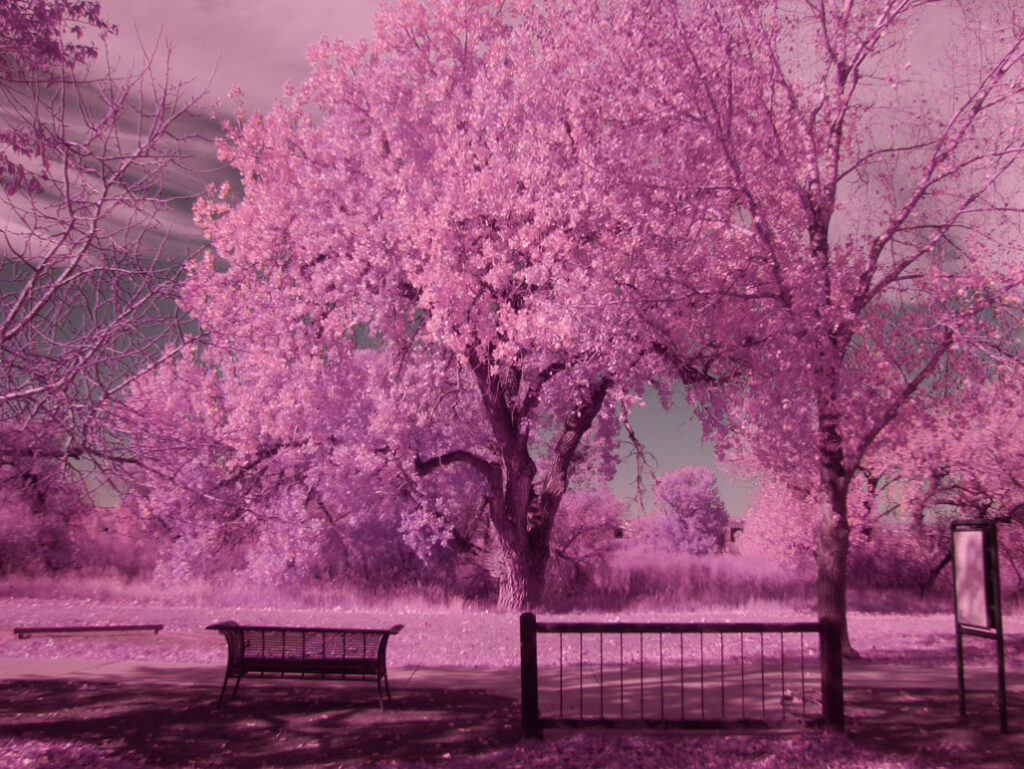 With the above quote, Mr. Clemens might have been talking about this Spring in Colorado. Spring came to Colorado like a freight train and the normal snowstorms of March and April have been, for the most part, non-existent. Right now, some of the deciduous trees here on Daisy Hill as well as many of the trees in McCabe Meadows, have started to blossom meaning that my annual foray into digital infrared photography will be sooner than later. I’m starting to get excited….
Capturing Infrared Photographs
Infrared images have a dreamlike look produced by a characteristic known as the Wood Effect that’s mainly caused by foliage, such as tree leaves and grass, strongly reflecting infrared light the same way visible light is reflected by snow. There is some minor contribution to the IR image from chlorophyll fluorescence but it’s not the real cause of the brightness seen in infrared photographs. This effect is named after infrared photography pioneer Robert W. Wood (1868-1955) and not after the material wood, which interestingly does not strongly reflect infrared.
Chlorophyll fluorescence is light that’s emitted by chlorophyll molecules during changes from excited to non-excited states. It is an indicator of photosynthetic energy conversion in plants. Excited chlorophyll dissipates the absorbed light energy by driving photosynthesis as heat in non-photochemical quenching or by emission as fluorescence radiation.–from Wikipedia
Any photograph you make is about light but infrared photography is different. It’s more about capturing images using invisible light, which is why the technical comparisons to traditional photography can be initially difficult to understand when getting started in the genre. If you want to create a dramatic landscape image, for example, few subjects beat a sunrise image captured in all its vibrant colors. That same scene photographed in infrared might be disappointing unless there’s some kind of IR reflective subject matter in the frame and even then, it’s a crap shoot of what the image will look like since there may be little infrared radiation to capture.
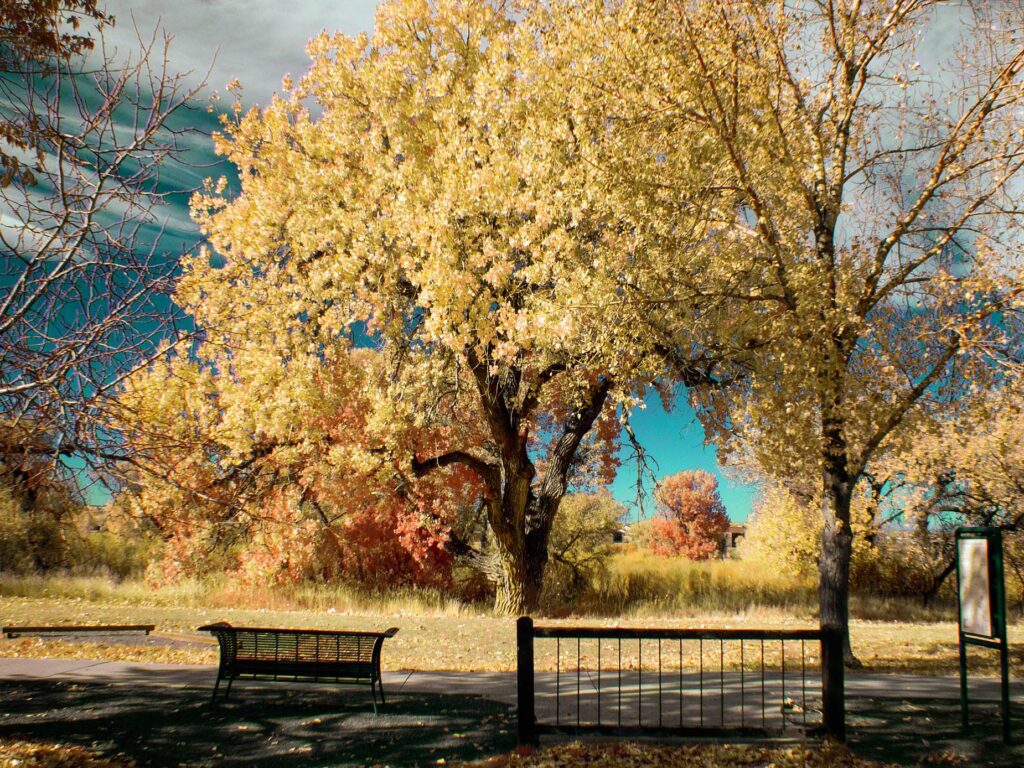
How I Made this Photograph: photographed my favorite tree with a Panasonic Lumix GX1 that was IR-converted by Life Pixel using their Hyper Color filter. The lens was the Olympus M. Zuiko 17mm f/2.8 lens that one of these days I’m going to do a deep dive into it’s sharpness. (It’s DxO score is just 19.) The Av exposure was 1/640 sec at f/16 and ISO 400. You can see the JPEG above right. The RAW file was processed using one of the Photoshop actions Life Pixel once provided with some of their conversions and was further tweaked in Vivenza.
I’m not Robert Wood but here’s one of Farace’s Laws that applies to infrared photography: If the lighting looks great for traditional subject matter it’s probably not going to work as well for infrared photography. Conversely, the worst possible light, such as High Noon, is perfect for infrared capture. Don’t just take my word for it; you should experiment because you never know for sure what the results will be when working in infrared.
There are no ‘official’ subjects for digital IR photography although I take a crack at the topic in my car photography Blog. Summer landscapes with leafy deciduous trees, lots of grass and puffy clouds often produce a great infrared image but evergreens, like the Ponderosa Pines here on Daisy Hill, don’t reflect as much infrared but may reflect some IR light.
 I’ve found that Life Pixel does a great job with IR conversions and they’ve done some of the conversions for my Canon DSLRs and all of my Panasonic Lumix G-series cameras. This is not a paid or sponsored endorsement, just my experience.
New copies of my book, The Complete Guide to Digital Infrared Photography are available from Amazon for $41.98, with used copies selling for around seventeen bucks, as I write this. New copes of my book Creative Digital Monochrome Effects that has a chapter on IR photography are available from Amazon for $16.15, with used copies selling for around eight buck, as I write this.