
#filmfriday is on hiatus today as I take a look at Tripods. I think tripods are a simple tool that can really improve the sharpness and even the composition of your images. That’s because using a tripod forces you to take the time to look at the four corners of your frame before making an exposure so there are no surprises.
Today’s Post by Joe Farace
Some cameras are heavier and need to be on tripods. Others are small enough to hide in your pocket. There are places where you don’t want to feel like you are disturbing anything, so I may use a camera like that.–Jonas Mekas
 Why use a tripod?
The most obvious benefit is that it provides better image sharpness than what would otherwise be possible at slower hand-held shutter speeds. Reality check: As you get older your ability to hand hold a camera isn’t what it used to be and typically means you’ll need to use higher shutter speeds to create the kind of sharp images you could easily produce when you were younger.
As good as lens stabilization or IBIS has become, and it’s pretty amazing these days, you may find that a tripod might come in handy when you want to capture the sharpest possible images, especially for macro photography,
For my own photography. I’ve found that using a tripod also encourages a more deliberate approach to making photographs. It almost forces you to think about composition and taking the time it takes to move a tripod’s controls before banging off a few frames can improve the quality of your photographs, more than you might otherwise imagine.
There are just a few basic characteristics needed for a useful tripod: It must be sturdy enough to support the camera securely but lightweight enough so you’ll actually take it with you! After that it becomes a matter of matching the type of tripod construction and material it’s made from with how you work and, more importantly, what you can afford. Years ago, before I could afford a real Tiltall tripod, I bought one of the many knockoffs that were popular at the time and it was so poorly that the head became so sloppy I could hand-hold my Mamiya C33 better than using the tripod. I have a real Tiltall now.
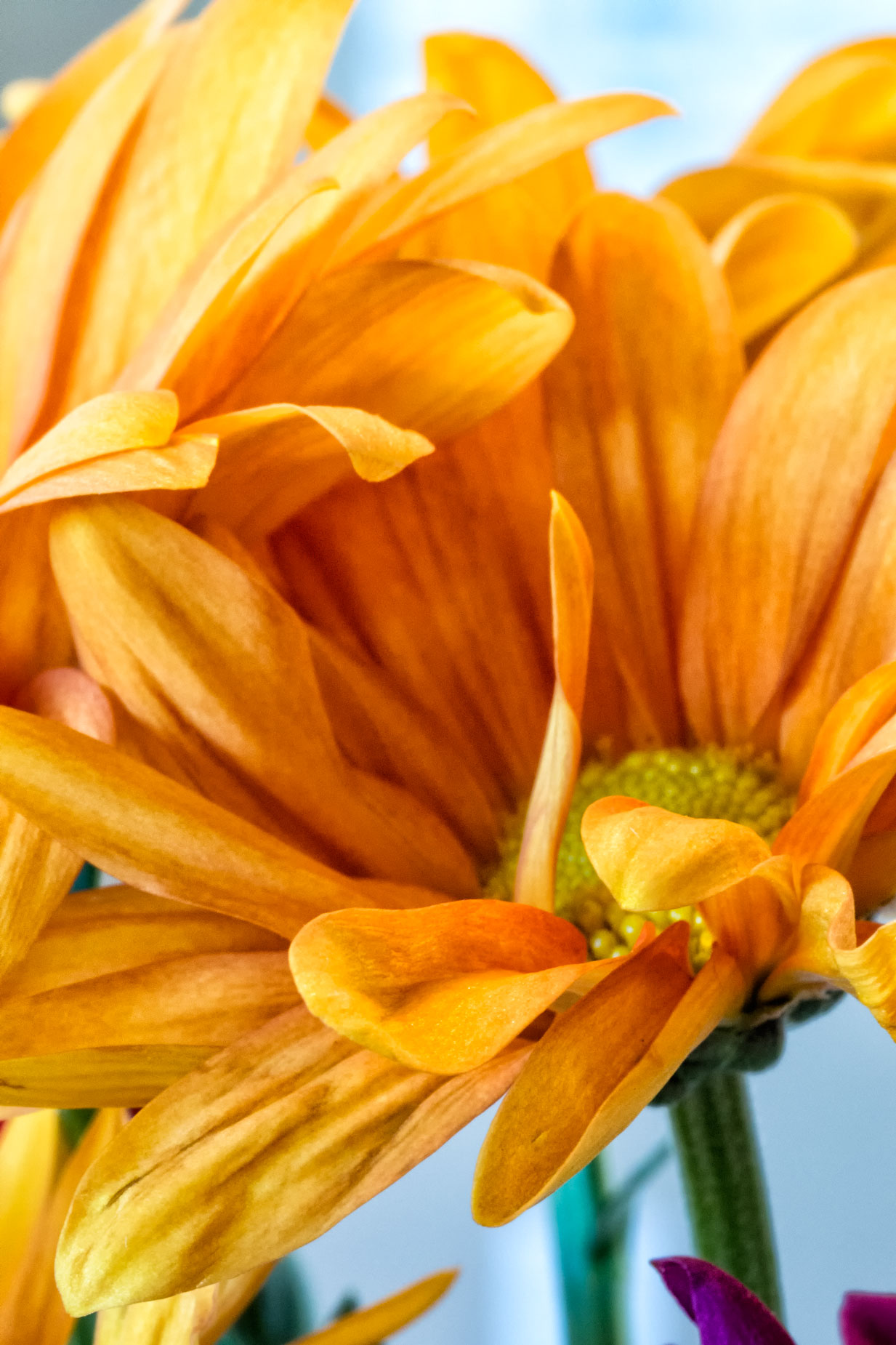
How I Made this photograph: I used my Olympus E-M5 Mark I to photograph this flower I purchased at a local supermarket, It was mounted on a green Manfrotto tripod with a M.Zuiko Digital ED 60mm f/2.8 Macro lens attached. The exposure was 1/5 sec at f/16 and ISO 1600. The RAW file was processed in Tonal Contrast from Color Efex with some Dfine used to control any noise.
Up Close and Personal
Some applications simply demand a tripod. If you’re doing close-up work, I think using a tripod is a necessity. The use of small lens apertures to offset macro work’s shallow depth-of-field has to be compensated with slower shutter speeds. But just as important is critical focusing with the camera, which can be helped with accessories such as focusing rails.
Some companies will gladly sell you a focusing rail set for hundreds of dollars but for those of us, who only engage in occasional macro photography, something less expensive might be a better choice, even if it’s just a gateway before investing in more precision and expensive gear if and when we get hooked on macro.
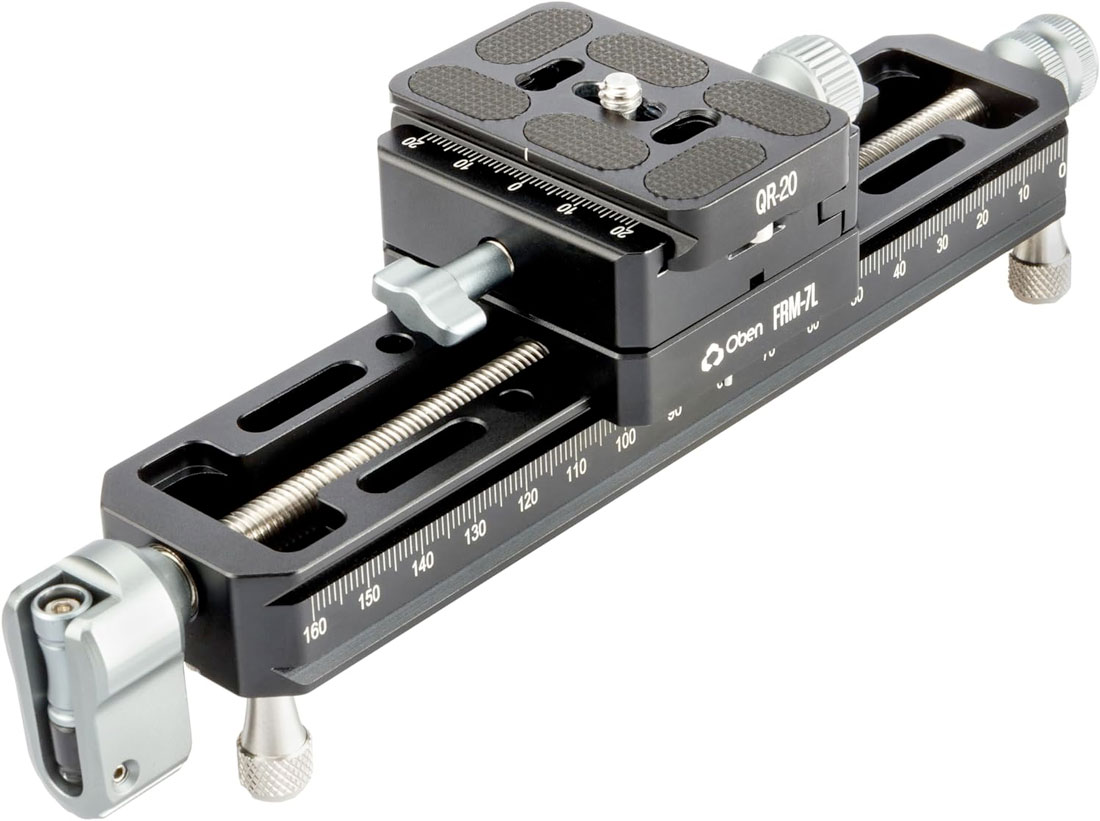 The one thing that my recent close focusing experiments have shown me is that it’s not a good idea to skimp on a precision photographic device. My like my ill-fated fake Tiltall, the cheap store-brand focusing rail I tried to use with my Olympus E-M5 Mark II and M.Zuiko Digital ED 60mm f/2.8 Macro lens while seemingly well-built was not designed or constructed to a high enough standard and produced vibrations that, during long exposures, created the kind of double images I associate with poorly hand-held shots.
I went looking or a better alternatives and while some, like the Novoflex or Arca Swiss, seemed extremely well built, they are out of my budget. Because of my real-world budget I’m considering Oben’s Macro Focusing Rail ($105.95). The rail’s friction is adjustable for greater control when working with heavy lenses and the mounting platform features 360 degree panning with 90 degree stops when a quick aim adjustment is needed. As soon as my ship comes in I’ll pick up one and give you an update on how the Oben’s Macro Focusing Rail works with real-world macro photography.
If you liked today’s blog post and would like to treat me to a cup of Earl Grey tea ($2.50), please click here. And if you do, thanks so much.