
Tuesday’s Thoughts by Joe Farace
“Here’s looking at you, kid”, a line spoken by Humphrey Bogart in the 1942 film Casablanca
I used to agonize over titles for this blog’s posts, trying to balance a description of the contents with SEO (search engine optimization) requirements to keep Google’s algorithm happy and inspire people to read the post. Nowadays, I just write the first title that pops into my head. Yet… on some days I end up changing a post’s title four or five times. You may wonder if that’s because of a deep-seated insecurity. Obviously each post contains something I want to share with you. I don’t know what the title of this post will be eventually but I hope you get something from it anyway.
You are what you drive
There’s an old expression, once popular in the automotive world, that says: “You are what you drive.” (There’s even a book with that title.) I don’t think that perspective is as popular today because most contemporary cars are generic and boring. I think the expression may still be true for some people, like enthusiasts for whom a car is more than a transportation module. I extrapolated that concept into a post for my car photography website called “You are what you shoot” and I think that, when it comes to photographers and their cameras, there’s some truth there as well.
In Andreas Feininger’s 1973 landmark book, Photographic Seeing, there’s a section he called “The Different Forms of Seeing” where the author discusses how four well-known photographers of that era might photograph an identical female subject. He then posits a theory that “differences in seeing would, of course, reflect in their work.” Naming names, Feininger then goes on to eviscerate each of their hypothetical images as “sterile,” “dull,” “unimaginative,” “stereotypical and rather cold.” Yikes! My friend Rick Sammon has a much friendlier theory about seeing and puts it this way: “The camera looks both ways” and “that in picturing the subject, you are also picturing part of yourself.”
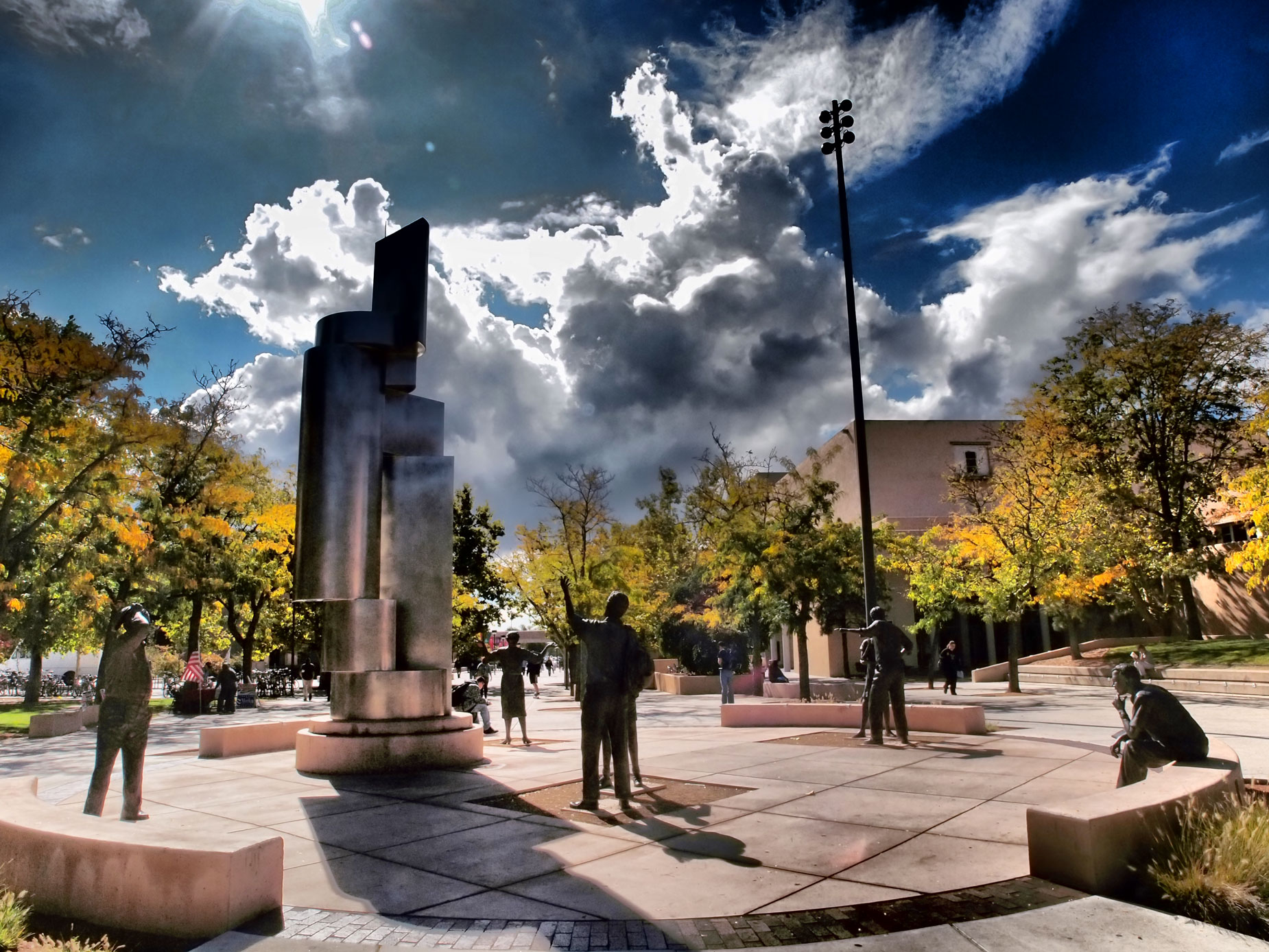
How I made this photograph: I made this photograph when visiting Albuquerque and was walking around the University of New Mexico campus with an Olympus E-5 (not an EM-5) DSLR and Zuiko Digital ED 12-60mm f2.8-4.0 SWD lens. Exposure using the camera’s Dramatic Tones Art Filter was 1/250 sec and f/16 at ISO 320. Olympus cameras, including their newer models, let you shoot a bracket using all of the available Art filters and I found this is a delicious way to chew up memory cards.
Here’s another theory
The late Richard Avedon once said,“ My portraits are more about me than they are about the people I photograph.” What I think he meant was that when Avedon created a portrait, he liked to control as much of the environment. lighting and maybe even the subject to reflect his view of them, not necessarily how the subject might see themselves. Not that I would ever compare my portrait work to Mr. Avedon’s, perhaps some of this philosophy might apply to my own studio work* as well. Maybe all/some/many photographers have this same predilection because their own images strive to restructure the world into how they imagine it should be.
After reading that section of Feininger’s book and thinking about Avedon’s and Sammon’s concepts, instead of sleeping one night I lay in bed thinking about what my portraits of women say about me. I don’t want to bother you with all of the Neo-Freudian ideas that ran through my head but all of this was fresh in my mind this morning, hence this post.
*PS. Look for a discussion of how Barry Staver and I create portraits in an upcoming Pixels, Grain & Cookies podcast on my YouTube channel, Joe Farace’s Videos,.
If you liked today’s blog post and would like to treat me to a cup of Earl Grey tea ($2.50), please click here. And if you do, thanks so much.